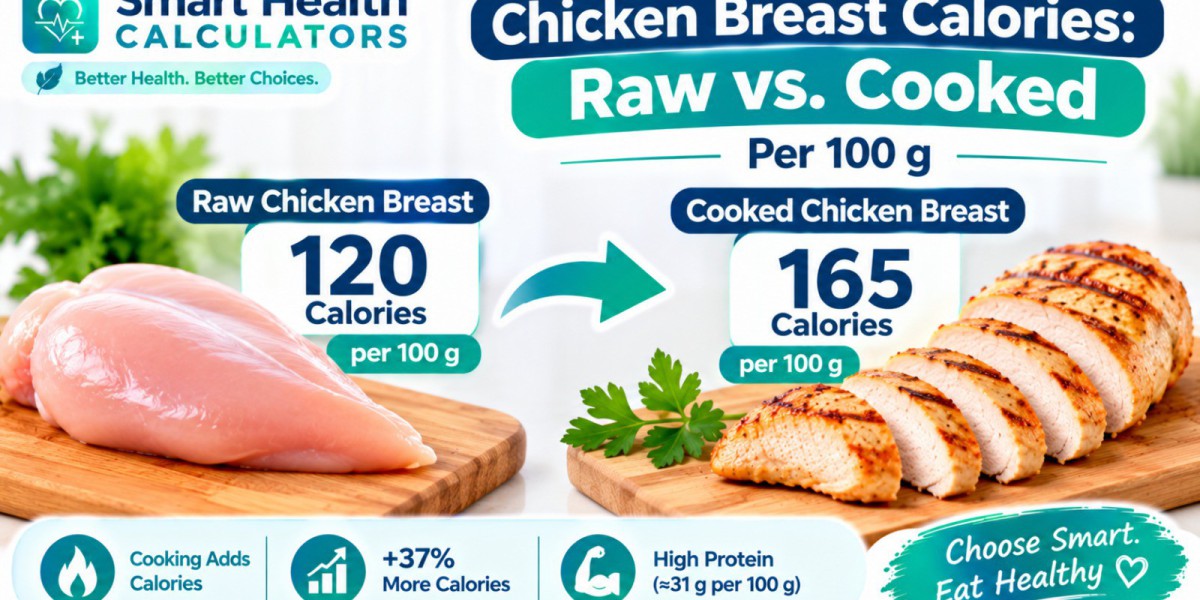

You weigh your chicken on the scale, open your tracking app, and find two entries: raw chicken breast at 120 calories and cooked chicken breast at 165. Same bird, same cut, a 45-calorie gap. Which one is right?
Both are. They describe the same meat at different moments, and the difference is mostly water. This guide shows exactly how much changes, why it changes, and how to log your chicken so your calorie and protein totals hold up. You'll get USDA-based numbers, conversion math, portion examples, and a simple rule for logging.
How Many Calories Are in 100g of Chicken Breast?
100g of raw, boneless, skinless chicken breast contains about 120 calories and 22.5g of protein. 100g of roasted chicken breast contains about 165 calories and 31g of protein. The difference comes from water loss during cooking, which concentrates calories and protein into a smaller weight.
Cooking doesn't add calories to the meat. It removes water, so each 100g of cooked chicken contains more meat than 100g of raw.
Reference Table: Chicken Breast Per 100g (Boneless, Skinless, Plain)
| Preparation | Calories (kcal) | Protein | Fat | Carbs |
|---|---|---|---|---|
| Raw | 120 | 22.5g | ~2.6g | 0g |
| Cooked, grilled | 151 | 30.5g | 30.5g | 0g |
| Cooked, stewed | 151 | 29g | — | 0g |
| Cooked, roasted | 165 | 31g | ~3.6g | 0g |
These figures come from USDA FoodData Central SR Legacy reference entries for plain, boneless, skinless chicken breast. They aren't universal values for every product on a shelf. Your exact number shifts with the cut, how much water was lost, and whether anything was added.
You can browse the original records yourself at USDA FoodData Central, the official government database behind most nutrition apps.
Why Chicken Breast Calories Change After Cooking
Raw chicken breast is roughly three-quarters water. Heat pushes some of that water out as steam and juices. The protein, fat, and minerals stay behind in the meat.
Picture a wet sponge. Squeeze it and it weighs less, but the sponge material hasn't changed. Cooked chicken is the squeezed sponge.
The Water Loss Effect
A typical breast loses around 25% of its raw weight when cooked through, though the exact amount depends on the method and how long it cooks. Take 100g of raw chicken:
- Before cooking: 100g, about 120 kcal, about 22.5g protein
- After cooking: about 75g, still roughly 120 kcal and 22.5g protein
- Per 100g of the cooked result: about 160–165 kcal and about 30–31g protein
The calories in the pan stay the same. The weight changes, so calories per 100g go up.
Why the Numbers Don't Match Perfectly
If you multiply 75g of cooked chicken by 1.65 kcal per gram, you get about 124 calories, a few more than the raw 120. That small gap is normal. USDA lists raw and roasted values as separate food records, measured from different samples, and the cooked sample can differ slightly in fat content and moisture. A 3–4% difference is well within the margin of real-world variation.
Practical takeaway: treat the conversion as a good estimate, not a lab measurement.
Raw vs Cooked Chicken Breast: Side-by-Side Comparison
Here's the same chicken followed through the cooking process.
| State | Weight | Calories | Protein | Fat |
|---|---|---|---|---|
| Raw (skinless, boneless) | 100g | ~120 kcal | 22.5g | ~2.5g |
| Cooked (from 100g raw) | ~75g | ~120 kcal | ~22.5g | ~2.5g |
| Cooked (scaled to 100g) | 100g | ~165 kcal | ~165 kcal | ~3.6g |
Read the middle row carefully. It shows why the two numbers aren't in conflict: 75g of cooked chicken and 100g of raw chicken hold nearly the same nutrition.
Is Raw or Cooked Chicken Breast Higher in Calories?
Per 100g, cooked chicken is higher. In total, the piece you cooked is unchanged. A 200g raw breast has the same calories before and after the pan, as long as nothing is added to it. Only the weight on the scale and the label you compare it to differ.
Chicken Breast Macros Per 100g
Chicken breast is one of the leanest, most protein-dense animal foods you can buy. Here's what the macronutrient composition looks like.
Protein
Raw chicken breast provides about 22.5g of protein per 100g. Roasted provides about 31g. Grilled sits near 30.5g and stewed near 29g in the USDA records.
Chicken is a complete protein, meaning it contains all nine essential amino acids your body can't make itself. That's why it's a staple for muscle building, weight loss, and meal prep.
If you're working out how much protein you need in total, see our guide on how much protein you need per day. For context on how chicken stacks up against other foods, the ranking of the most protein-rich foods is a useful companion.
Fat
Skinless breast is low in fat: roughly 2.5–2.6g per 100g raw and about 3.6g per 100g roasted. Saturated fat is only a small fraction of that. The fat figure stays small, but it explains much of the calorie gap between chicken breast and darker cuts.
Carbohydrates and Fiber
Plain chicken breast contains zero carbohydrates and no fiber. If you see carbs on a chicken label, they come from breading, glazes, marinades, or flavor injections. For fiber, you'll need to pair chicken with plants. Our list of high-fiber foods is a good place to start.
Micronutrients
Chicken breast also supplies potassium, phosphorus, niacin, and vitamin B6, and it contains sodium naturally. The sodium amount depends heavily on whether the product has been brined or injected with a salt solution, so check the package.
Calories by Cooking Method: Grilled, Roasted, Boiled, Baked, Air-Fried
The USDA gives separate values for different preparations. Here's how they compare, along with what you should watch for.
| Method | What happens | Calories per 100g (plain) |
|---|---|---|
| Roasted or baked | Dry heat, moderate water loss | ~165 |
| Grilled | Dry heat, often higher water loss | ~151 |
| Stewed or boiled | Moist heat, moisture retained | ~151 |
| Air-fried | Dry heat, similar to roasting | Close to roasted (without oil) |
| Pan-fried | Dry heat plus added fat | Higher if oil is used |
Dry Heat vs Moist Heat Cooking
Dry heat methods like roasting, grilling, baking, and air frying drive off water faster, so the cooked meat is denser per 100g. Moist heat methods like boiling, poaching, and stewing let the meat hold more water, so the cooked weight stays higher and the calories per 100g come out lower.
Don't take this as proof that boiling is "healthier." You aren't eating fewer calories from the same breast. You're eating the same breast with more water in it.
Which Cooking Method Keeps Chicken Lowest in Calories?
Grilling, baking, boiling, poaching, and air frying all stay low as long as you don't add fat. Calories rise when you add oil, butter, breading, or sugary sauces. That's where the real calorie difference comes from, not from the cooking method itself.
How Much Do Oil and Sauces Add?
- 1 teaspoon of oil: about 40 calories
- 1 tablespoon of oil: about 120 calories
- Breading and deep frying: can add 100+ calories per 100g, depending on how much coating and oil the meat absorbs
- Marinades: usually small, but sweet or oil-heavy marinades add up
If you cook chicken in a tablespoon of oil and eat all of it, the calories in that oil belong in your log. A nonstick pan or an oven rack avoids the issue entirely.
How Much Weight Does Chicken Breast Lose When Cooked?
Weight loss in the pan is the whole reason the raw and cooked numbers differ. Here's a working range.
| Cooking style | Typical weight loss | Cooked weight from 100g raw |
|---|---|---|
| Boiled or poached | ~20–25% | ~75–80g |
| Baked or roasted | ~25% | ~75g |
| Grilled | ~25–30% | ~70–75g |
| Over-cooked or very thin cuts | 30%+ | ~70g or less |
These are practical estimates, and the USDA's cooking-yield research shows that yields vary by cut and cooking conditions. Thicker breasts lose proportionally less than thin cutlets. Longer cooking at higher heat dries meat out and lowers yield.
For authoritative background on how the government measures food composition and cooking yields, see the USDA Agricultural Research Service.
The Fastest Way to Find Your Own Yield
You don't have to guess. Do this once and you'll have a personal number:
- Weigh the raw breast.
- Cook it your usual way.
- Weigh the cooked breast (no bones, no skin, no sauce).
- Divide cooked weight by raw weight.
If a 240g raw breast comes out at 180g, your yield is 0.75. Use that number next time, and your cooked-weight logging becomes accurate for your method.
Raw to Cooked Chicken Conversion (With Examples)
This is the part that saves most people from tracking errors.
The Simple Formula
- Raw to cooked weight: raw weight × 0.75 ≈ cooked weight
- Cooked to raw weight: cooked weight ÷ 0.75 ≈ raw weight (or × 1.33)
What Is the Cooked Equivalent of 100g Raw Chicken?
About 75g cooked. And 100g of cooked chicken corresponds to about 133g raw.
Portion Examples
| Portion | Calories | Protein |
|---|---|---|
| 100g raw | ~120 | ~22.5g |
| 100g raw | ~120 | ~22.5g |
| 150g raw | ~180 | ~34g |
| 100g cooked (roasted) | ~165 | ~31g |
| 150g cooked (roasted) | ~248 | ~46.5g |
| 200g cooked (roasted) | ~330 | ~62g |
Ounces and Pounds
If you shop or cook in US units, here are the equivalents using the raw and roasted USDA values. One ounce is about 28.35g.
| Portion | Calories | Protein |
|---|---|---|
| 4 oz raw (113g) | ~136 | ~25g |
| 6 oz raw (170g) | ~204 | ~38g |
| 8 oz raw (227g) | ~272 | ~51g |
| 1 lb raw (454g) | ~545 | ~102g |
| 4 oz cooked (113g) | ~187 | ~35g |
| 6 oz cooked (170g) | ~281 | ~53g |
| 8 oz cooked (227g) | ~375 | ~70g |
Notice something helpful: 4 oz raw chicken delivers about 25g of protein, while 4 oz cooked delivers about 35g. If you've ever wondered why the "protein in 4 oz of chicken" figure varies so much from site to site, the answer is nearly always raw versus cooked.
How Big Is a Typical Chicken Breast?
Boneless, skinless breasts from a grocery store vary a lot. Many fall between about 170g and 250g raw, and large or "jumbo" packs can run 300g or more. That means the calorie count for "one chicken breast" can range from roughly 200 to over 360 calories. This is why weighing beats guessing.
Should You Weigh Chicken Raw or Cooked?
Weigh it raw whenever you can. Raw weight is more consistent, because it doesn't depend on how long you cooked the chicken or how much water it lost.
Why Raw Is More Reliable
- The raw weight matches the raw database entry directly.
- You aren't relying on a guess about water loss.
- If you're meal prepping a batch, the total raw weight is easy to divide.
When Cooked Weighing Works
Sometimes you only get the chicken cooked: leftovers, restaurant meals, or a big batch you've already portioned. In that case, use a cooked entry that matches the method (roasted, grilled, or stewed) and weigh the meat without bones or skin.
The Mistake to Avoid
The most common tracking error is weighing cooked chicken and logging it as raw. You eat 150g of cooked chicken, log it against the raw entry at 120 kcal per 100g, and record 180 calories. In reality you ate roughly 248. That's a gap of nearly 70 calories from a single serving, and it repeats at every meal.
The opposite error happens too. Weigh raw chicken, then log it against a cooked entry, and you overstate your intake by about a third.
Meal Prep: Batch Method
Cooking a week of chicken at once? Try this:
- Weigh the whole raw batch and note the total.
- Cook it all and weigh the finished chicken.
- Divide the cooked total into equal portions. Each portion has the same calories and protein, calculated from the raw total.
For example, 1,000g raw chicken is about 1,200 kcal and 225g protein. If it cooks down to 750g, each 150g cooked portion contains 1/5 of the batch: about 240 kcal and 45g protein. No database guessing required.
If you use a tracking app, our walkthrough on the MyFitnessPal macro calculator shows how to set up targets, and the macro calculator guide explains how to split calories between protein, fat, and carbs.
How to Pick the Right Database Entry When Logging
Most tracking mistakes come from picking a food entry that doesn't match the chicken you actually ate. Use this checklist.
- Match the state: raw, roasted, grilled, boiled, or fried.
- Match the cut: breast, not thigh or "chicken, general."
- Match skin and bone: "boneless, skinless" or "meat only."
- Prefer verified entries: USDA-sourced records beat user-submitted ones, which often contain typos or mixed data.
- Check the unit: per 100g, per ounce, or per piece. Don't mix them.
- Log extras separately: oil, sauce, and marinade go in as their own items.
USDA Data vs Packaged Chicken Labels
A package label and a USDA entry can disagree, and both may be correct. Some packaged chicken contains added water, salt, or broth ("enhanced" or "solution-injected" products). These can show lower calories per 100g raw but higher sodium. If you're using a branded product, trust that product's label over a generic entry.
To understand how these records are organized and dated, read the FoodData Central documentation. It explains the different data types, such as SR Legacy, Foundation Foods, and Branded Foods, and why they update on different schedules. The SR Legacy dataset, which holds the reference values used in this article, received its final update in April 2018.
Different Countries, Different Units
Nutrition labels outside the US often list energy in kilojoules (kJ) as well as kilocalories. One kcal equals about 4.184 kJ.
| Per 100g | kcal | kJ (approx.) |
|---|---|---|
| Raw | 120 | ~502 |
| Grilled/stewed | 151 | ~632 |
| Roasted | 165 | ~690 |
UK, EU, Australian, and New Zealand labels usually show both units, and serving sizes may differ from those in the US. UK readers can find safe handling guidance from the Food Standards Agency. Check whether a database is listing cooked or uncooked weight before you compare numbers across countries.
Skin, Bone, and Cut: What Changes the Calories?
The figures above are for plain, boneless, skinless breast. Change the cut and the numbers move.
Skin-On vs Skinless
Chicken skin is mostly fat. Raw breast with skin runs roughly 170 calories per 100g, compared with 120 for skinless, based on USDA data. If you eat the skin, use a skin-on entry. If you remove it after cooking, some of the rendered fat stays in the meat, so the skinless cooked entry slightly understates what you ate.
Bone-In vs Boneless
Bone adds weight but no calories. If you weigh a bone-in breast, the bone makes up part of that weight, so you'd overcount if you used a boneless entry. Either weigh the meat after removing the bone, or use a bone-in entry that accounts for the "edible portion."
Chicken Breast vs Chicken Thigh
Thigh meat contains more fat than breast, which gives it more flavor and more calories. Skinless thigh runs roughly 175–180 calories per 100g cooked, compared with 165 for roasted breast, with a little less protein per 100g. Tenderloins are part of the breast and are about as lean.
If your goal is maximum protein for minimum calories, breast wins. If you want juicier meat and don't mind a few more calories, thigh is a fair trade. Neither is "bad."
Is Chicken Breast Good for Weight Loss and Muscle Gain?
Chicken breast works well for both goals because it's high in protein and low in calories per gram of protein.
For Weight Loss
Protein helps you feel full, and chicken breast gives you a lot of it for relatively few calories. About 100g of cooked breast gives you roughly 31g of protein for 165 calories. That's a protein-to-calorie ratio few other foods match.
Chicken alone doesn't create a calorie deficit, though. Your total daily intake does. Our guides on weight loss strategies, calorie intake vs. calories burned, and the TDEE calculator walk through how to set a sensible target. You can also estimate your starting point with the BMR calculator.
For Muscle Gain and Body Recomposition
For muscle building, chicken breast provides high-quality protein without piling on excess fat. See the muscle gain diet plan and our article on body recomposition for how to pair protein with training and enough total calories.
How Much Chicken Breast Should I Eat for Protein?
Work backward from your protein goal. If you want 40g of protein in a meal:
- Raw: 40 ÷ 0.225 ≈ 178g raw chicken
- Cooked (roasted): 40 ÷ 0.31 ≈ 129g cooked chicken
Both describe about the same piece of meat. Your daily total depends on body size, activity, and goals, so use the protein needs guide rather than a single number for everyone.
A Budget Note
Chicken breast is often one of the more affordable lean proteins. If you're building a plan around cost, see our low-budget diet plan.
Food Safety: Cooking Chicken Properly
Accurate calorie counts mean nothing if the chicken isn't cooked safely. The USDA Food Safety and Inspection Service recommends cooking poultry to a safe internal temperature of 165°F (74°C), measured with a food thermometer in the thickest part.
- Don't rely on color or juices; use a thermometer.
- Don't wash raw chicken, since rinsing can spread bacteria around your kitchen.
- Use separate cutting boards and utensils for raw poultry.
- Refrigerate cooked chicken within two hours, and eat leftovers within three to four days.
For official guidance, check the FoodSafety.gov safe minimum cooking temperature chart and the USDA FSIS safe temperature chart.
A safety tip that also helps accuracy: cooking to the target temperature and no further keeps the chicken juicier. Overcooked chicken loses more water, so you get a lower yield and drier meat.
Real-World Examples
Example 1: The Gym Meal Prep
Sara cooks five portions of chicken for the week. She weighs 1,100g raw, then cooks it. After cooking, the batch weighs 830g (yield: about 0.75).
- Total: 1,100g × 1.2 = 1,320 kcal; 1,100g × 0.225 = about 248g protein
- Per portion (five equal portions): about 264 kcal and about 50g protein
No guessing, no database mismatch.
Example 2: The Restaurant Leftover
Dev has 180g of cooked grilled chicken from last night. He logs it against a grilled entry at about 151 kcal per 100g:
- 180g × 1.51 ≈ 272 kcal
- Protein: 180g × 0.305 ≈ 55g
Had he used the raw entry, he would have logged 216 kcal and 40.5g of protein, undercounting by 56 calories.
Example 3: The Oil Surprise
Lena pan-fries a 200g raw breast in one tablespoon of olive oil and drinks most of the pan juices with her rice.
- Chicken: 200g raw ≈ 240 kcal
- Oil: about 120 kcal
- Total: about 360 kcal, with the oil making up a third of the meal
She'd previously logged only the chicken. That's the kind of small change that quietly affects progress over weeks.
Example 4: Converting a Recipe
A recipe calls for 300g cooked chicken. You only have raw. How much do you need?
- 300g ÷ 0.75 = about 400g raw chicken
Buy two average breasts and you'll land near the target.
Common Mistakes When Counting Chicken Calories
- Logging cooked weight against a raw entry (or the reverse)
- Using a generic "chicken" entry that mixes cuts, skin, and cooking methods
- Forgetting oil, butter, or sauces
- Weighing chicken with bones or skin included
- Assuming every breast has the same yield
- Trusting unverified user-created database entries
- Ignoring added-water solutions in packaged chicken
- Treating a number from one site as universal without checking its source
Most of these disappear if you follow one rule: log what you weighed, in the state you weighed it.
Tools to Make This Easier
You don't need to do the math by hand every day. These free tools handle the heavy lifting:
- The calorie intake planner sets a daily calorie target based on your goals.
- The diet plan generator turns that target into a meal structure.
- The body fat estimator helps you track progress beyond the scale.
- Our calorie calculator guide and article on how to count calories cover the basics for beginners.
For a bigger picture of what a balanced plate looks like, our whole foods diet guide is a helpful reference.
For general healthy-eating context from a global authority, see the World Health Organization's healthy diet fact sheet. For practical, registered-dietitian-backed nutrition education, the Academy of Nutrition and Dietetics is a trusted resource.
Why Choose Smart Health Calculators?
Knowing the numbers is one half of the job. Applying them to your own body, goals, and routine is the other. That's where Smart Health Calculators comes in.
Here's why readers use it:
- Free tools built for real decisions: calorie planning, BMR, body fat, hydration, workouts, and more, all in one place
- Plain-language guides: every tool has supporting articles that explain the math, not just the result
- Practical focus: we aim for numbers you can act on, backed by reputable sources
- Transparent limits: our disclaimer is clear that these tools support education and planning, not medical diagnosis
You can read more about us, or explore advanced tools at Smart Health Calculators to build a full plan.
Ready for the next step? Book a seat at Advance Free Tools offered by Smart Health Calculators and turn your chicken tracking into a complete nutrition routine.
Frequently Asked Questions
How many calories are in 100g of chicken breast?
100g of raw, boneless, skinless chicken breast has about 120 calories. 100g of roasted chicken breast has about 165 calories. Grilled and stewed entries are about 151 calories.
Is raw or cooked chicken breast higher in calories?
Per 100g, cooked is higher because water has evaporated. The total calories in the whole piece don't change from cooking. Only the weight changes.
Does chicken breast lose calories when cooked?
No. Cooking removes water, not calories. Calories drop only if fat drips away, which is minimal in lean breast. Adding oil or sauce raises them.
Should I count chicken breast calories before or after cooking?
Raw weight is more consistent and easier to match to a database entry. If you weigh it cooked, use a cooked entry that matches your cooking method.
How much protein is in 100g of chicken breast?
Raw has about 22.5g of protein per 100g. Roasted has about 31g, grilled about 30.5g, and stewed about 29g.
Is 100g raw chicken equal to 100g cooked chicken?
No. 100g raw becomes roughly 75g cooked, and 100g cooked comes from about 133g raw.
How much weight does chicken breast lose during cooking?
Usually around 25%, but it ranges with the method, thickness, and cooking time. Weigh your own batch before and after to find your yield.
Does adding oil increase chicken breast calories?
Yes. One tablespoon of oil adds about 120 calories, and one teaspoon adds about 40. Log it separately.
D






