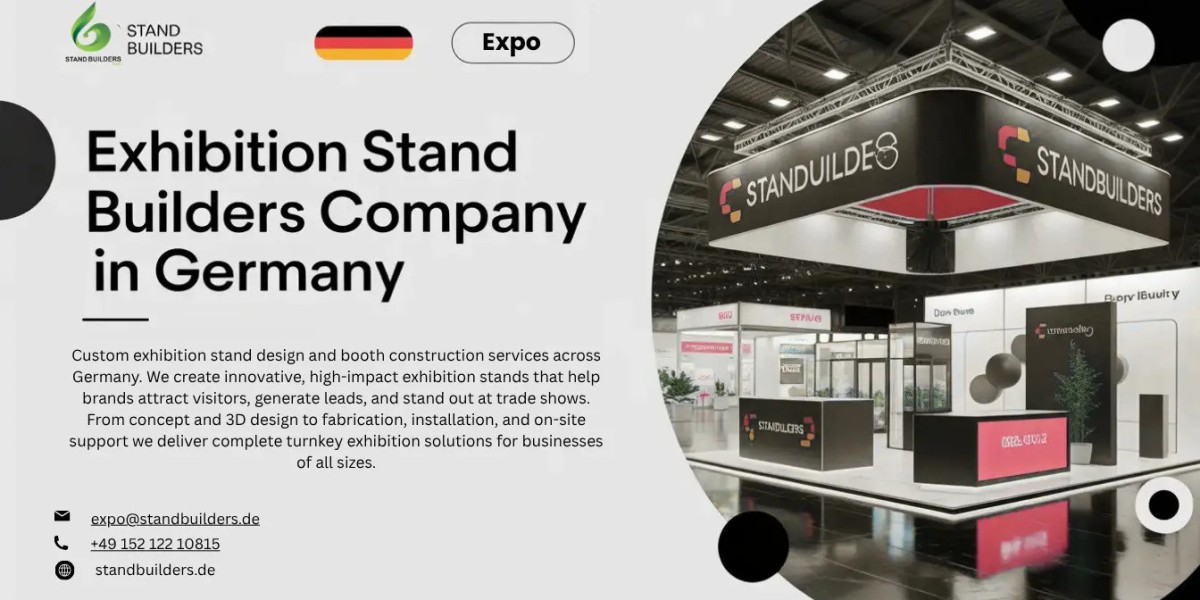

Germany is one of Europe's most important destinations for international exhibitions and trade shows. Whether it be in the fields of automotive and technology or in healthcare, manufacturing, retail, and consumer goods, exhibition sites in Germany draw in businesses, buyers, investors, and industry professionals from all over the world. For those companies that are planning to take part, success relies on far more than just securing floor space.
To have a good exhibition presence it is necessary to carefully consider the aims, the audience, the venue, the budget, the messaging and the physical design. At this stage it is useful to understand the role of an Exhibition Stand Builders in Germany. Instead of viewing a stand as a temporary construction, businesses are nowadays tending to see exhibition planning as an extension of their general brand and marketing strategy.
Understanding the Exhibition Landscape in Germany
Germany boasts a vibrant exhibition culture, with internationally recognised exhibition centres and specialised trade fairs providing support for it. Major industrial events are regularly held in cities including Frankfurt, Düsseldorf, Munich, Berlin, Cologne, Hanover, and Stuttgart.
Every exhibition has a particular kind of audience and commercial setting; for example, a technology-oriented event will draw in start-ups, engineers, and investors, whereas an industrial exhibition will be mainly attended by procurement teams, manufacturers, and technical decision-makers. It is important to understand this audience before coming up with the concept for the stand.
The competition can also be fierce. Since large halls may have hundreds or even thousands of exhibitors, visitors generally have to make rapid decisions regarding which stands are worth looking at. For this reason, clear communication, practical visitor flow, and a distinct visual concept all become important factors in the design.
Key Factors to Consider Before Participating
The planning for an exhibition should in principle start several months prior to the event, since early planning allows businesses the necessary time to get a clear understanding of the regulations, to book the services they need, to develop creative ideas, to coordinate the logistics and to make any required amendments.
The first thing to take into account is the reason for taking part. While some companies go along mainly to generate leads, others attend in order to launch products, to network, to give demonstrations, to establish partnerships, or to improve their brand awareness. A design intended for technical demonstrations will need a completely different arrangement from one that is aimed at private business meetings.
Another important factor is the amount of space available for stands. When the space is limited it is necessary to carry out careful prioritisation, but if the area is larger it can include meeting rooms, product displays, storage, demonstration areas, and hospitality zones.
Venue regulations should also be looked at in advance. Rules regarding height, rigging, electrical needs, fire safety standards, loading procedures, and the schedule for installation can all affect the final design.
Types of Exhibition Stand Designs
The kind of exhibition objectives you have will determine the kind of stand you should take. No one design format will be suitable for all companies or all events.
Custom Exhibition Stands
Custom stands are created specifically for a given brand, location, and marketing aim and may include distinctive architectural features, areas for displaying products, meeting spaces, integrated lighting, and branded graphics.
Customisation can be of use in helping businesses to create a more identifiable environment in those halls which are visually crowded. At the same time, the design must stay functional and not become visually complicated.
Modular Exhibition Stands
Modular systems make use of components that can be reused and are arranged in different ways to suit various exhibition spaces; they are especially useful for companies that take part in a number of events each year.
Their flexibility also means that they are useful in cases where businesses wish to keep a consistent branding while at the same time adapting their physical presence to different venues.
Double-Decker Exhibition Stands
In large exhibition spaces, double-decker constructions can be used to provide extra areas for meetings or hospitality above the main level. Although they help make better use of the vertical space, they do so at the cost of needing more detailed structural planning, additional safety considerations, and obtaining venue approvals.
Minimalist Exhibition Designs
Minimalist studios emphasize simple architecture, subtle branding, open spaces, and a clear visual hierarchy. This method is especially effective for premium, technology, healthcare, and professional-service brands since clarity is more important than excessive decoration.
Current Exhibition Stand Design Trends in Germany
Exhibition design is still developing in keeping with changes in how business communicates. Technology is being incorporated more and more into physical environments via interactive displays, touchscreens, product demonstrations, digital presentations, and immersive experiences.
Sustainability is also a major factor to take into account; reusable structures, recyclable materials, energy-efficient lighting, modular components, and a reduction in single-use graphics all contribute to companies being able to cut down on waste.
Meanwhile, there is increasing interest in designs that are centred on the people. Rather than using all the available square metres for graphics or furniture, modern stands usually set up comfortable spaces in which visitors can communicate naturally with the representatives.
For German exhibition stand builders, these changing expectations mean that their design choices now have to take into account both aesthetic considerations and practical functionality.
Budget and Cost Considerations
The amount that is allocated to an exhibition depends a great deal on the size of the stand, the construction needs, the materials used, the technology involved, the location, the length of the event, and the level of logistical complexity.
The exhibition budget doesn't consist merely of the cost of the stand; it also includes expenses for venue services, transportation, installation and dismantling, furniture, lighting, graphics, technology, storage, hospitality, staffing, and travel.
It is a frequent error in planning to devote the majority of the budget to visual construction and at the same time neglect operational costs. A more balanced method takes into account the entire exhibition lifecycle.
For instance, although a reusable and modular type of structure involves a significant initial outlay it can prove to be more cost-effective for a company that takes part in a number of exhibitions; on the other hand, a highly customised stand might be the more appropriate option when a major product launch or a high-profile event makes it worthwhile to have a special atmosphere.
Common Exhibition Stand Mistakes to Avoid
A very common error is to begin too late. Making decisions at the last minute can restrict the range of design options, raise logistical pressure, and leave little room for correcting problems.
A further problem is too much visual clutter. With so many messages, graphics, colours, screens, and product displays it becomes difficult for visitors to work out what a company really offers.
Poor visitor flow can lead to another problem; although a stand might appear impressive it could still perform badly if visitors have difficulty in working out where the entrance, reception area, the product demonstrations, or the meeting spaces are.
Another practical problem is the need for storage. Space is required for marketing materials, personal possessions, packaging, technical equipment, and hospitality supplies. If there is not enough storage, these items will soon become visible and the stand will look untidy.
People should also refrain from designing with photographs alone in mind; although a stand may appear very good in promotional pictures it will not provide adequate support for actual conversations. Exhibition design must be based on the viewpoint of the visitor and not just on the angle of a camera.
When Businesses Consider Exhibition Stand Professionals
When businesses have only a limited amount of experience in carrying out exhibitions they usually consult specialists if the projects involve complex construction, strict deadlines, international logistics or requirements particular to the venue.
A German contractor who provides exhibition stands can be involved in various aspects including design development, technical planning, construction coordination, installation, dismantling, and adherence to the venue's requirements.
Germany-based Stand Builders can also get involved in cases where a business requires a physical environment that integrates branding, visitor flow, product presentation, and meeting facilities.
For companies that are holding events in a number of countries, collaborating with exhibition stand builders in Europe can also make the coordination process easier when it is necessary to keep the same design standards at all the events.
Conclusion
Taking part in a German exhibition can offer businesses useful chances to meet international audiences, show off their products, establish relationships, and get a better understanding of changing industry expectations. Yet in order to achieve these aims it is not enough just to book exhibition space.
All of the following factors early planning, realistic budgeting, an understanding of the audience, careful design, efficient visitor flow, and thorough logistical coordination help to improve the exhibition experience, and companies should assess the entire project rather than concentrating solely on the visual look of the stand.
For those companies which are organising complicated exhibitions, contracting a exhibition stand builders company in Germany offers a practical solution for organising the design, the construction, the technical requirements and the on-site carrying out. The best method is still one which is based on well-informed decisions, clearly defined objectives and a stand environment that takes into account the way visitors actually interact with the brand.
FAQs
What early date should a company set when planning its exhibition stand in Germany?
It is generally advisable to plan at least six months in advance for a major exhibition, especially when dealing with custom stands. Making preparations early gives enough time for design development, obtaining approvals, carrying out production, managing the logistics, and making any necessary revisions.
What kind of exhibition stand would be appropriate for a small business?
A modular or compact custom stand may be suitable for small businesses, the appropriate choice varying according to the amount of space available, the aims of the exhibition, the number of products and the anticipated level of visitor interaction.
What is the cost of an exhibition stand in Germany?
Since there is no fixed price, the costs will vary according to things like the size of the stand, the type of construction materials, the complexity of the design, the use of technology, the need for graphics, the logistics involved, the installation, and the venue services. The full project budget must include both the costs of construction and those of operation.
What is the importance of visitor flow in the design of an exhibition stand?
The number of visitors influences how easily people are able to get into the stand, understand it, explore the products, communicate with the staff, and proceed towards the meeting areas. A stand that is visually appealing may still perform poorly if its arrangement makes interaction difficult.
What sort of role does a builder of exhibition stands have?
A person who builds exhibition stands might carry out a number of stages in a project, such as design development, technical planning, construction, graphics, installation, dismantling, and coordination with the exhibition's requirements. The specific scope will vary according to the complexity of the project and the services needed.