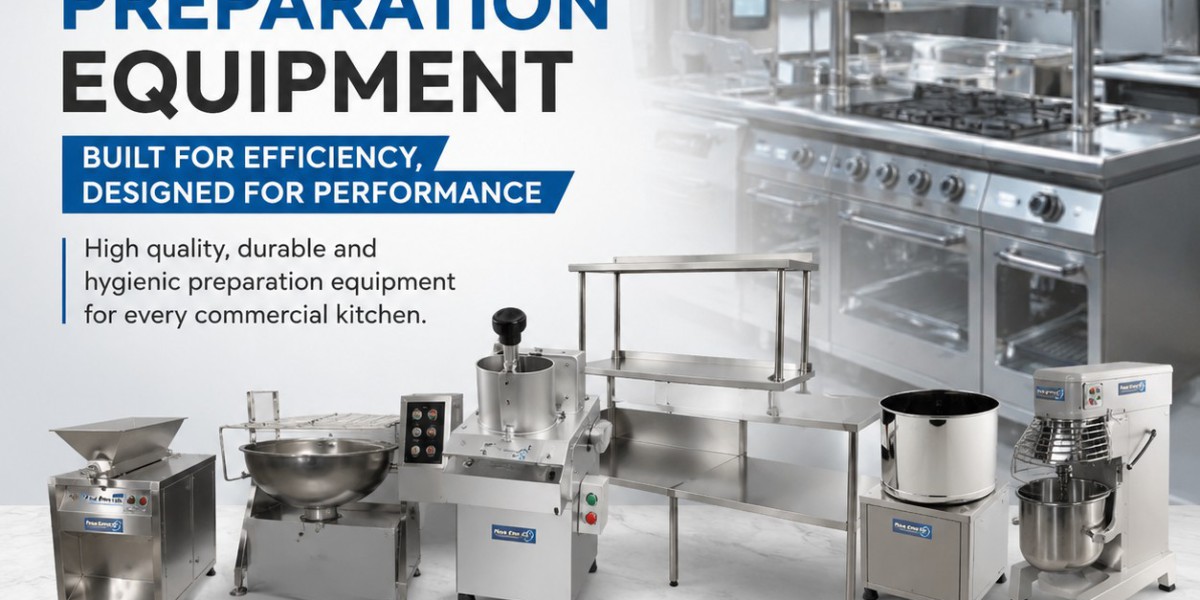

The purchase decision should not be based only on the equipment's initial price.
A machine with a higher purchase price can sometimes provide better financial value if it reduces labour requirements, improves throughput, minimizes downtime, reduces preparation time, and delivers consistent output.
Similarly, inexpensive equipment may become costly if it requires excessive labour, frequent maintenance, repeated processing cycles, or early replacement.
This is why calculating the Return on Investment (ROI) of Preparation Equipment before purchasing can help businesses make more informed procurement decisions.
ROI provides a structured way to compare the investment against the financial benefits generated by the equipment.
What Is Preparation Equipment ROI?
Return on Investment measures how much financial benefit an equipment investment generates compared with its total investment cost.
A basic ROI formula is:
ROI (%) = (Total Financial Benefit − Total Investment Cost) ÷ Total Investment Cost × 100
For Preparation Equipment, the financial benefit may come from several sources, including:
- Labour savings
- Increased production capacity
- Reduced processing time
- Lower maintenance expenses
- Reduced material waste
- Lower downtime
- Improved consistency
- Increased production output
The exact calculation depends on the type of equipment and the business model.
Why Purchase Price Alone Is Not Enough
Suppose two preparation machines are available.
Equipment A
Purchase cost: ₹2,00,000
Equipment B
Purchase cost: ₹3,00,000
At first glance, Equipment A appears to be the better financial choice.
But suppose Equipment B:
- Requires fewer operators
- Processes ingredients faster
- Has higher practical throughput
- Reduces preparation time
- Requires fewer replacement components
- Handles peak production more effectively
The additional ₹1,00,000 investment may be recovered through operating savings.
Therefore, buyers should compare total cost and total benefit, not only purchase price.
Step 1: Calculate the Complete Investment Cost
The first step is to determine the actual cost of acquiring and commissioning the equipment.
The investment may include:
- Equipment purchase price
- Transportation
- Installation
- Electrical work
- Plumbing where applicable
- Site preparation
- Accessories
- Initial training
- Commissioning
- Additional infrastructure
For example:
| Cost Component | Example |
|---|---|
| Equipment | ₹3,00,000 |
| Transportation | ₹20,000 |
| Installation | ₹15,000 |
| Electrical work | ₹10,000 |
| Accessories | ₹5,000 |
| Total Investment | ₹3,50,000 |
The ROI calculation should ideally use the complete investment rather than only the equipment quotation.
Step 2: Calculate Labour Savings
Labour reduction is one of the most measurable benefits of commercial Preparation Equipment.
Suppose manual preparation requires three employees.
After installing suitable equipment, the same operation requires two employees.
The saving is equivalent to one employee's allocated labour cost for that activity.
For example:
Monthly labour saving = ₹25,000
Annual labour saving:
₹25,000 × 12 = ₹3,00,000
This becomes a significant part of the equipment's annual financial benefit.
However, buyers should calculate actual labour allocation rather than assuming that every machine completely eliminates a worker.
In many commercial kitchens, automation reduces labour hours rather than eliminating a complete position.
Step 3: Calculate Time Savings
Time is another important economic factor.
Suppose manual preparation requires four hours per day.
Preparation Equipment reduces the process to two hours.
The business saves two operating hours every day.
The value of this time can come from:
- Reduced labour hours
- Earlier production completion
- Increased production capacity
- Better employee utilization
- Reduced overtime
Time savings become especially valuable in high-volume kitchens where preparation must be completed within a fixed window.
Step 4: Calculate Additional Production Capacity
Some equipment investments are justified because they allow a business to produce more within the same operating window.
For example:
Manual preparation:
100 kg/hour
Equipment-assisted preparation:
250 kg/hour
The additional capacity is:
150 kg/hour
This additional capacity may allow a business to:
- Serve more customers
- Add new menu items
- Support additional outlets
- Increase catering orders
- Expand central-kitchen production
The financial benefit should be estimated using realistic additional production rather than theoretical machine capacity.
Step 5: Consider Peak Production
ROI calculations should account for peak demand.
A machine may appear unnecessary when average daily volume is considered.
However, if a large percentage of production must be completed within a short preparation window, equipment can provide significant operational value.
For example:
Daily preparation requirement = 800 kg
Peak preparation window = 3 hours
Required throughput:
800 ÷ 3 = 267 kg/hour
If existing equipment can process only 150 kg/hour, the business may face delays, overtime, or manual intervention.
A higher-capacity machine may therefore provide value even if the daily average appears manageable.
Step 6: Calculate Overtime Savings
Undersized or inefficient preparation systems can extend working hours.
If employees regularly work overtime because preparation takes longer than expected, equipment that reduces processing time may generate measurable savings.
For example:
Monthly overtime cost = ₹30,000
Annual overtime cost:
₹30,000 × 12 = ₹3,60,000
If equipment reduces the overtime requirement substantially, the saving contributes directly to ROI.
Step 7: Include Maintenance Costs
ROI should not be calculated using only savings.
Equipment also creates ongoing expenses.
Consider:
- Preventive maintenance
- Spare parts
- Consumables
- Servicing
- Lubrication where applicable
- Replacement components
- Technician charges
A machine with a low purchase price but high maintenance requirements may have a different ROI profile from a higher-quality machine with more predictable maintenance.
Step 8: Estimate Downtime Costs
Downtime is often overlooked in equipment calculations.
If a machine stops working during a peak production period, the business may experience:
- Production delays
- Additional labour
- Manual processing
- Missed dispatch schedules
- Service delays
- Reduced output
For high-volume operations, downtime can have a greater financial impact than routine maintenance.
When comparing Preparation Equipment Suppliers, ask about service support, spare parts, maintenance requirements, and expected response procedures.
Step 9: Consider Material Waste
Preparation equipment can sometimes improve consistency in processing.
Depending on the application, better control may reduce unnecessary material loss.
Potential areas include:
- Cutting consistency
- Portioning
- Mixing
- Processing yield
- Batch consistency
The financial value of reduced waste depends on the ingredient cost and actual operating results.
It should therefore be measured using real production data wherever possible.
Step 10: Calculate Total Annual Benefit
After identifying individual savings, combine them.
For example:
| Benefit | Annual Value |
|---|---|
| Labour savings | ₹3,00,000 |
| Overtime savings | ₹1,20,000 |
| Reduced waste | ₹60,000 |
| Productivity benefit | ₹1,00,000 |
| Gross Annual Benefit | ₹5,80,000 |
Now subtract annual operating costs.
Suppose:
Annual maintenance and operating cost = ₹80,000
Net annual benefit:
₹5,80,000 − ₹80,000 = ₹5,00,000
This ₹5,00,000 becomes the estimated annual financial benefit for the ROI calculation.
Step 11: Calculate Payback Period
The payback period tells you how long it takes for the investment to recover its cost.
A basic formula is:
Payback Period = Total Investment ÷ Annual Net Benefit
Suppose:
Total investment = ₹3,50,000
Annual net benefit = ₹5,00,000
Payback period:
₹3,50,000 ÷ ₹5,00,000 = 0.7 years
That is approximately eight to nine months.
A shorter payback period generally indicates faster recovery of the investment, although payback should not be the only decision criterion.
Step 12: Calculate ROI
Using the same example:
Total investment = ₹3,50,000
Annual net benefit = ₹5,00,000
Basic annual ROI:
₹5,00,000 ÷ ₹3,50,000 × 100 ≈ 143%
This is a simplified illustration.
Actual ROI should be calculated using verified operating costs, realistic savings, equipment lifespan, depreciation/accounting treatment where relevant, and business-specific assumptions.
Equipment Life Matters
Preparation Equipment may operate for many years.
Therefore, buyers should consider the expected service life of the machine.
A machine with a higher initial investment may still provide stronger long-term value if it:
- Operates reliably
- Has suitable capacity
- Requires manageable maintenance
- Has available spare parts
- Can support production growth
- Maintains consistent performance
For this reason, ROI should ideally be considered alongside Total Cost of Ownership (TCO).
ROI vs Total Cost of Ownership
ROI answers:
"What financial return can this investment generate?"
TCO asks:
"What will this equipment actually cost throughout its useful life?"
TCO may include:
- Purchase price
- Installation
- Energy
- Maintenance
- Spare parts
- Labour
- Cleaning
- Downtime
- Replacement
- Disposal
Both measurements are useful.
A buyer should avoid selecting equipment based on ROI calculations that ignore long-term ownership costs.
Why Practical Capacity Matters in ROI
A machine's financial value depends heavily on actual output.
Suppose a manufacturer advertises:
300 kg/hour
But the equipment realistically produces:
200 kg/hour
under your operating conditions.
The expected labour and productivity savings may therefore be overstated.
When evaluating Preparation Equipment in India, buyers should ask for application-specific capacity information.
Where practical, equipment should be tested using representative ingredients and realistic operating conditions.
How to Compare Preparation Equipment Suppliers
When comparing Preparation Equipment Suppliers, request information that supports your ROI calculation.
Ask for:
- Machine capacity
- Practical throughput
- Batch size
- Cycle time
- Motor power
- Operator requirement
- Cleaning time
- Maintenance schedule
- Spare-part information
- Warranty
- Expected service requirements
This information allows procurement teams to compare different options more objectively.
What to Ask Preparation Equipment Suppliers in India
If you are comparing Preparation Equipment Suppliers in India, ask each supplier the same questions.
For example:
- What is the practical output?
- What ingredients were used during capacity testing?
- How many operators are required?
- What is the complete cycle time?
- How much cleaning time is required?
- What are the maintenance requirements?
- What are the common replacement parts?
- What is the expected service life?
- What installation work is required?
- What after-sales support is available?
Standardizing these questions makes supplier comparison easier.
Evaluating a Preparation Equipment Manufacturer
A Preparation Equipment Manufacturer should be able to provide technical information that helps buyers estimate operational value.
Look for clarity regarding:
- Capacity
- Construction
- Material
- Motor
- Safety
- Maintenance
- Cleaning
- Installation
- Testing
- Spare parts
- Warranty
A manufacturer that understands your application can also help determine whether a standard machine is sufficient or whether customization is required.
Why a Preparation Equipment Manufacturer in India Should Be Evaluated Beyond Price
When selecting a Preparation Equipment Manufacturer in India, buyers should consider the complete relationship.
Important factors include:
Manufacturing Quality
Consistent fabrication and appropriate material selection can influence equipment durability.
Technical Support
The manufacturer should be able to address application and operational questions.
Customization
Certain kitchens may require equipment adapted to specific dimensions or workflows.
Installation
Proper installation can influence machine performance and reliability.
Service
Accessible service support can reduce downtime.
Spare Parts
Availability of critical components can influence long-term equipment availability.
These factors can affect the actual ROI of the investment.
Example: Comparing Two Equipment Options
Suppose a commercial kitchen is considering two machines.
| Factor | Machine A | Machine B |
|---|---|---|
| Purchase Cost | ₹2,50,000 | ₹3,50,000 |
| Installation | ₹20,000 | ₹25,000 |
| Total Initial Investment | ₹2,70,000 | ₹3,75,000 |
| Annual Labour Saving | ₹1,80,000 | ₹2,70,000 |
| Annual Overtime Saving | ₹50,000 | ₹1,00,000 |
| Annual Waste Saving | ₹30,000 | ₹50,000 |
| Annual Maintenance | ₹60,000 | ₹50,000 |
Machine A:
Annual net benefit:
₹1,80,000 + ₹50,000 + ₹30,000 − ₹60,000 = ₹2,00,000
Machine B:
Annual net benefit:
₹2,70,000 + ₹1,00,000 + ₹50,000 − ₹50,000 = ₹3,70,000
Machine B requires more initial investment but provides a larger annual benefit.
This demonstrates why comparing purchase prices alone can lead to an incomplete decision.
Common Mistakes When Calculating Equipment ROI
Using Theoretical Capacity
Always use realistic practical throughput.
Ignoring Cleaning Time
Cleaning reduces productive operating time.
Ignoring Labour Changes
Calculate actual labour-hour savings.
Ignoring Maintenance
Include realistic annual service costs.
Assuming All Additional Capacity Becomes Revenue
Additional capacity has financial value only if the business can actually use it.
Ignoring Downtime
Unexpected downtime can reduce expected returns.
Using Unrealistic Growth Forecasts
Future production should be estimated conservatively.
Ignoring Equipment Lifespan
A long-term investment should be evaluated over its useful operating life.
When Does Preparation Equipment Usually Provide Strong ROI?
Equipment can provide stronger financial returns when:
- Production volume is high
- Labour requirements are significant
- Preparation is repetitive
- Peak preparation windows are short
- Manual processing is slow
- Consistency is important
- Overtime costs are high
- Equipment utilization is high
- Downtime is expensive
For small-volume operations, the financial justification may be different.
The key is to match the investment with actual operational requirements.
A Practical ROI Checklist for Buyers
Before purchasing Preparation Equipment, calculate:
Purchase price
Installation cost
Transportation
Infrastructure requirements
Labour hours before equipment
Labour hours after equipment
Processing time before equipment
Processing time after equipment
Peak production requirement
Practical machine capacity
Maintenance cost
Spare-part cost
Energy or utility cost
Downtime risk
Material waste
Expected service life
Annual net benefit
Payback period
Estimated ROI
This checklist can make equipment procurement more data-driven.
Final Thoughts
Calculating Preparation Equipment ROI before making a purchase helps businesses move beyond simple price comparison.
The right calculation should consider the complete financial impact of the equipment, including labour savings, production capacity, time savings, overtime, maintenance, downtime, material waste, installation, and expected service life.
Whether you are evaluating Preparation Equipment in India, comparing Preparation Equipment Suppliers in India, or working directly with a Preparation Equipment Manufacturer in India, request enough technical and commercial information to calculate realistic operating benefits.
The most expensive machine is not necessarily the worst investment, and the cheapest machine is not necessarily the best value.
The better choice is the equipment that delivers the right practical capacity, supports the workflow, controls operating costs, and generates measurable value throughout its useful life.
Good equipment procurement is not about paying less upfront. It is about achieving better value over time.
Frequently Asked Questions
What is the ROI of Preparation Equipment?
Preparation Equipment ROI measures the financial return generated by the equipment compared with the investment required to purchase, install, operate, and maintain it.
What costs should be included when calculating ROI?
Include purchase price, installation, transportation, infrastructure, maintenance, spare parts, energy or utilities, labour, and other relevant ownership costs.
How can Preparation Equipment reduce operating costs?
Depending on the application, equipment can reduce labour hours, processing time, overtime, material waste, and production delays.
Should I use rated or practical capacity for ROI calculations?
Practical capacity is generally more useful because it reflects actual operating conditions such as loading, unloading, cleaning, ingredient characteristics, and operator handling.
How do I compare Preparation Equipment Suppliers in India?
Compare practical capacity, construction, technical specifications, operator requirements, maintenance, spare parts, warranty, installation, service, and total ownership cost.
What should I check with a Preparation Equipment Manufacturer in India?
Ask about equipment capacity, application suitability, material specifications, customization, testing, installation, maintenance, spare parts, warranty, and after-sales support.
Is ROI enough to select commercial kitchen equipment?
No. ROI should be considered alongside workflow suitability, safety, hygiene, capacity, reliability, maintenance, space requirements, and Total Cost of Ownership.