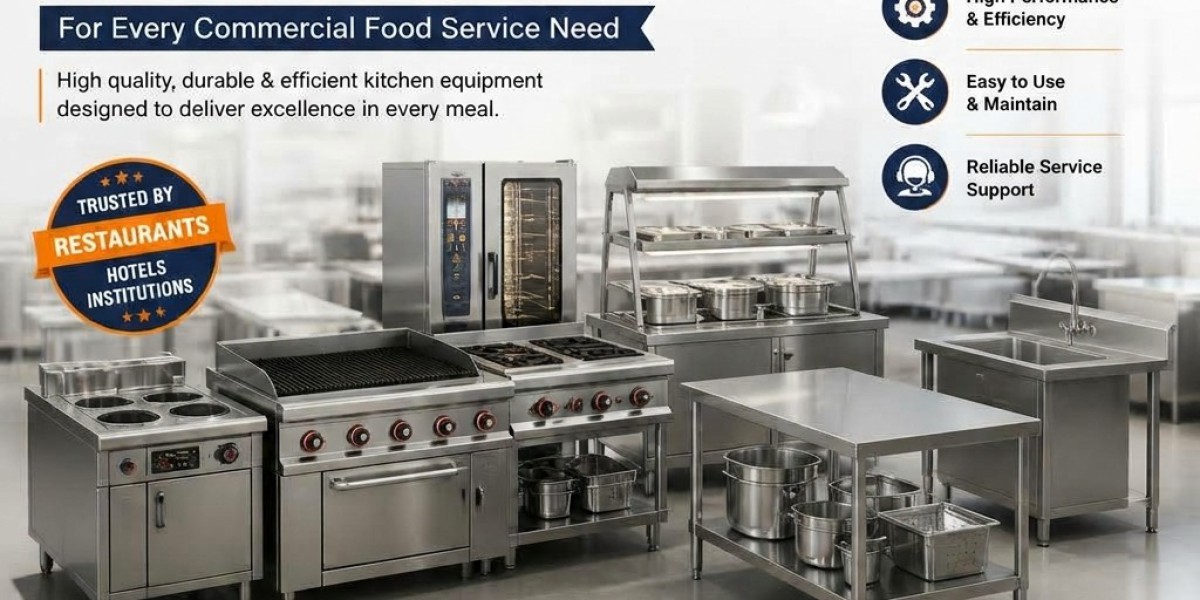

For this reason, choosing equipment is not only about selecting individual machines. A well-planned cafeteria kitchen considers production volume, batch sizes, cooking time, staff movement, storage requirements, and the sequence of different kitchen activities.
A professional Cafeteria Kitchen Equipment Manufacturer can help plan equipment according to the actual operational requirements of a cafeteria rather than using a one-size-fits-all approach.
Why Equipment Capacity Matters in a Cafeteria Kitchen
Equipment capacity directly affects how much food a kitchen can process during a specific period. If equipment is too small, staff may need to run multiple batches, increasing preparation and cooking time.
On the other hand, equipment that is significantly larger than the actual requirement can occupy valuable space and may remain underutilized.
Capacity planning should therefore consider factors such as:
- Number of meals served per day
- Peak-hour demand
- Average batch size
- Cooking time
- Preparation time
- Holding requirements
- Number of kitchen staff
- Menu variety
- Available kitchen space
A Cafeteria Kitchen Equipment Manufacturer in India can use these factors to help determine suitable equipment capacities for different production areas.
Understanding the Relationship Between Batch Size and Production
Batch size is an important part of cafeteria kitchen planning. Different menu items may require different quantities and cooking methods.
For example, a kitchen preparing large quantities of rice may need equipment designed for bulk cooking, while vegetables, gravies, snacks, or bakery products may require different capacities and cooking processes.
If batch size is not considered during equipment selection, the kitchen may experience:
- Repeated cooking cycles
- Longer preparation periods
- Uneven workload distribution
- Increased staff movement
- Delays during serving hours
Matching equipment capacity with realistic batch requirements helps create a smoother production cycle.
Workflow Planning Is More Than Equipment Placement
Kitchen workflow refers to the movement of food, ingredients, utensils, equipment, and staff from one activity to another.
A practical cafeteria workflow may follow a sequence such as:
Receiving → Storage → Preparation → Cooking → Holding → Serving → Washing
The equipment should support this sequence instead of forcing staff to move repeatedly between unrelated areas.
For example, preparation equipment should be positioned close to the preparation area, while cooking equipment should remain within the main cooking zone. Storage and refrigeration should also be accessible without creating unnecessary movement through active cooking areas.
Good workflow planning can reduce interruptions and make daily kitchen operations more organized.
How Poor Capacity Planning Creates Production Bottlenecks
A bottleneck occurs when one stage of the kitchen process cannot keep up with the rest of the operation.
For instance, a cafeteria may have sufficient cooking capacity but insufficient preparation capacity. In another case, cooking may be fast enough, but holding or serving capacity may become the limiting stage.
This means equipment capacity should not be evaluated individually.
A useful planning approach is to examine the complete production chain:
Preparation Capacity
Can vegetables, ingredients, sauces, and other components be prepared quickly enough for the cooking section?
Cooking Capacity
Can the cooking equipment handle the required batch sizes within the available production window?
Holding Capacity
Can prepared food be safely and efficiently held before serving?
Serving Capacity
Can the service area handle peak demand without creating queues or delays?
Looking at these stages together provides a more realistic understanding of kitchen capacity.
Peak-Hour Demand Should Influence Equipment Selection
Average daily meal volume does not always represent the actual pressure on a cafeteria kitchen.
A cafeteria may serve a large percentage of its meals during a short lunch period. Equipment therefore needs to support peak production rather than only average production.
For example, if most meals are served within two hours, the kitchen must have enough preparation and cooking capacity to complete production within that window.
A Cafeteria Kitchen Equipment Manufacturer can consider peak-hour demand when developing an equipment plan, helping avoid capacity gaps during the busiest operating periods.
Matching Equipment Capacity With the Menu
Every cafeteria has a different menu structure. A kitchen serving mainly Indian meals may require different cooking and preparation equipment from a cafeteria focused on snacks, bakery products, or mixed cuisines.
Menu analysis can help identify:
- Which dishes require bulk cooking
- Which ingredients need extensive preparation
- Which foods require frying or grilling
- Which products need refrigeration
- Which items require hot holding
- Which processes can be performed in batches
Equipment selection based on the actual menu can provide a more practical production setup.
Space Utilization and Workflow Efficiency
Available floor space is another important consideration.
Large equipment should not simply be selected because it offers greater capacity. Its dimensions, operating clearance, access requirements, and relationship with nearby equipment should also be considered.
A properly planned cafeteria kitchen should provide enough space for:
- Staff movement
- Equipment operation
- Ingredient handling
- Cleaning activities
- Maintenance access
- Food transfer
- Safe working conditions
A Cafeteria Kitchen Equipment Manufacturer in India can take these practical requirements into account while planning equipment layouts and customized solutions.
The Role of Equipment Standardization
Standardization can simplify kitchen operations, especially in large institutional cafeterias.
When equipment is selected with consistent operating methods and compatible dimensions, staff can become familiar with routine procedures. Standardized equipment can also make maintenance, cleaning, replacement planning, and operational training more manageable.
However, standardization should not mean using identical equipment everywhere. Capacity and application should still be matched with the specific production requirement of each section.
Maintenance Should Be Considered During Planning
Production efficiency depends not only on equipment capacity but also on equipment availability.
If equipment is difficult to clean, inspect, or maintain, routine maintenance may take longer and affect kitchen operations.
When planning cafeteria equipment, attention should be given to:
- Accessibility for cleaning
- Service access
- Durable construction
- Regular inspection requirements
- Ease of operation
- Replacement of commonly serviced components
This approach can support more predictable kitchen operations over the equipment's working life.
How a Manufacturer Can Support Better Cafeteria Planning
A reliable Cafeteria Kitchen Equipment Manufacturer can contribute to the planning process by understanding the kitchen's operational requirements before recommending equipment.
The planning process may include:
- Understanding daily and peak meal volumes
- Reviewing the cafeteria menu
- Identifying preparation and cooking processes
- Estimating suitable equipment capacities
- Studying available floor space
- Planning equipment workflow
- Considering storage and holding requirements
- Reviewing cleaning and maintenance access
- Identifying possible production bottlenecks
- Developing equipment specifications around the actual application
This application-based approach can help create a kitchen that works as a complete production system rather than a collection of separate machines.
Final Thoughts
High-volume cafeteria operations require more than a large number of kitchen machines. Equipment capacity, batch size, production timing, workflow, menu requirements, space utilization, and peak-hour demand all influence the efficiency of a commercial food production environment.
Choosing equipment according to actual operational requirements can help reduce unnecessary movement, manage production stages more effectively, and support consistent food service.
For this reason, working with an experienced Cafeteria Kitchen Equipment Manufacturer in India can be useful when planning a cafeteria kitchen where capacity and workflow need to work together.






