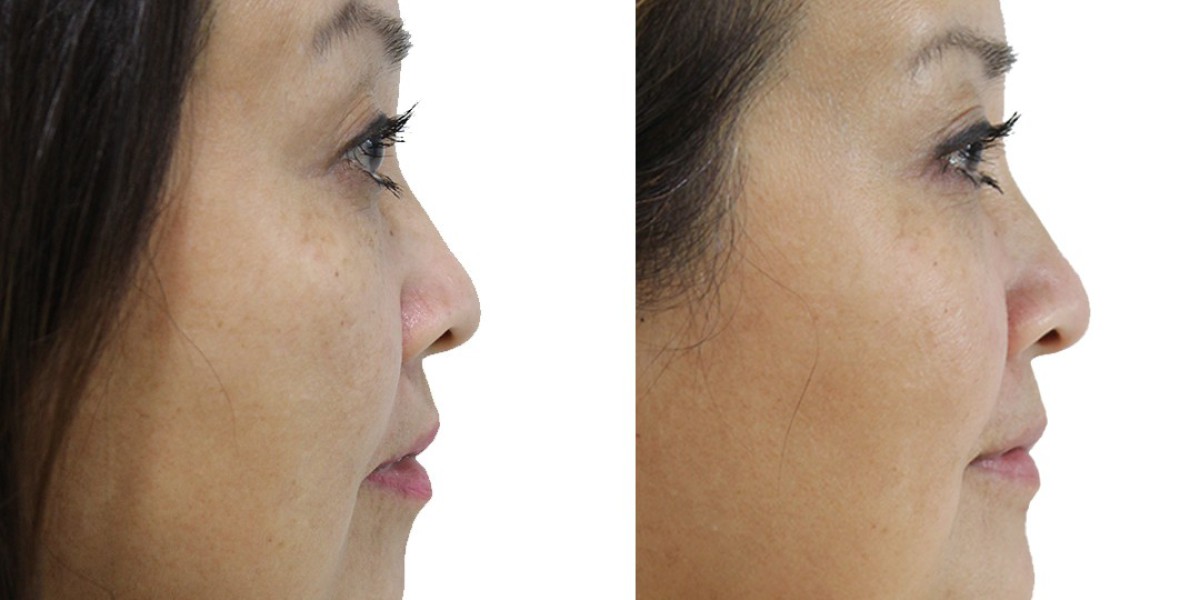

Three people joined the same clinical trial because they had a similar concern. Their chins sat too far back compared with the rest of their facial profile. Even though the problem sounded similar, their treatment plans were not.
A 52-year-old man received 2 mL of hyaluronic acid filler during his first treatment and another 2 mL at a later touch-up. A 22-year-old woman received 2 mL first and another 1.2 mL later. A 44-year-old woman started with 2.9 mL and received another 1.8 mL during her follow-up treatment.
These were real patients included in a 2022 randomized controlled trial published in Plastic and Reconstructive Surgery. What makes the study useful is that the doctors did not only change the amount. They also changed where the filler was placed depending on what each person's chin needed.
That is why the common question, “Is 1 mL of chin filler enough?” does not have one simple answer.
For some people, 1 mL may create the small but noticeable change they want. For others, that same amount may not be enough because the chin also needs more projection, extra length, added width or support around the surrounding jawline.
The amount only starts to make sense once the doctor understands what needs to change.
Why 1 mL Is Not a Standard Dose for Every Chin
Filler treatments are often discussed in millilitres, so it is easy to assume that 1 mL is the normal starting point. In reality, the syringe size only tells you how much product is available. It does not tell you how much correction your face needs.
A 2022 study published in Dermatologic Surgery looked at 326 patients who received hyaluronic acid filler for chin augmentation. The median amount used was 1.85 mL, and the doctors adjusted their technique according to the shape and anatomy of each patient's chin.
That does not mean 1.85 mL is the right amount for someone in the Netherlands. The study was conducted in China, so it should not be treated as a Dutch treatment recommendation.
What it does show is that real chin treatments do not fit neatly into a fixed 1 mL rule. Some people need less while others need more, and the reason usually comes down to anatomy and the type of correction being planned.
The Doctor First Needs to Understand What Makes Your Chin Look Small
When someone says, “My chin looks small,” that description can mean several different things.
One person may have a chin that sits too far back when viewed from the side. Another may have a chin that projects well enough but looks vertically short. Someone else may have enough length but lack width when viewed from the front.
There can also be asymmetry, where one side of the chin is slightly less developed than the other.
These differences matter because they change how filler needs to be used.
Projection describes how far the chin comes forward.
Length refers to the vertical height of the chin and lower face.
Width affects whether the chin looks narrow or broad from the front.
Symmetry matters when one side needs more support than the other.
The doctor may also assess the area between the chin and jawline. If there is a hollow beside the chin, improving that transition may require additional filler.
This is why asking for “1 mL in the chin” before an assessment puts the decision in the wrong order. The doctor first needs to understand what is causing the appearance you want to change. Only then can they estimate how much filler is likely to be useful.
Chin Filler Is Planned Around the Whole Face
The chin cannot be judged properly on its own because its appearance depends on how it relates to the nose, lips, jawline and overall facial profile.
Someone considering kin fillers may only need a small increase in forward projection if their chin already has enough length and width. Another person may have both a recessed and vertically short chin, which means the treatment has to solve two separate problems.
That difference can completely change the amount needed.
A small increase in projection may only require a focused treatment. If the doctor also needs to add length or improve the transition into the jawline, the same 1 mL has to cover more areas.
The patient's preferred degree of change matters too. Two people with similar starting anatomy may want different results. One may want a very subtle adjustment while another may want a more noticeable improvement in profile. As long as both goals are realistic and medically appropriate, that difference can affect the amount and placement of filler.
For this reason, a proper assessment usually involves looking at the face from the front and the side. A chin may look balanced in one view but less proportionate in another.
The Same Amount Can Be Used in Completely Different Ways
Volume alone does not explain a chin filler treatment because placement matters just as much.
The 2022 Plastic and Reconstructive Surgery trial showed this clearly. One patient received 2 mL during the first treatment. Of that amount, 1 mL was placed in the central projection point of the chin and the other 1 mL was distributed around the surrounding area.
Another patient also received 2 mL, but the full amount was placed in the central chin region during the initial treatment.
The total volume was identical, but the treatment plan was not.
If the main problem is lack of forward projection, more filler may be concentrated around the centre of the chin. If the doctor also wants to improve width or create a smoother transition around the edges, the product may need to be spread across a wider area.
This is why a before-and-after photo labelled “2 mL chin filler” does not tell you enough to know whether the same amount would work for your face.
When 1 mL May Be Enough
There are situations where 1 mL can make a meaningful difference.
Someone may already have a reasonably well-shaped chin and only want a little more projection. Another person may have a small asymmetry that needs a limited correction rather than a complete change in chin shape.
A smaller amount may also make sense for someone who wants a subtle result.
Even then, it is important not to assume that subtle automatically means 1 mL.
A person with a wider or larger facial structure may need more product to create even a modest visible change. Someone with a smaller face may see a noticeable difference with less.
The useful question is not whether 1 mL sounds conservative. It is whether that amount can provide enough support in the exact areas that need correction.
Why Some People Need More Than 1 mL
The amount usually starts to increase when the doctor needs to correct more than one feature of the chin.
A recessed chin may need more forward projection. If that same chin is also short, the doctor may need to add vertical length. A narrow chin may require extra width so the result does not look pointed or out of proportion.
Sometimes the surrounding contour beside the chin also needs support.
Research shows how much treatment volume can vary.
A 2023 prospective observational study published in Dermatologic Surgery involved 23 women and 15 men. The average amount used was 1.89 mL in women and 2.68 mL in men.
Those numbers should not be used as treatment targets for people in the Netherlands because the study involved a Chinese population.
Their real value is that they show how much the required volume can change from one patient to another. Even within the same type of treatment, there was no single amount that worked for everyone.
Men Do Not Automatically Need More Filler Than Women
The 2023 study found a higher average volume among male participants, but that does not mean men automatically need more chin filler.
The study was looking at anatomical and aesthetic differences within a particular population. It was not creating a fixed rule for men and women.
A woman with significant chin retrusion may need a larger correction than a man whose chin only needs a small increase in projection. The opposite can also be true.
Doctors may consider general differences in chin width and lower-face structure, but the individual face still matters more than sex alone.
This is why research averages are useful for understanding variation, but they should never be used as a personal dosing formula.
More Filler Does Not Mean Twice as Much Visible Change
Another common misunderstanding is that 2 mL should create exactly twice the visible change of 1 mL.
That is not how filler behaves.
The final appearance depends on where the product is injected, how deep it is placed, the shape of the underlying bone and the characteristics of the surrounding tissue.
Some of the filler may be used to improve width. Some may support the lower edge of the chin. Another part may be used to increase forward projection.
Because of this, doubling the volume does not automatically double the projection.
A doctor should therefore think about what the extra volume is meant to achieve rather than simply adding more product for a stronger result.
Sometimes the Treatment Is Better Done in Stages
The clinical cases mentioned earlier also show why some patients return for a touch-up.
A second treatment does not automatically mean the first one failed. In some cases, the doctor makes an initial correction, waits for the area to settle and then reassesses whether more filler is actually needed.
In the 2022 randomized trial, the 22-year-old woman received 2 mL initially and 1.2 mL later. The 44-year-old woman received 2.9 mL first and another 1.8 mL at touch-up. The 52-year-old man received 2 mL during both sessions.
These totals should not be treated as standard treatment amounts because they came from a specific research protocol.
What they show is that the final amount is sometimes clearer after the first result has been reviewed. A staged approach can help the doctor avoid trying to force every part of the correction into one appointment.
The Type of Filler Changes the Plan Too
Millilitres tell you the amount of filler used, but they do not tell you how that filler behaves.
Different hyaluronic acid fillers can have different levels of firmness, elasticity and structural support. These properties matter in the chin because the goal is often to improve shape and projection around an area supported by bone.
A filler chosen for structural support may behave differently from a softer product used in a more mobile part of the face.
This is why comparing treatment options only by the number of millilitres can be misleading.
After hours of research, it is easy to get caught up in whether one provider offers 1 mL and another offers 2 mL. A more useful comparison is whether the doctor can explain why a particular filler was selected, where it will be placed and what change that placement is expected to create.
Bone Structure Can Set a Limit on What Filler Should Correct
Filler can change the visible contour of the chin, but it cannot change the underlying jawbone.
That distinction matters when the chin is significantly recessed.
A mild lack of projection may respond well to filler. A more pronounced skeletal issue can be different because the problem may involve the structure of the jaw rather than simply the visible contour of the chin.
In those situations, adding more and more filler is not always the right solution.
A responsible doctor should be able to recognise when extra volume would stop improving the balance of the face.
This is another reason the correct amount is not simply the maximum amount that can be injected.
Swelling Can Make the Early Result Look Fuller
The chin you see immediately after treatment is not always the final result.
Temporary swelling can make the area look fuller than it will once the tissues settle.
The 2022 Dermatologic Surgery study involving 326 patients reported swelling and pain in 87.1% of patients, bruising in 9.5% and asymmetry in 2.5%. The researchers reported no infection, embolism, necrosis or nodules in that particular study group.
These numbers come from one study and should not be treated as universal complication rates.
They do help explain why doctors may wait before deciding whether a patient needs more filler. If the area is still swollen, it can be difficult to judge the final shape accurately.
Filler Treatments Have Become Much More Common in the Netherlands
The discussion around correct filler volume is especially relevant in the Netherlands because injectable cosmetic treatments have grown quickly.
According to the Inspectie Gezondheidszorg en Jeugd (IGJ), the number of filler treatments in the Netherlands increased by 81% between 2019 and 2022.
The estimated number rose from around 162,000 treatments in 2019 to 294,000 in 2022. The IGJ states that newer nationwide figures are expected later in 2026.
These numbers cover filler treatments in general rather than chin fillers alone, but they still show how common injectable treatments have become.
As more people consider filler, the quality of the assessment and the experience of the person deciding the volume become increasingly important.
Who Chooses the Volume Matters as Much as the Volume Itself
The IGJ treats Botox and filler injections as medical procedures that require specific knowledge and skills.
In 2025, the inspectorate received 175 reports concerning Botox and filler treatments. In 117 cases, or 67%, the person reporting the case said, or IGJ investigation found, that the treatment had been performed by someone who was not authorised to carry it out.
That does not mean 67% of all filler treatments in the Netherlands were performed by unauthorised practitioners. The figure applies only to the reports received by the IGJ.
The distinction matters because percentages can easily sound more alarming than the data actually shows.
The IGJ also explains that injectors need detailed knowledge of facial anatomy so they know where and how injections can be performed safely. They must also understand the products being used and consider the patient's medical profile.
That connects directly with filler volume because deciding between 1 mL and a larger amount is not just a cosmetic choice. It is part of medical treatment planning.
What Dutch Patients Should Ask Before Agreeing to a Volume
According to Rijksoverheid, Botox and fillers in the Netherlands may only be injected by a competent doctor. Patients can check professional registration through the BIG-register.
However, registration alone is not the whole story.
Rijksoverheid also explains that being legally registered as a doctor does not automatically prove that someone has enough experience with every cosmetic procedure. Practical experience and additional training still matter.
Before agreeing to 1 mL, 2 mL or more, ask what that amount is supposed to achieve.
Is the doctor mainly trying to improve projection? Does the chin also need more length or width? Will all the filler go into the centre of the chin, or will some be placed around the surrounding contour?
You can also ask whether the treatment is expected to be completed in one session or reviewed later.
A useful explanation should describe your face and treatment goals. It should not simply be, “Most people get 2 mL.”
Permanent Cosmetic Fillers Are Not an Option in the Netherlands
There is another Dutch rule worth knowing.
Rijksoverheid states that permanent wrinkle fillers may not be used for cosmetic purposes in the Netherlands. The government explains that permanent filler can be difficult or sometimes impossible to correct if too much is injected or if it is placed incorrectly.
Permanent fillers may still have medical reconstructive uses, but they are not permitted simply for cosmetic enhancement.
For someone thinking about chin filler, this is another reason to ask not only how many millilitres will be used, but also what product is being injected.
Research Gives Context, Not Your Personal Dose
Research can tell us how much filler doctors have used in different groups of patients, but it cannot tell one individual exactly how much they need.
The 326-patient Dermatologic Surgery study reported a median of 1.85 mL. The 2023 prospective observational study reported averages of 1.89 mL in women and 2.68 mL in men within its Chinese study population.
The 2022 randomized clinical trial also documented individual patients receiving initial amounts from 2 mL to 2.9 mL, followed by different touch-up volumes.
These findings are useful because they show that treatment volume varies from person to person. They do not provide a dosing chart for patients in the Netherlands.
At present, there is no reliable Dutch national dataset showing that the average Dutch chin filler patient needs a specific number of millilitres. That is why personal assessment remains more useful than trying to match yourself to an average from a study.
So, Is 1 mL Enough for Your Chin?
It can be, but only if the correction you need fits within that amount.
If your chin already has good length and width and only needs a small increase in projection, 1 mL may be enough to create a balanced change.
If your chin is more recessed, shorter, narrower or asymmetrical, more product may be needed. The amount can increase again if the surrounding contour also needs support.
What matters most is the reason behind the number.
Choosing 1 mL simply because it sounds safer is not a reliable approach. Choosing 2 or 3 mL because more product sounds like better value is not a good approach either.
The most useful question is:
What exactly are you trying to correct, and how does this amount of filler achieve that correction?
Once the doctor can explain the answer in terms of projection, length, width, symmetry, desired degree of change and overall facial balance, the number of millilitres starts to make sense.
The Right Amount Starts With Your Face, Not the Syringe
The difference between 1 mL and 2 mL is not simply one extra syringe.
For one person, 1 mL may be enough to improve projection. Another person may need more because the treatment also has to add length, improve width or smooth the transition into the jawline.
Research supports that variation, but it does not provide one correct amount for everyone.
For someone considering chin filler in the Netherlands, the better approach is to start with facial anatomy, realistic treatment goals, the type of filler being used and the experience of the doctor performing the procedure.
Only after those points are clear does the number of millilitres become meaningful.
For one face, 1 mL may be enough. For another, it may not be.
The right amount is the amount that creates the planned correction without adding volume your face does not actually need.
Research Sources
Inspectie Gezondheidszorg en Jeugd (IGJ), Dutch data on filler treatment growth, professional competence and reports involving Botox and filler procedures.
Rijksoverheid, guidance on cosmetic injections, BIG registration, practitioner competence and permanent cosmetic fillers.
Plastic and Reconstructive Surgery, 2022, randomized controlled trial on hyaluronic acid chin augmentation and patient-specific treatment volumes.
Dermatologic Surgery, 2022, study involving 326 patients examining hyaluronic acid chin augmentation, treatment volume and reported adverse effects.
Dermatologic Surgery, 2023, prospective observational research examining anatomical differences and chin filler volumes.