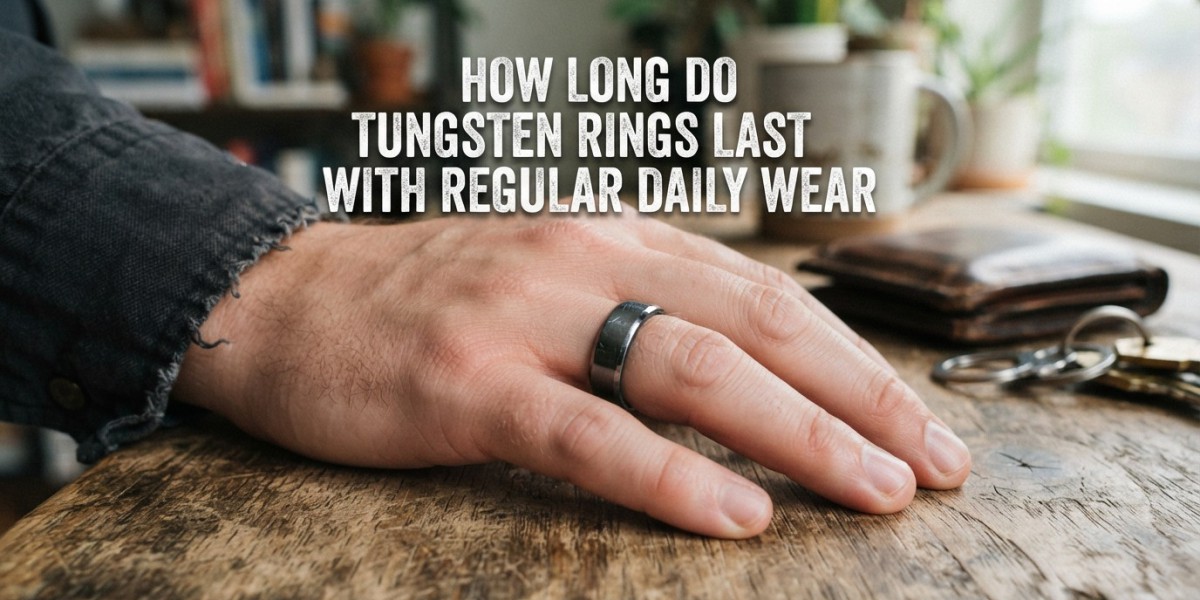

Ask a jeweler how long a ring should last, and you’ll get this sort of loose reply about “lifetime quality” or whatever. With tungsten rings you usually hear something more grounded, though, because the metal acts differently than gold, silver, or platinum in ways that actually show up on your hand every day. People who do hands-on work, hit the gym most days, or just don’t want to babysit their jewelry tend to choose it for a reason. But the full story is both a strong point and a real downside, and yeah, it’s better to know both before you buy.
Why Tungsten Rings Resist Scratching So Well
Tungsten carbide is basically tungsten powder fused together with a binding metal, like cobalt or nickel, under heat and pressure. That process forms a dense crystalline build. And that build is what puts its hardness way above gold, platinum, or even titanium.
You can see the difference fast. A gold band on a mechanic’s hand tends to pick up visible scratches in just a few weeks. Now put a tungsten band through the same shop floor stress, and it often looks almost the same months later, like after six months it’s still holding up.
That’s why you’ll see tungsten so often in men’s wedding bands, but also in toolboxes, gyms, and job sites where rings take constant knocks. The surface doesn’t dull the way softer metals do, so you don’t end up doing the same regular polishing or those “maybe we should re-plate it” situations that come up with gold and silver.
What Daily Wear Actually Looks Like Over Years
If your life is mostly normal—cooking, typing, driving, the occasional yard work—then a solid tungsten band can keep its look for decades. Because it resists scratches so reliably, there usually isn’t some moment where you suddenly notice heavy wear.
Plenty of people say they’ve worn the same ring for 15 to 20 years, and the finish is still basically there, like it didn’t get that gradual fade you’d expect.
Still, it’s not magic. Cleaning matters, because tungsten hardness doesn’t stop soap residue, lotion film, or skin oils from building up over time. A simple soft cloth, or a mild soapy water rinse every couple weeks, usually keeps the ring looking like day one.
The Real Limit for Tungsten Rings: Impact Resistance
Ok, here’s the part that kind of flips the usual expectation. Hardness is great for scratches, but that same property makes tungsten carbide more brittle. Gold and titanium can bend or dent under a hard hit without totally failing. Tungsten doesn’t really do that. If you take a sharp, direct impact—a hand slamming into a metal doorframe, a ring getting caught while machinery is moving, a weight landing wrong—then it can crack or shatter rather than just getting a dent and staying intact.
It doesn’t happen every day, but it’s the scenario worth remembering if your routine includes rough handling. A lot of construction workers, or people doing heavy lifting, fall into the habit of removing the ring before high-risk tasks and then putting it back on after. It’s a small habit that avoids the one failure mode tungsten actually has.
Fit and Comfort Don't Change on Their Own
Another thing: tungsten doesn’t stretch or compress like softer metals. So if your finger size changes with weight gain or loss, age, or temperature shifts, the ring won’t quietly accommodate.
If that happens, you usually need resizing from a pro. And in many cases, resizing tungsten just isn’t practical, so replacement ends up being the next step. Anyone buying tungsten, especially younger buyers, should plan for that reality instead of assuming it’ll adapt the way a gold band might.
Most newer tungsten rings now include a comfort-fit interior too, meaning the inside has a slight inward curve. That reduces pressure points, and it tends to be way more comfortable for long-term daily wear than older flat-profile designs.
Getting the Most Out of Long-Term Wear
Despite the fact that tungsten requires only a small amount of maintenance, having a few straightforward routines can significantly extend its lifespan. To give one example, it is recommended that the ring be removed prior to engaging in activities such as heavy lifting, contact sports, or the use of power tools. That removes most of the actual risk right away. Also, keeping it separate and storing it in a fabric-lined box, rather than just tossing it in with the rest of the jewelry, helps protect the tungsten and whatever gentler pieces it’s sharing space with. Then, just doing an occasional check for hairline cracks, especially after a pretty hard knock, catches trouble early before it turns into a full break.
Because resizing tungsten later is limited at best, getting the fit measured properly at the time you buy it matters more here than it does with other metals.
How Long Should You Expect One to Last?
For most of daily life, cooking, desk work, general errands, and even moderate exercise, tungsten tends to hold up better than a bunch of other options. The surface stays nice and intact for years without polishing or needing extra attention, which is basically the main reason people like this kind of jewelry in the first place.
The trade-off is impact, not wear. A single hard hit carries more risk for tungsten rings than it would for a softer metal that bends instead of breaking. For most wearers, that's a fair exchange: a ring that shrugs off years of ordinary use, as long as you're mindful of the rare moment when force, not time, is what it has to survive.






