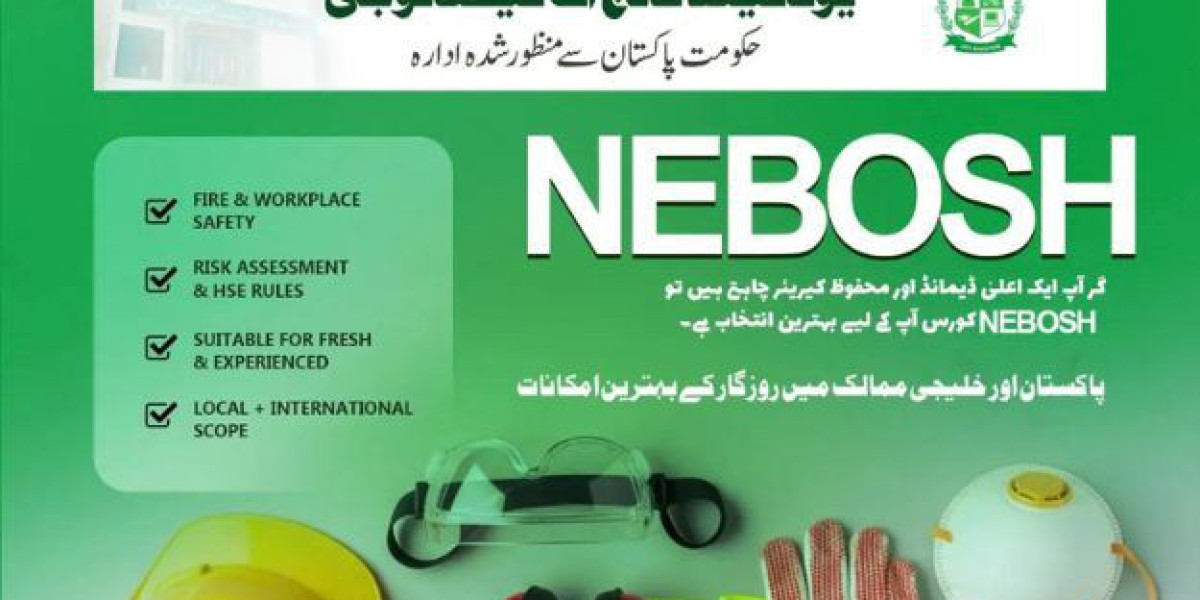

A Practical Starting Point for a Career in Workplace Safety
The NEBOSH International General Certificate is a widely recognized qualification in occupational health and safety. It is designed for people who want to understand workplace hazards, manage health and safety responsibilities, or begin developing a professional career in the safety field.
The qualification is suitable for managers, supervisors, people with health and safety responsibilities, and those starting a health and safety career. NEBOSH updated the qualification for 2026 so that its content and assessments continue to reflect current workplace needs.
For students considering a NEBOSH Course in Rawalpindi, understanding what the qualification actually teaches is useful before choosing a training provider or starting preparation.
What Does the NEBOSH International General Certificate Teach?
The course focuses on practical health and safety knowledge that can be applied in different types of workplaces. Students learn how organizations manage safety, how hazards are identified, and how risks can be controlled.
The syllabus also develops an understanding of workplace health and safety management systems, human factors, risk management, monitoring, and common workplace hazards. These skills are relevant across industries rather than being limited to one type of job.
For example, imagine a workplace where employees regularly move heavy materials. A trained learner should be able to look beyond the task itself, identify potential hazards, consider who could be affected, and think about suitable control measures.
Learning How to Manage Workplace Risks
Risk management is a major part of the NEBOSH International General Certificate. Learners develop the ability to recognize hazards and consider sensible ways of reducing workplace risks.
This is useful because safety professionals are expected to understand real working conditions. They may need to inspect an area, communicate with employees, review existing controls, and suggest improvements.
Understanding Common Workplace Hazards
Workplaces can contain different types of hazards depending on the industry. The qualification develops knowledge that can be applied to issues involving work equipment, fire, electricity, physical and psychological health, musculoskeletal health, and chemical or biological agents.
Rather than simply memorizing safety terms, learners need to understand how these issues can appear in practical workplace situations.
How Is the NEBOSH International General Certificate Assessed?
The current qualification uses two assessments: GIC1 and GIC2. These replaced the previous IG1 and IG2 structure for learners following the updated specification.
GIC1 is a scenario-based open-book assessment. Learners apply their knowledge to a workplace situation rather than answering only simple memory-based questions. It also includes a closing interview in which learners are asked about their submitted work.
GIC2 is the practical part. Learners complete a workplace risk assessment and develop an action plan. NEBOSH describes it as a practical assessment designed to test what the learner can actually do.
This practical approach is particularly useful because risk assessment is a common responsibility in health and safety work.
Practical Learning Makes Safety Knowledge More Useful
Studying definitions alone does not prepare someone for every workplace situation. A good NEBOSH Course in Rawalpindi should help learners understand how safety principles relate to practical examples.
Consider a warehouse where boxes are blocking part of a walkway. Simply recognizing that something is wrong is only the first step. A safety learner should be able to identify the hazard, consider who may be affected, examine existing controls, and recommend suitable improvements.
This type of thinking helps students connect their studies with workplace responsibilities.
Who Can Study the NEBOSH International General Certificate?
NEBOSH states that there are no formal entry requirements for the qualification. However, learners need a suitable level of English to understand the syllabus and explain health and safety concepts clearly.
NEBOSH recommends an English standard equivalent to IELTS 6.0 or higher. This is a recommendation about the language level needed to study effectively, rather than a separate academic entry qualification.
Therefore, students should consider their English reading and writing skills before enrollment, particularly because the assessments require them to understand scenarios and explain their reasoning.
What Skills Can Students Develop?
The NEBOSH International General Certificate can develop skills that go beyond remembering safety rules. Learners practice hazard identification, risk assessment, safety management, communication, and problem-solving.
They also develop a better understanding of how workplace safety decisions are made. For instance, recommending a control measure requires considering whether it actually addresses the risk rather than simply choosing the first solution that comes to mind.
In addition, clear written communication matters because safety professionals often prepare reports, risk assessments, inspection findings, and recommendations.
Can NEBOSH Help With a Safety Career?
The qualification is designed for people with health and safety responsibilities as well as those beginning a career in occupational health and safety.
After completing the qualification, a learner may explore roles related to occupational health and safety, depending on the employer's requirements, previous education, experience, and other professional skills.
A certificate alone does not guarantee employment. However, combining recognized safety education with practical knowledge, communication ability, and workplace experience can provide a stronger foundation for professional development.
Studying a NEBOSH Course in Rawalpindi
Students looking for local training can consider the NEBOSH Course in Rawalpindi offered by United College of Technology (UCT). When comparing training options, students should look beyond the course name and ask about teaching methods, assessment preparation, study support, current batch schedule, and registration arrangements.
Course duration can vary depending on how a Learning Partner organizes tuition. Therefore, students should confirm the current duration, class timings, admission process, fees, NEBOSH registration arrangements, and certificate information with UCT before enrolling.
It is also worth confirming that the training and registration arrangements correspond to the current NEBOSH specification, because the General Certificate was updated in 2026.
Six Questions Students Commonly Ask Before Enrolling
1. What is the NEBOSH International General Certificate?
It is an occupational health and safety qualification designed for managers, supervisors, people with safety responsibilities, and those beginning a health and safety career. It teaches practical principles for managing workplace health and safety.
2. Do I need previous safety experience?
NEBOSH lists no formal entry requirements for the qualification. However, suitable English-language ability is important because learners need to understand scenarios and communicate safety concepts clearly.
3. Is there a practical assessment?
Yes. GIC2 requires learners to complete a practical workplace risk assessment and develop an action plan. This assesses the learner's ability to apply safety knowledge in practice.
4. Is the NEBOSH exam open book?
The GIC1 assessment is an open-book, scenario-based assessment. Under the current structure, it also includes a closing interview about the learner's submission.
5. What can I learn from a NEBOSH Course in Rawalpindi?
Students can develop knowledge of workplace health and safety management, risk assessment, hazard control, monitoring, and common workplace hazards. The exact teaching schedule and additional support depend on the training provider.
6. Is NEBOSH useful only for construction workers?
No. NEBOSH describes the International General Certificate as relevant to every workplace. Its principles can be applied across different industries where occupational health and safety needs to be managed.
Build Safety Knowledge That Can Be Used in Real Workplaces
The NEBOSH International General Certificate is designed around practical workplace health and safety rather than one particular industry. It helps learners understand how hazards are identified, risks are assessed, safety systems are managed, and improvements are planned.
For students considering a NEBOSH Course in Rawalpindi, the best approach is to understand the qualification structure first and then compare current training arrangements carefully. Strong preparation, practical thinking, and a clear understanding of risk assessment can help turn course knowledge into skills that are useful in real workplaces.