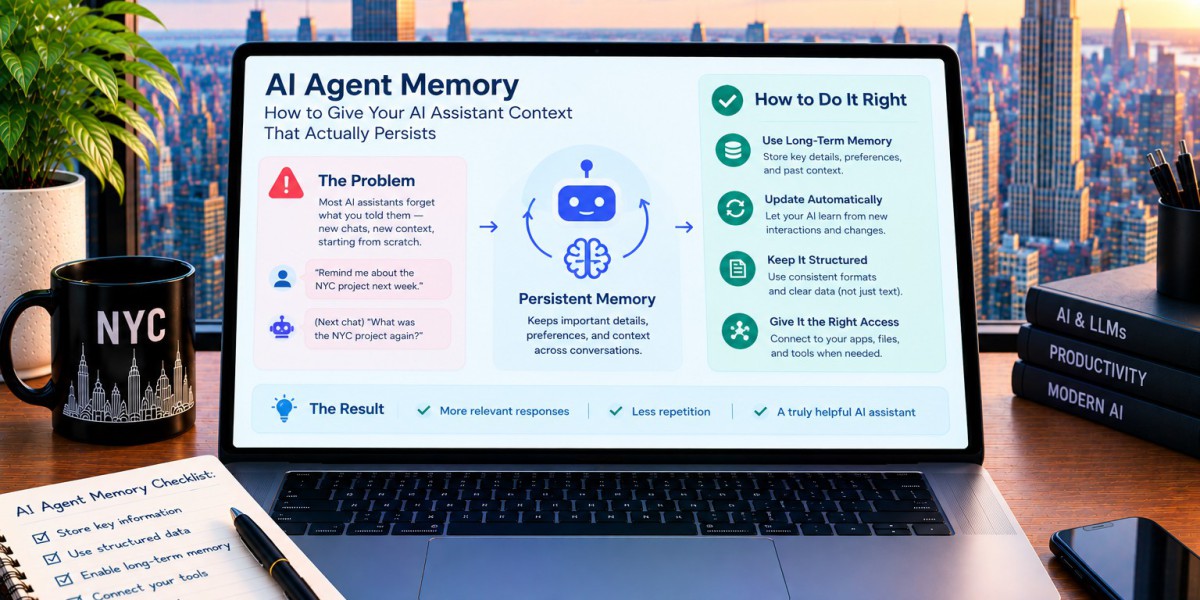

A customer support AI confidently references a return policy that was retired three months earlier, because nobody built a mechanism for the system to recognize that a fact it once knew had since become wrong. This is a documented, real failure pattern in production AI memory systems, and it points to something genuinely counterintuitive worth understanding before building any AI feature meant to remember things across conversations: giving an AI assistant memory isn't primarily a storage problem; it's a governance problem. Getting this distinction right from the start is exactly the kind of technical groundwork worth doing with a mobile app development company in New York businesses trust before your AI assistant starts confidently repeating information that's since become false.
Why This Matters More Than It Used to, Right Now
Gartner projects 40% of enterprise applications will be integrated with task-specific AI agents by the end of 2026, up from under 5% in 2025, one of the steepest enterprise software adoption curves ever recorded. But actual production deployment is more measured than that adoption curve suggests: separate research found only 23% of organizations actively scaling an agentic AI system in at least one business function, with another 39% still in the experimentation stage. Memory sits directly behind that gap between pilot and production; an agent that can't retain context across a session genuinely doesn't survive contact with a real workflow, which is exactly why memory has moved from an afterthought into its own actively researched, benchmarked layer of the AI stack over the past eighteen months.
The Three Genuinely Different Kinds of Memory Worth Distinguishing
Current architecture thinking separates AI agent memory into three distinct categories, each requiring different handling: semantic memory covers business facts, definitions, entities, and relationships, the kind of information that should be centrally governed and kept current. Episodic memory covers past workflows, decisions, tool calls, and user feedback, a genuine history of what happened, not necessarily facts that need ongoing verification. Procedural memory covers skills, runbooks, approval paths, and operating constraints, essentially, how the agent is supposed to behave, not what it knows.
This distinction matters practically because each type has a different failure mode if handled carelessly. Semantic memory that goes stale produces exactly the retired-policy problem covered above. Episodic memory referenced inappropriately, bringing up a customer's complaint from six months ago during an unrelated, casual product inquiry, produces a genuinely awkward, trust-eroding interaction even though the information itself is technically accurate.
Short-Term vs. Long-Term Memory: A Structural Distinction, Not Just a Scale Difference
Short-term memory functions much like human working memory, retaining immediate context during a single interaction: the current thread, task state, and recent tool outputs. Long-term memory extends beyond any single session, persisting facts, preferences, and history that should carry forward into future interactions. The practical constraint worth knowing: current-generation models impose real, hard token limits on active context; a widely used flagship model caps out around 128,000 tokens for its active working context, meaning short-term memory alone cannot simply accumulate indefinitely, forcing genuine architectural decisions about what gets kept, summarized, or discarded as a conversation grows.
The Genuinely Important, Underappreciated Problem: Memory Going Stale
Here's the finding worth taking most seriously before deploying any long-term memory system: a 2026 long-term memory benchmark found that memory agents can and do reuse invalid or outdated memories when the underlying facts have changed, exactly the retired-policy scenario that opened this piece. The architectural fix worth understanding: separate the memory layer, which optimizes for recall, from the context layer, which governs meaning and currency. Long-term business context specifically should come from a governed path that checks identity, scope, freshness, and certification before the agent actually acts on it, not simply pulled from whatever was stored previously without any verification step.
The Token Waste Problem Most Teams Don't Realize They Have
Worth knowing directly: research benchmarks put token waste from redundant or unnecessary context at roughly 24% to 41% of a typical agent's context window, meaning a meaningful share of what an agent is paying to process on every single request is genuinely unnecessary. This is addressed through what's called context engineering, organized around four practical strategies: writing (persisting information outside the immediate context window, commonly through a "scratchpad" the agent maintains during task execution), selecting (retrieving only genuinely relevant memories rather than everything available), compressing (summarizing rather than retaining full raw history), and isolating (keeping different types of context appropriately separated rather than blending everything into one undifferentiated pool).
What Actually Determines Whether a Memory Gets Surfaced
Beyond simple keyword matching, current memory retrieval systems weigh several factors together: relevance (how related is this memory to the current topic), recency (when did this happen), and importance (how significant was this information when it occurred). A weighted scoring approach combining these three factors consistently outperforms retrieval based on any single factor alone, and equally important, knowing when not to surface a technically relevant memory is itself part of building a system that feels genuinely appropriate rather than unsettling to interact with.
A Practical Way to Decide
- Separate your memory architecture by type from the start; semantic, episodic, and procedural memory each need different governance, not one undifferentiated storage system treated identically across all three.
- Build a freshness-checking mechanism for semantic memory specifically, given the documented, real risk of an agent confidently reusing outdated facts that have since changed.
- Budget for context engineering as an ongoing practice, given how much of a typical agent's context window, commonly a quarter to nearly half, is genuinely wasted on redundant or unnecessary information without active management.
- Weight memory retrieval by relevance, recency, and importance together, and build in explicit rules for when a technically relevant memory shouldn't be surfaced, given how directly this affects whether an interaction feels appropriate or unsettling.
FAQs
Is AI agent memory just a bigger context window, or is it architecturally different?
Genuinely different: a larger context window helps with short-term memory within a single session, but long-term memory that persists across sessions and stays current over time requires a separate storage and governance architecture, not just a bigger window for the same session.
Why does my AI assistant sometimes reference outdated information it should have "forgotten"?
This is a documented, real failure mode in memory systems. Without an explicit mechanism to check whether a stored fact is still current, an agent can confidently reuse invalid or outdated memories, which is why separating memory storage from a governed, freshness-checked context layer matters.
How much of my AI agent's context is actually being wasted on unnecessary information?
Current research benchmarks put this at roughly 24% to 41% of a typical agent's context window, a substantial, often-unrecognized inefficiency that context engineering techniques like compression and selective retrieval are specifically designed to address.
Should my AI system reference every technically relevant piece of history it has stored?
No, current best practice explicitly builds in rules for when not to surface a memory, since referencing something technically accurate but contextually inappropriate (an old complaint during an unrelated casual inquiry) can feel unsettling and erode trust, even when the information itself is correct.
Is building proper AI memory infrastructure worth it for a smaller business, or mainly for large enterprises?
The core principles scale down reasonably well; even a modest customer support or internal assistant benefits from basic separation between short-term session context and governed long-term facts, since the failure pattern of confidently repeating outdated information isn't unique to large-scale enterprise deployments.
Bottom Line
AI agent memory has evolved from an afterthought into a genuinely critical, actively researched layer of production AI systems, and the businesses building this well aren't the ones with the largest context windows; they're the ones treating memory as a governance problem, with explicit freshness checks and appropriate separation between fact-storage and interaction-history. This is exactly the kind of careful, architectural thinking worth building in with a mobile app development company in New York businesses trust before your AI assistant starts confidently telling customers something that used to be true.