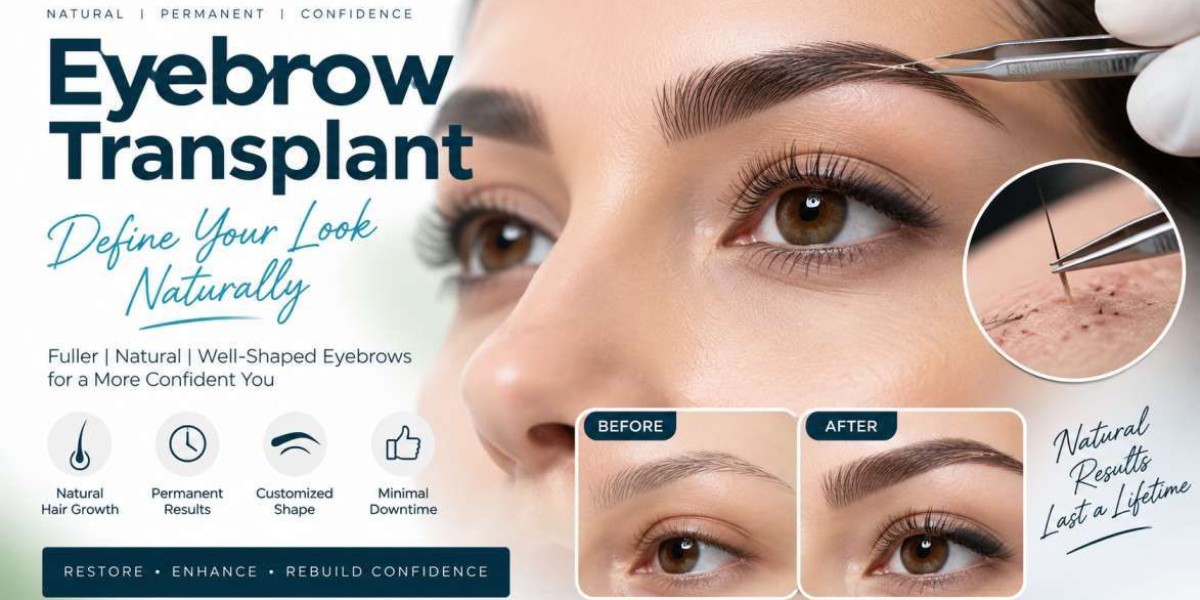

Well-shaped and fuller eyebrows can significantly enhance facial appearance and balance. However, factors such as genetics, over-plucking, aging, injury, scarring, or certain hair-loss conditions can lead to thin or uneven eyebrows. Eyebrow Transplant treatment offers a personalized hair restoration approach designed to improve eyebrow density and create a more natural-looking appearance.
What Is Eyebrow Transplant Treatment?
An Eyebrow Transplant is a cosmetic hair restoration procedure in which individual hair follicles are taken from a suitable donor area and carefully implanted into areas with sparse or missing eyebrow hair. The follicles are positioned according to the natural direction and angle of eyebrow growth.
Unlike temporary cosmetic solutions, eyebrow transplantation focuses on restoring actual hair growth. The treatment can be customized based on the patient's facial structure, existing eyebrow pattern, desired density, and aesthetic goals.
Who Can Benefit From Eyebrow Transplant?
An Eyebrow Transplant may be suitable for people who have:
- Naturally thin or sparse eyebrows
- Uneven eyebrow growth
- Over-plucked eyebrows
- Gaps in the eyebrow area
- Hair loss following injury or scarring
- Reduced eyebrow density due to aging
- Long-term eyebrow thinning
A professional consultation is important before treatment to evaluate the donor area, eyebrow condition, and expected outcome.
Benefits of Eyebrow Transplant Treatment
An Eyebrow Transplant can provide several potential advantages when performed by an experienced hair restoration professional. The treatment can help improve eyebrow fullness while maintaining a natural appearance.
Key benefits may include:
- Natural-looking eyebrow restoration
- Customized eyebrow shape and density
- Improved facial balance and definition
- Long-term hair restoration
- Use of the patient's own hair follicles
- Individual follicle placement for better precision
The final result can vary depending on individual hair characteristics, follicle survival, treatment technique, and aftercare.
How Eyebrow Transplant Works
The process usually begins with a detailed consultation. The eyebrow shape and desired density are carefully planned according to the patient's facial features. A suitable donor area is then selected.
Healthy follicles are carefully extracted and prepared for transplantation. The follicles are subsequently implanted into the eyebrow region at appropriate angles and directions. Precise placement is particularly important because eyebrow hair generally grows at a flatter angle than scalp hair.
Following treatment, patients receive aftercare instructions to support healing and follicle growth.
Recovery After Eyebrow Transplant
Temporary redness, swelling, tenderness, or small crusts may occur following an Eyebrow Transplant. These effects generally improve as the treated area heals.
Patients should follow their provider's instructions regarding cleaning, touching, exercise, and other activities during the recovery period. New hair growth does not appear immediately because transplanted follicles need time to establish their natural growth cycle.
Achieving Natural-Looking Results
The success of an Eyebrow Transplant depends greatly on careful planning and precise follicle placement. An experienced provider considers eyebrow direction, angle, density, shape, and facial proportions when designing the treatment.
Because transplanted hair may grow differently from natural eyebrow hair, regular trimming may be required after the hair has fully grown. Consistent follow-up can also help monitor the development of the results.
Choosing an Eyebrow Transplant Specialist
Choosing the right provider is an important step when considering eyebrow restoration. Look for a qualified professional with relevant experience in hair transplantation and eyebrow restoration.
During your consultation, discuss your desired eyebrow shape, expected results, available donor hair, treatment technique, recovery requirements, and potential risks. Reviewing appropriate before-and-after examples can also help establish realistic expectations.
Conclusion
Eyebrow Transplant treatment can be a valuable option for individuals looking to restore sparse, uneven, or thin eyebrows with a personalized hair restoration approach. Careful eyebrow design, precise follicle placement, professional treatment, and proper aftercare are essential for achieving natural-looking results. A consultation with a qualified specialist can help determine whether eyebrow transplantation is appropriate for your needs.
Frequently Asked Questions
What is an Eyebrow Transplant?
An Eyebrow Transplant is a hair restoration procedure that transfers individual follicles from a suitable donor area to the eyebrow region.
Does an Eyebrow Transplant look natural?
Natural-looking results depend on factors such as eyebrow design, follicle placement, growth direction, donor hair characteristics, and the experience of the provider.
How long does eyebrow hair take to grow?
Hair growth occurs gradually because transplanted follicles follow a natural growth cycle. The exact timeline varies between individuals.
Can the eyebrow shape be customized?
Yes. The shape and density can generally be planned according to facial proportions, existing eyebrow hair, and the patient's aesthetic goals.
Is eyebrow transplantation permanent?
Transplanted follicles are intended to provide long-term hair growth, but individual results can vary depending on several biological and treatment-related factors.
Meta Title: Eyebrow Transplant Treatment | Expert Brow Restoration
Meta Description: Learn how Eyebrow Transplant treatment can restore sparse brows with personalized design, precise follicle placement, and natural-looking results.