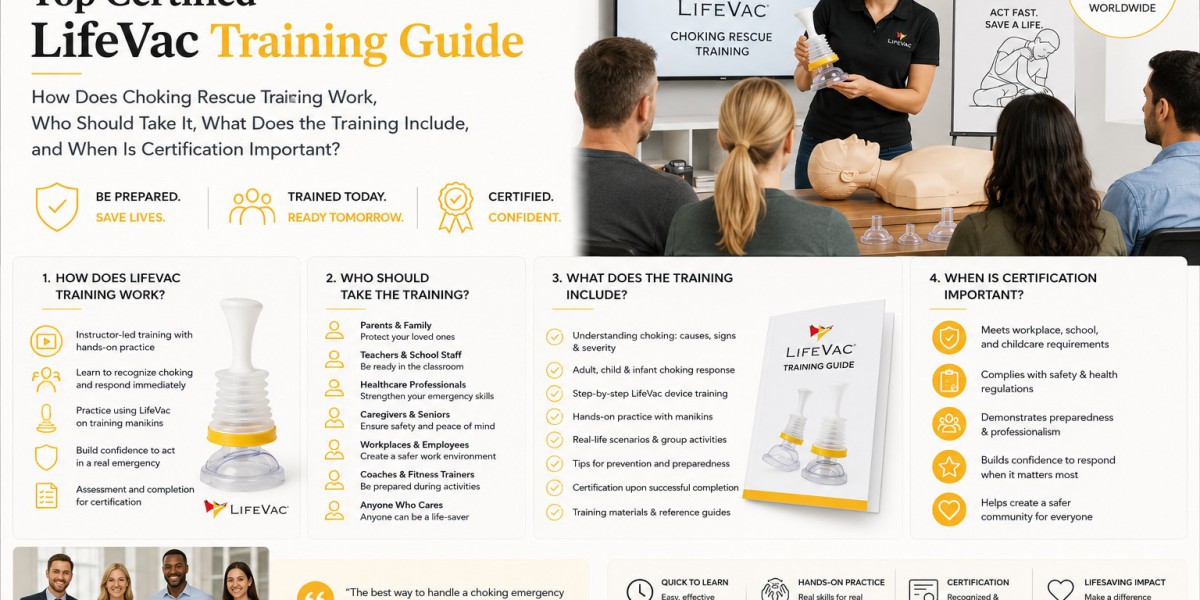

Choking can happen suddenly at home, in schools, workplaces, restaurants, care facilities, or during travel. Because an airway emergency can become serious very quickly, knowing what to do before professional medical help arrives is an important part of health and safety planning. Proper education can help people recognize choking, respond calmly, follow established emergency procedures, and understand when additional rescue equipment may be appropriate.
Certified LifeVac Training is designed to help people become familiar with Life Vac equipment, its proper use, and the role of a choking rescue device in an emergency plan. LifeVac states that its device is intended as a second-line treatment and does not replace calling emergency services or following standard choking rescue protocols.
Training should therefore be viewed as part of a broader emergency preparedness program rather than as a replacement for first aid, CPR, or professional medical care.
What Is Choking Rescue Training?
Choking rescue training teaches people how to identify a blocked airway and respond appropriately. A person with a partial obstruction may still be able to cough or speak, while a person with a severe obstruction may be unable to breathe, speak, or cough effectively.
Current Red Cross guidance for severe airway obstruction includes calling for help and using appropriate back blows and abdominal or chest thrusts according to the person's age and situation.
A good training program can cover:
Recognizing the signs of choking
Understanding partial and severe airway obstruction
Knowing when to call emergency services
Learning standard choking response procedures
Understanding how a rescue device fits into an emergency plan
Becoming familiar with equipment before an emergency
Practicing calmly and safely
Knowing where emergency equipment is stored
Understanding the importance of regular safety reviews
The goal is not simply to watch a demonstration. Effective training should help participants understand the reason behind each step and become more confident with emergency procedures.
How Does Certified LifeVac Training Work?
Certified LifeVac Training can involve reviewing educational material, watching instructional demonstrations, learning how the device is designed to be used, and completing an assessment where applicable.
Life Vac provides training videos covering topics such as device use, mask placement, and practical demonstrations. Its training page also provides access to instructions for use and practice instructions. After watching the training material, users can take a quiz to earn a training certificate.
The training process can generally be understood in several stages.
1. Learn the basics
Participants first learn about choking emergencies and why fast action matters. This includes understanding that a choking emergency requires immediate attention and that emergency medical services should be contacted.
2. Understand standard choking procedures
Life Vac training should not be considered a replacement for standard choking response procedures. Participants should understand the accepted first-line response appropriate to the person's age and condition.
3. Become familiar with the device
Participants can learn the main components of the device, including the different mask sizes and the purpose of the practice mask. The LifeVac Home Kit, for example, includes an adult mask, pediatric mask, and practice mask.
4. Watch practical demonstrations
Visual demonstrations can make it easier to understand equipment placement and operation. Life Vac provides instructional material showing how to insert and remove the mask and how to use the device.
5. Complete an assessment
Where a training certificate is offered, an assessment or quiz can help confirm that the participant has reviewed the required educational information. Life Vac provides a certificate process after completion of its training quiz.
Who Should Take Choking Rescue Training?
Choking training can be useful for many people because choking emergencies are not limited to medical professionals. Parents, teachers, caregivers, restaurant workers, office employees, childcare workers, and other responsible adults may benefit from knowing how to respond.
Parents and Families
Parents and family members often spend significant time around children. Learning basic choking response procedures can help them prepare for unexpected emergencies.
Families can also make emergency equipment easier to access by choosing a known storage location and making sure adults in the household understand the emergency plan.
Teachers and School Staff
Schools may have many students eating, playing, and participating in activities throughout the day. Staff members responsible for student safety can benefit from first aid and choking-response education.
Life Vac's school safety information recommends strategic placement of equipment in areas such as cafeterias, nurse offices, gyms, and other locations where students may need immediate assistance.
Childcare Workers
Young children can be particularly vulnerable to choking hazards. Childcare providers may therefore benefit from training that helps them recognize choking signs and respond according to established safety procedures.
Caregivers
People caring for older adults or individuals with certain disabilities may also benefit from emergency preparedness training. A complete safety plan should take into account the person's individual needs and the procedures recommended by qualified healthcare professionals.
Workplace Staff
Businesses can include choking response education within wider workplace safety programs. Restaurants, hotels, schools, offices, gyms, and care facilities may have particular reasons to prepare employees for airway emergencies.
First Aid and CPR Instructors
Professional instructors may also have an interest in learning about Life Vac equipment. Life Vac provides information for CPR and first aid instructors and has a process for people interested in becoming Life Vac trainers.
What Does the Training Include?
A useful training program should provide practical information instead of focusing only on theory. Participants should understand both the emergency and the equipment.
Typical subjects can include:
Choking recognition: Participants learn how to identify signs that may indicate an airway obstruction.
Emergency activation: Training emphasizes getting emergency medical assistance and involving other people when possible.
Standard response: Participants learn the appropriate first-line choking procedures for adults, children, and infants according to recognized guidelines.
Device awareness: Participants learn the purpose and limitations of a choking rescue device.
Mask selection: Participants become familiar with the appropriate mask options supplied with the device.
Practical demonstration: Visual instruction helps participants understand how the equipment is positioned and operated.
Practice: A practice mask can help users become familiar with the device before an actual emergency. Life Vac specifically describes its practice mask as a way to become comfortable with the device.
Assessment: A quiz or assessment may be included when certification is offered.
Emergency planning: Participants should also consider where the equipment will be stored and how other people can locate it quickly.
Why Are LifeVac Instructions Important?
LifeVac Instructions are an important part of preparation because emergency equipment should not be used for the first time during a stressful situation. Familiarity can reduce confusion and help users understand the manufacturer's directions.
Life Vac provides instructions for use, practice instructions, information cards, and training videos.
People responsible for safety equipment should review the manufacturer's current information and ensure that staff know where the instructions are kept.
It is also useful to inspect equipment periodically. For example, the manufacturer states that while the device itself does not expire, its mask manufacturer recommends replacing masks every two to three years or according to the expiration date on the packaging.
Understanding the LifeVac Wall Mounted Kit
The LifeVac Wall Mounted Kit can be relevant for organizations that want emergency equipment kept in a visible and accessible location.
Storage is an important part of emergency preparedness. Equipment that is difficult to find may not be useful when every second matters. A clearly marked location can help employees, teachers, caregivers, or other responsible adults identify the equipment quickly.
Organizations should consider placing emergency equipment according to their own safety assessment. Areas with food consumption, children, high visitor traffic, or people who may have increased choking risk may deserve particular attention.
A wall-mounted storage approach can also make it easier to include choking rescue equipment within a broader emergency preparedness system alongside other safety equipment.
LifeVac® vs Illegal Counterfeit Devices: Why Product Authenticity Matters
LifeVac® vs Illegal Counterfeit Devices is an important safety topic because emergency equipment should come from a reliable and authorized source.
A counterfeit or unauthorized product may not provide the same materials, design, quality controls, instructions, or support associated with the genuine product. In a medical or emergency situation, users should avoid assuming that two products are equivalent simply because they look similar.
Before purchasing emergency equipment, consumers can check the product identity, packaging, instructions, seller information, and manufacturer details. Organizations should also maintain purchasing records and use trusted supply channels.
The key point is simple: emergency equipment should be selected carefully, and users should understand exactly what product they have available.
When Is Certification Important?
Certification can be particularly useful when an organization wants evidence that employees or designated safety personnel completed a particular training program.
For a family using Life Vac at home, becoming familiar with the equipment and reviewing the available training material may be the main priority. For a school, workplace, childcare center, or other organization, documented training may provide an additional way to track employee preparedness.
Certification may be valuable when:
An organization has a formal safety policy
Employees have specific emergency-response responsibilities
A workplace wants training records
A school wants staff to follow a consistent safety procedure
A facility regularly reviews emergency preparedness
An organization wants designated personnel to receive structured education
However, a certificate should not be treated as proof that someone can replace emergency medical professionals. Training, certification, practice, and emergency response procedures all work together.
LifeVac® vs Illegal Counterfeit Devices: What Should Organizations Check?
LifeVac® vs Illegal Counterfeit Devices should be considered when an organization is purchasing multiple units for employees, classrooms, facilities, or public areas.
Organizations can create a purchasing checklist that includes:
Confirming the manufacturer and product identity.
Reviewing the product's instructions.
Checking that the correct masks and accessories are included.
Reviewing training information.
Confirming that staff know where the equipment is located.
Keeping emergency procedures visible.
Reviewing equipment periodically.
Replacing components according to manufacturer guidance.
These steps can help organizations build a more organized safety system.
How Should Training Be Practiced?
Watching a video once may not be enough for long-term preparedness. People can forget procedures when they are not reviewed regularly.
A simple practice plan can include:
Reviewing the training material periodically
Discussing the emergency plan with staff
Identifying the location of the device
Practicing with the appropriate training equipment
Reviewing who is responsible for calling emergency services
Checking that instructions remain accessible
Including choking response in wider first aid discussions
The aim is to make the emergency plan familiar without creating confusion about which procedures should be used first.
Why Should LifeVac Instructions Be Reviewed Regularly?
LifeVac Instructions should be treated as part of ongoing safety preparation rather than paperwork that is read once and forgotten.
Product information can be updated, employees can change, equipment can be moved, and emergency plans can become outdated. Regular reviews provide an opportunity to make sure everyone knows the current procedure and location of the equipment.
Organizations should always follow the current manufacturer's instructions and applicable local emergency guidance rather than relying on an old training memory.
LifeVac® vs Illegal Counterfeit Devices: A Practical Safety Reminder
LifeVac® vs Illegal Counterfeit Devices is not simply a purchasing issue. It is also about ensuring that people responsible for emergency response know which equipment they have been trained to use.
A safety manager can document the product name, training date, responsible staff members, equipment location, and review schedule. This creates a simple system that can be checked during regular safety inspections.
The goal is to reduce uncertainty. In an emergency, people should know who will call for help, who will provide first aid, where emergency equipment is located, and how the organization expects staff to respond.
How LifeVac Instructions Fit Into an Emergency Plan
LifeVac Instructions should be kept close enough to the equipment that a responsible user can review them when needed. Staff can also be directed to the manufacturer's training resources before an emergency occurs.
Life Vac states that the device is intended as a second-line treatment and should only be used after standard choking protocols have failed. It is intended for adults and pediatric choking victims at least one year of age.
This distinction is important. A rescue device should be part of a complete emergency plan, not the entire plan.
Building a Strong Health and Safety Program
A strong health and safety program combines education, preparation, equipment, communication, and regular review.
For organizations, this may mean providing first aid and CPR training, teaching staff how to identify choking, maintaining emergency contact procedures, placing appropriate equipment in accessible locations, and keeping safety information updated.
The LifeVac Wall Mounted Kit can be considered as part of this type of preparedness strategy where appropriate. Its purpose is to keep equipment accessible while supporting an organized emergency response plan.
The LifeVac Wall Mounted Kit should not replace professional medical care, emergency services, or recognized first aid procedures. Instead, organizations should understand its intended role and train responsible people accordingly.
Final Thoughts
Choking emergencies require fast and organized action. Training helps people recognize the problem, follow standard response procedures, contact emergency services, and understand the role of additional rescue equipment. Certified LifeVac Training can help users become familiar with Life Vac equipment and complete the available training and assessment process.
For homes, schools, workplaces, childcare settings, and care environments, regular safety preparation can make emergency responsibilities clearer. Reviewing training material, practicing safely, keeping equipment accessible, and following current manufacturer guidance are all useful parts of preparedness. Organizations serving the LifeVac Middle East market should also consider local emergency requirements and relevant health and safety practices when developing their choking-response plans.
FAQs
1. What is Certified LifeVac Training?
It is training designed to help users become familiar with Life Vac equipment, its intended role in a choking emergency, proper use information, and available assessment or certification processes.
2. Does Life Vac training replace CPR or first aid training?
No. Life Vac states that its device is intended as a second-line treatment and does not replace calling emergency services or standard choking rescue procedures.
3. Who can benefit from choking rescue training?
Parents, teachers, caregivers, childcare workers, workplace employees, restaurant staff, safety personnel, and other responsible adults may benefit from appropriate choking and first aid education.
4. Is certification required for every Life Vac user?
Not necessarily. Requirements can depend on the organization, workplace, local regulations, or specific role. Users should check their organization's safety policies and applicable requirements.
5. What does Life Vac training cover?
Training resources can cover device operation, mask placement, instructional demonstrations, practice information, instructions for use, and an assessment that can lead to a training certificate.
6. Why is practice important?
Practice helps users become familiar with equipment before an emergency. Life Vac provides a practice mask with certain kits specifically to help users become comfortable with the device.
7. Where should a choking rescue device be stored?
It should be stored in an accessible location identified by the organization's emergency plan. Schools and workplaces may consider areas where people eat or where a choking emergency could reasonably occur.
8. How often should training be reviewed?
There is no single schedule suitable for every organization. Regular review is useful, especially when staff change, equipment changes, procedures are updated, or an organization's safety policy requires refresher training.
9. Can a wall-mounted kit support workplace preparedness?
Yes, accessible wall-mounted storage can help staff identify and reach emergency equipment quickly. It should be used alongside an appropriate emergency response plan and not as a replacement for standard first aid procedures.
10. What is the most important part of choking preparedness?
The most important part is having a clear emergency plan, knowing how to recognize choking, following appropriate first-line response procedures, calling emergency services, and understanding any additional equipment available.