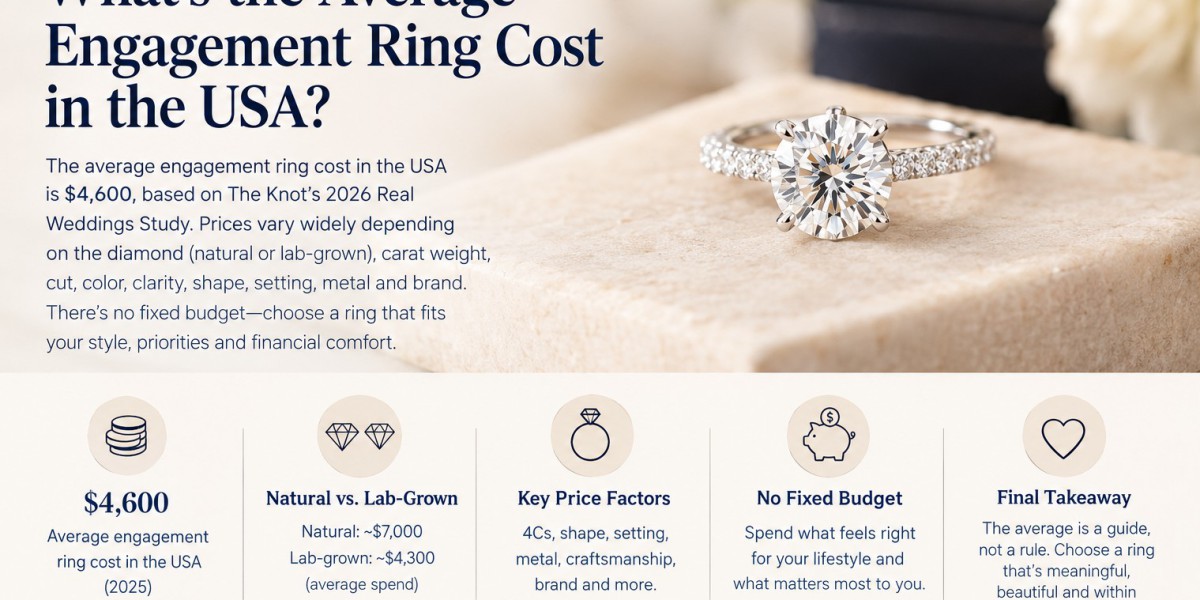

Buying an engagement ring is an exciting milestone, but one question often comes first: How much does an engagement ring cost in the USA?
According to The Knot’s 2026 Real Weddings Study, couples spent an average of $4,600 on an engagement ring in 2025. The study also found an average center-stone carat weight of 1.9 carats.
However, $4,600 is an average—not a required budget. Engagement rings in the United States can cost considerably less or much more depending on the diamond or gemstone, carat weight, metal, setting, craftsmanship, brand, and whether the center stone is natural or lab-grown.
How Much Does an Engagement Ring Cost in the USA?
The average engagement ring cost in the USA is approximately $4,600, based on The Knot's 2026 Real Weddings Study covering purchases made in 2025.
That figure should be viewed as a reference point rather than a spending rule. GIA notes that there is no fixed amount that someone should spend on an engagement ring. Some buyers spend under $3,000, while others spend considerably more than $7,500.
Factor Effect on Price
Diamond carat weight Larger stones generally cost more
Cut Better-performing cuts can increase value
Color More colorless diamonds generally cost more
Clarity Higher clarity generally costs more
Diamond shape Round diamonds can command higher prices
Natural vs. lab-grown Lab-grown can offer a different price point
Ring metal Platinum typically costs more than gold
Setting Pavé, halo and three-stone designs can add cost
Customization Bespoke work can increase labor and material costs
Brand and craftsmanship Can significantly affect the final price
What Is the Average Engagement Ring Cost in 2025?
The latest figures from The Knot's Real Weddings Study put the 2025 average engagement ring expenditure at $4,600.
The same study provides an interesting look at the difference between natural and lab-grown center stones:
- Natural-stone engagement rings: average spend of approximately $7,000
- Lab-grown-stone engagement rings: average spend of approximately $4,300
- Average natural center stone: 1.6 carats
- Average lab-grown center stone: 2.0 carats
These figures help explain why the overall average doesn't tell the entire story. Two engagement rings can have very different prices while offering similar visual impact.
Why Do Engagement Rings Cost So Much?
An engagement ring isn't priced according to the diamond alone. The final cost is influenced by several components.
1. Diamond or Gemstone Quality
For diamond engagement rings, the **4Cs—cut, color, clarity and carat weight—**are among the most important factors affecting price.
Cut influences how effectively a diamond interacts with light.
Color measures how much color is present in a diamond. On the GIA D-to-Z scale, D represents the highest color grade.
Clarity describes internal inclusions and surface characteristics.
Carat weight measures the diamond's weight, rather than simply its visible size.
GIA explains that these characteristics can significantly influence a diamond's rarity and price.
2. Diamond Shape
The shape you choose can also affect the price.
Round brilliant diamonds are often more expensive because of their popularity and the amount of rough diamond lost during cutting. Fancy shapes such as oval, cushion and princess can provide alternative options at different price points.
The Knot's 2026 study found that round was the most popular engagement-ring shape at 26%, followed closely by oval at 25%.
3. Ring Setting
The setting is another major part of the total cost.
A simple solitaire setting generally uses less material and fewer accent stones than designs such as:
- Halo settings
- Pavé bands
- Three-stone rings
- Split-shank designs
- Intricate vintage-inspired settings
- Custom designs
A more detailed setting can increase both material and labor costs. However, it can also create greater visual impact without requiring an exceptionally large center stone.
4. Metal Choice
The metal surrounding the stone also contributes to the final price.
Common options include:
- 14K gold
- 18K gold
- White gold
- Yellow gold
- Rose gold
- Platinum
Platinum is generally positioned at a higher price point because of its rarity and properties, while gold offers several choices across different budgets.
Interestingly, The Knot reports that yellow gold accounted for 39% of engagement-ring purchases in its 2026 study, showing how preferences are changing beyond traditional white-metal designs.
How Much Should You Spend on an Engagement Ring?
There is no universally correct engagement-ring budget.
The old idea that someone should spend two or three months of their salary is not a financial requirement. GIA specifically states that there is no hard-and-fast rule for how much an engagement ring should cost.
Instead, start with a budget that fits your financial circumstances.
For example, someone might choose a $2,500 ring because they prefer a simple design, while another buyer may spend $8,000 or more on a larger center stone or custom setting.
The average is useful for market context—not as a personal spending target.
What Can You Get at Different Engagement Ring Budgets?
There is no fixed product specification for each price range because diamond prices vary substantially. However, a general budgeting framework can help.
Under $1,000
At this level, buyers may consider:
- Smaller natural diamonds
- Lab-grown diamonds
- Alternative gemstones
- Simple solitaire settings
- 10K or 14K gold designs
The emphasis is often on a clean design and thoughtful selection of the center stone.
$2,000–$4,000
This range opens up more choices, including:
- Larger lab-grown diamonds
- Smaller-to-medium natural diamonds
- Oval, pear, cushion and other fancy shapes
- Pavé or halo details
- 14K and 18K gold settings
$4,000–$7,500
This range overlaps with and extends beyond the current U.S. average.
Depending on the stone and design, buyers may explore:
- Larger lab-grown center stones
- Higher-quality natural diamonds
- More elaborate settings
- Three-stone designs
- Customization
- Premium gold or platinum options
$7,500+
Higher budgets can provide access to larger or rarer diamonds, premium craftsmanship, elaborate settings and more extensive customization.
However, spending more does not automatically mean a ring will be more attractive or meaningful.
Natural Diamond vs. Lab-Grown Diamond: Which Costs More?
One of the biggest changes in the U.S. engagement-ring market is the growth of lab-grown diamonds.
The Knot's 2026 Real Weddings Study reported that 61% of engagement-ring purchases used lab-grown center stones, compared with a much smaller share earlier in the decade.
The study's reported average spending also showed a substantial difference:
Natural center stone: approximately $7,000
Lab-grown center stone: approximately $4,300
For buyers comparing these options, price isn't the only consideration. The diamond's grading information, specifications, setting, retailer, craftsmanship and purchase policies should also be evaluated.
How to Get More Value From Your Engagement Ring Budget
You don't necessarily need to increase your budget to create a larger-looking or more impressive ring.
Prioritize Cut
A well-cut diamond can produce strong brightness and sparkle. GIA emphasizes that cut affects how a diamond interacts with light and recommends paying close attention to cut quality.
Consider Fancy Shapes
Round diamonds remain extremely popular, but oval, cushion, pear, emerald and other shapes can provide a distinctive appearance and different pricing.
Look Slightly Below Popular Carat Marks
Diamond prices can increase around commonly sought-after weights such as 1.00 or 1.50 carats.
GIA notes that stones just below these thresholds—for example, around 0.97 or 1.47 carats—can sometimes cost less while appearing visually similar in size.
Don't Overpay for Invisible Clarity
Some inclusions are difficult or impossible to see without magnification.
GIA notes that diamonds in grades such as VS2 or SI1 can sometimes provide a balance between appearance and price because inclusions may not be visible to the naked eye.
Compare Complete Ring Prices
Don't compare diamonds alone.
Compare the complete ring, including:
- Center stone
- Side stones
- Setting
- Metal
- Craftsmanship
- Certification or grading report
- Warranty
- Return policy
- Resizing
- Insurance considerations
This provides a more realistic picture of what you're actually purchasing.
What Is a Good Engagement Ring Budget?
A good engagement-ring budget is one that allows you to purchase a ring you genuinely like without creating unnecessary financial pressure.
Instead of asking:
"How much am I supposed to spend?"
A better question is:
"What ring can I comfortably afford while getting the design, quality and characteristics that matter most to us?"
The Knot's current average of $4,600 can help establish a market reference, but individual budgets can reasonably fall above or below it.
Do You Need to Spend Three Months' Salary on a Ring?
No.
The three-month-salary concept is an outdated marketing convention rather than a financial rule. GIA states that there is no fixed amount that everyone should spend on an engagement ring.
Your engagement ring budget should reflect your own priorities and financial situation.
A thoughtfully selected $3,000 ring can be just as meaningful as a $10,000 ring.
What Other Costs Should You Budget For?
The purchase price may not be your only expense.
Potential additional costs include:
Ring Resizing
Some rings may need resizing after purchase. Complex designs, particularly those with continuous pavé or intricate construction, can require additional work.
Insurance
Jewelry insurance can provide coverage for risks such as loss, theft or damage, depending on the policy.
Engraving
Personalized engraving may add an additional charge.
Rush Orders
Custom or made-to-order rings can require additional time. GIA notes that rush orders can sometimes involve additional fees.
Wedding Band
If your overall jewelry budget includes both an engagement ring and wedding band, remember to account for the second ring separately.
How to Choose an Engagement Ring Without Overspending
A practical approach is to follow these steps:
1. Set your maximum budget.
Know the amount you are comfortable spending before shopping.
2. Decide what matters most.
For example, prioritize diamond size, sparkle, metal, design or customization.
3. Compare different diamond options.
Look at differences in the 4Cs rather than focusing only on carat weight.
4. Consider natural and lab-grown diamonds.
Compare their specifications and prices before making a decision.
5. Review certification.
For a diamond purchase, ask for an appropriate grading report and review the details carefully. GIA recommends using reputable grading reports when buying diamonds.
6. Compare the complete ring.
The center diamond is only one component of the finished piece.
7. Check the retailer's policies.
Review return, resizing, warranty and after-sales service terms.
Final Thoughts: How Much Should an Engagement Ring Cost?
So, what's the average engagement ring cost in the USA?
The latest available figure is $4,600, based on The Knot's 2026 Real Weddings Study of 2025 weddings.
But an average should never become a rule.
The right engagement ring budget depends on what you value: diamond size, sparkle, design, metal, craftsmanship, customization, or the option to choose a lab-grown center stone.
The smartest approach is to set a comfortable budget first, understand the factors that affect price, compare your options, and choose the ring that fits both your preferences and your financial plans.
For buyers exploring modern engagement rings, lab-grown diamonds can provide another route to achieving a larger center stone or distinctive design within a particular budget.
Frequently Asked Questions
What is the average cost of an engagement ring in the USA?
The average engagement ring expenditure was $4,600 in 2025, according to The Knot's 2026 Real Weddings Study.
Is $5,000 enough for an engagement ring?
Yes. A $5,000 budget is around the current U.S. average and can provide a wide range of options. The exact ring will depend on the diamond or gemstone, setting, metal, shape and craftsmanship.
Is $10,000 too much for an engagement ring?
There is no universal maximum or minimum. A $10,000 budget is above the current U.S. average, but whether it makes sense depends on the buyer's financial circumstances and desired ring specifications.
How much does a 1-carat engagement ring cost?
There is no single price for a 1-carat engagement ring. Diamond prices vary based on cut, color, clarity, shape, whether the stone is natural or lab-grown, and other factors. The setting and metal also contribute to the final price.
Are lab-grown diamonds cheaper than natural diamonds?
The latest data from The Knot shows a lower average engagement-ring spend for rings with lab-grown center stones—about $4,300 versus $7,000 for natural center stones in its 2026 Real Weddings Study.
Is the three-month salary rule still relevant?
It is not a requirement. GIA describes the three-month-salary concept as an outdated convention and recommends setting a budget based on what you can comfortably afford.
What affects engagement ring prices the most?
The center stone's characteristics—including the diamond's cut, color, clarity and carat weight—can have a major effect on price. Shape, metal, setting complexity, craftsmanship and customization also influence the final cost.