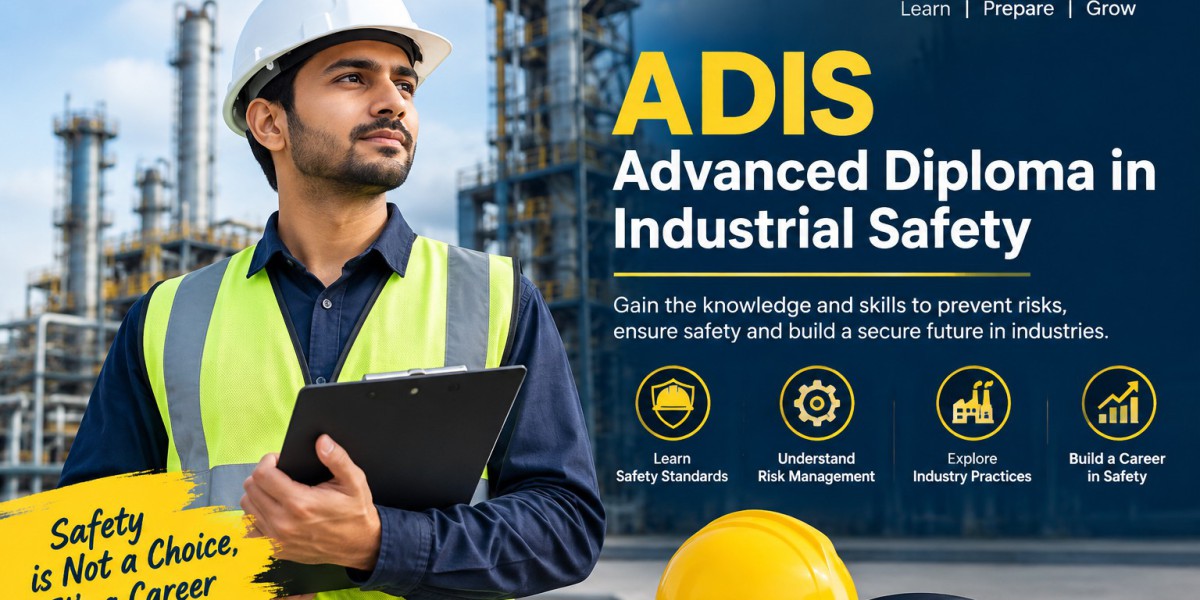

ADIS (Advanced Diploma in Industrial Safety): Course Overview.
ADIS, or Advanced Diploma in Industrial Safety, is a professional programme for learners who want to build
expertise in workplace safety, hazard prevention, occupational health and industrial risk management. The
course is relevant for candidates looking to enter safety-focused roles across manufacturing, construction,
engineering, infrastructure, energy and other industrial environments.
The growing focus on accident prevention, regulatory compliance and employee well-being has increased the
importance of trained safety professionals. An ADIS programme can help learners understand how to identify
workplace hazards, assess risks, recommend preventive controls and support emergency preparedness. It is
particularly useful for engineering or technical graduates, diploma holders, safety personnel and working
professionals who want to strengthen their knowledge of industrial safety.
For students searching for an ADIS course in India, important factors include eligibility, course duration,
syllabus, learning mode, institutional recognition, practical exposure and career opportunities. These factors
should be checked with the institution before admission.
What Will You Learn in an ADIS Course?
The curriculum generally combines safety management concepts with practical workplace applications.
Students can develop an understanding of accident prevention, industrial hazards, occupational health and
safety legislation. Hazard Identification and Risk Assessment (HIRA), safety inspections and risk-control
methods are important areas of study.
Learners may also study fire prevention and firefighting systems, electrical and mechanical safety, chemical and
hazardous-material safety, construction safety, environmental protection and emergency management.
Communication and safety reporting are also valuable because safety professionals often need to prepare
reports, conduct briefings and coordinate with workers, supervisors and management.
The CareerVidya course page lists areas such as industrial safety management, occupational health, safety
legislation, HIRA, fire safety, machine safety, environmental safety and emergency planning within its
programme structure.
ADIS Eligibility and Duration.
Eligibility requirements can differ depending on the institution offering the programme. CareerVidya's current
course page states that candidates may include graduates or diploma holders from engineering, science or
technical disciplines, along with safety officers, supervisors, site engineers and relevant working professionals.
Some institutions may also consider work experience or have additional admission conditions.
The programme is typically structured around one year and may be divided into two academic semesters,
although duration and learning format can vary by institution. Depending on the provider, learners may have
access to classroom, weekend, online or flexible study options. Candidates should verify the exact eligibility
criteria, duration, practical requirements and recognition of the selected programme before enrolling.
ADIS Syllabus and Key Subjects.
An ADIS syllabus is designed to develop knowledge that can be applied at industrial worksites. Common
subjects may include Industrial Safety Management, Safety Engineering, Accident Prevention, Industrial
Hygiene, Occupational Health, Safety Legislation, HIRA, Ergonomics and Safety Communication.
Advanced topics can include Fire Prevention and Firefighting, Electrical Safety, Mechanical Hazards, Chemical
Safety, Construction and Machine Safety, Environmental Safety, Safety Auditing and Emergency or Disaster
Management. Practical training or a project may also be included, depending on the institution.
This combination helps learners move beyond theoretical concepts and understand how safety procedures are
applied during inspections, risk assessments, emergency planning and compliance activities.
Career Scope After ADIS.
After completing an ADIS programme, candidates can explore safety-related opportunities depending on their
qualification, practical experience and employer requirements. Potential job profiles include Safety Officer,
Safety Supervisor, HSE Executive, Fire and Safety Officer, Safety Auditor, Compliance Executive, EHS
professional and Industrial Safety Consultant.
Career opportunities may be available in manufacturing plants, construction projects, engineering companies,
power and energy facilities, oil and gas operations, infrastructure projects, chemical industries and other
safety-sensitive workplaces. Professionals who develop strong site experience and additional industry
certifications can broaden their career options over time.
For working professionals, ADIS can also support a transition from technical, operations or supervisory roles
into safety and compliance functions. However, job eligibility and designation requirements should always be
checked against the employer and applicable regulations.
Why Consider ADIS?
ADIS can be a practical choice for people who want specialised knowledge rather than a general management
qualification. It focuses on preventing workplace incidents, controlling hazards, supporting compliance and
building a safety-oriented work culture.
The programme can also complement existing technical or industrial experience. A candidate with engineering,
diploma or site experience may use safety education to add another professional skill area. When evaluating an
ADIS programme, students should compare the syllabus, practical exposure, faculty, learning format,
institutional recognition, total fee and career support rather than selecting a course only on the basis of price.
CareerVidya's page highlights practical case studies, safety audits, flexible learning options and career
guidance as part of its ADIS offering.
How to Choose the Right ADIS Programme.
Before applying, compare the programme structure and verify the institution's eligibility and recognition
requirements. Check whether the syllabus includes HIRA, fire safety, occupational health, safety legislation,
industrial hygiene, emergency management and safety auditing. Practical exposure is especially useful
because safety work requires the ability to identify hazards and apply controls in real situations.
Candidates should also understand the complete fee structure, duration, examination pattern, project or
internship requirements and learning mode. Working professionals should confirm whether the class schedule
can be managed alongside employment. Finally, review the career support offered by the institution and
understand that placement outcomes depend on the learner's qualifications, skills, experience and employer
requirements. Careervidya
Frequently Asked Questions (FAQs)
Q1. What is ADIS?
ADIS stands for Advanced Diploma in Industrial Safety. It focuses on workplace safety, industrial hazards, risk
management, accident prevention and related compliance practices.
Q2. Who can pursue an ADIS course?
Eligibility varies by institution. Graduates or diploma holders from engineering, science or technical
backgrounds and relevant working professionals may be eligible.
Q3. What is the duration of ADIS?
ADIS programmes are commonly structured as one-year programmes, but the exact duration depends on the
institution and study mode.
Q4. What subjects are covered in ADIS?
Subjects may include industrial safety management, HIRA, occupational health, fire safety, safety legislation,
electrical and mechanical safety, environmental safety and emergency management.
Q5. What jobs can I get after ADIS?
Depending on qualifications and experience, candidates may explore roles such as Safety Officer, Safety
Supervisor, HSE Executive, Safety Auditor, Fire and Safety Officer and EHS professional.
Q6. Is ADIS suitable for working professionals?
It can be suitable when the institution provides a compatible learning format. Working professionals should
verify class schedules and eligibility before admission.
Q7. Is practical training important in ADIS?
Yes. Practical exposure can help learners understand inspections, hazard identification, risk assessment,
emergency procedures and safety audits in real workplace situations.






