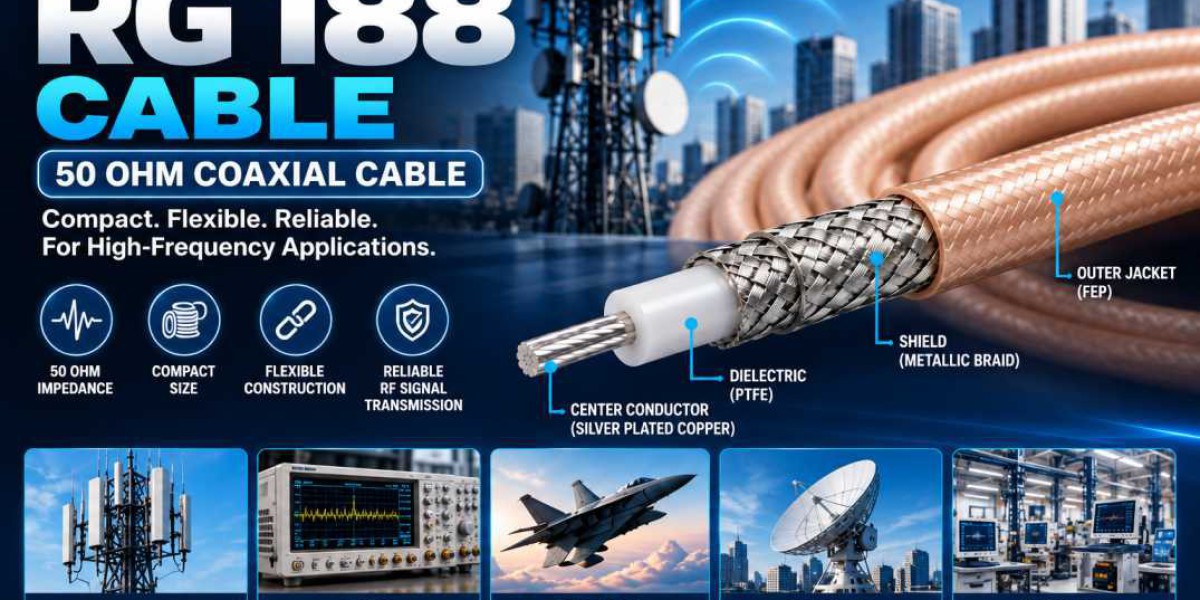

RG 188 Cable is a compact, flexible coaxial cable designed for reliable RF and high-frequency signal transmission in electronic, communication, instrumentation, and other demanding applications. Its small diameter makes it useful where installation space is limited, while its coaxial construction provides controlled impedance and shielding for dependable signal transfer.
RG 188 Cable is commonly considered for RF assemblies, wireless communication equipment, test and measurement systems, aerospace and defense electronics, instrumentation, and compact electronic devices. The actual electrical and mechanical characteristics can vary according to the manufacturer and specific cable construction, so the product datasheet should always be checked before final selection.
What Is RG 188 Cable?
RG 188 Cable is a flexible RF coaxial cable consisting of a central conductor, dielectric insulation, shielding layer, and protective outer jacket. The coaxial structure keeps the signal conductor separated from the outer shield while helping control impedance and reduce unwanted electromagnetic interference.
The compact construction of RG 188 Cable makes it suitable for equipment where conventional larger coaxial cables may be difficult to route. Its flexibility also helps simplify connections inside electronic equipment, instruments, communication systems, and RF assemblies.
RG 188 Cable Construction
The performance of an RF cable depends heavily on its internal construction. RG 188 Cable generally incorporates several functional layers.
Center Conductor
The center conductor carries the RF signal through the cable. Depending on the particular construction, conductor material and plating can vary. The conductor design influences electrical conductivity, flexibility, and termination characteristics.
Dielectric
The dielectric material surrounds the center conductor and maintains the required spacing between the conductor and shield. It also contributes to impedance control, signal propagation, and overall cable performance.
Shielding
The shielding layer surrounds the dielectric and provides the return path for the RF signal while helping protect the transmission line from external electromagnetic interference. Shield construction can vary between cable manufacturers and product versions.
Outer Jacket
The outer jacket protects the internal cable structure from mechanical damage, handling, and environmental exposure. Jacket material should be considered when the cable is intended for demanding operating conditions.
Key Specifications of RG 188 Cable
The exact specifications of RG 188 Cable depend on the manufacturer, construction, and intended application. Important parameters generally include:
Parameter | Description |
Cable Type | Flexible RF coaxial cable |
Impedance | Typically specified for RF system compatibility |
Construction | Center conductor, dielectric, shield and outer jacket |
Cable Size | Compact construction |
Flexibility | Suitable for equipment-level routing |
Shielding | Designed for RF shielding and signal integrity |
Applications | RF, telecom, instrumentation, aerospace and electronics |
Connector Options | Depends on cable assembly and application |
For production or system integration, always verify impedance, frequency range, attenuation, VSWR, temperature rating, cable diameter, minimum bend radius, and connector compatibility from the manufacturer's datasheet.
Important Electrical Characteristics
Several electrical parameters should be evaluated when selecting RG 188 Cable for an RF application.
Impedance
Impedance is one of the most important characteristics of any coaxial transmission line. The cable impedance should match the RF equipment and connectors used in the system to reduce reflections and maintain signal integrity.
Insertion Loss
Insertion loss represents the signal power lost as the RF signal travels through the cable. Cable length, operating frequency, conductor construction, dielectric characteristics, and connector assemblies can all influence total loss.
VSWR
Voltage Standing Wave Ratio indicates the degree of impedance mismatch within an RF transmission system. Lower VSWR generally indicates better matching between interconnected RF components.
Return Loss
Return loss describes the amount of RF signal reflected back toward the source because of impedance discontinuities. Good connector termination and appropriate cable selection are important for maintaining RF performance.
Features of RG 188 Cable
RG 188 Cable offers several characteristics that make it useful for compact RF applications:
Compact coaxial construction
Flexible cable design
Suitable for RF signal transmission
Shielded construction
Useful for equipment-level interconnections
Suitable for compact electronic systems
Available in cable assemblies with different RF connectors
Applicable to communication and instrumentation systems
Suitable for various RF and microwave-related applications depending on specification
Applications of RG 188 Cable
Aerospace and Defense
Compact RF cables are widely required inside electronic systems where space, weight, routing, and signal reliability are important. RG 188 Cable can be considered for suitable aerospace and defense RF assemblies when its electrical and environmental specifications meet the system requirements.
Wireless Communication
RG 188 Cable can be used for interconnections within wireless communication equipment, RF modules, radio systems, and other communication electronics.
Test and Measurement
RF test equipment requires reliable connections between instruments, components, and devices under test. RG 188 Cable assemblies can provide compact connections where flexibility and controlled RF transmission are required.
Instrumentation
Electronic instrumentation systems often contain multiple RF and signal interfaces within limited spaces. The compact construction of RG 188 Cable can simplify internal routing and equipment integration.
Industrial Electronics
RF-based industrial equipment, electronic controls, communication systems, and instrumentation may use compact coaxial cables for signal interconnections.
RF and Microwave Systems
Depending on the specific cable's rated frequency and electrical performance, RG 188 Cable may be used in RF assemblies, modules, antennas, communication equipment, and other high-frequency systems.
RG 188 Cable Assemblies
An RG 188 Cable assembly combines the cable with suitable RF connectors installed at one or both ends. Connector selection depends on the equipment interface and application requirements.
Common connector families used in RF cable assemblies can include SMA, BNC, TNC, N-Type, and other interfaces, provided that the connector is properly matched to the cable construction.
A properly manufactured assembly should provide secure mechanical termination and consistent electrical performance across the cable-to-connector transition.
Advantages of RG 188 Cable
One of the main advantages of RG 188 Cable is its compact form factor. In densely populated electronic equipment, smaller cables can simplify routing and reduce installation difficulties.
Its flexible construction can also make it useful for connections that require repeated routing or movement. Shielding helps support reliable RF transmission by reducing susceptibility to external electromagnetic interference.
The overall suitability, however, depends on the exact cable specification, operating frequency, cable length, environmental conditions, and connector assembly.
How to Select the Right RG 188 Cable
Before selecting RG 188 Cable for an RF system, evaluate the following factors:
1. Operating Frequency
Confirm that the cable supports the required frequency range and RF performance.
2. Impedance
Match the cable impedance with the equipment and other transmission-line components.
3. Cable Length
Longer cable lengths generally introduce greater attenuation, so the required length should be considered during system design.
4. Environmental Conditions
Check temperature, humidity, mechanical stress, chemical exposure, and other environmental requirements.
5. Flexibility and Bend Radius
For compact equipment, verify the cable's flexibility and recommended minimum bend radius.
6. Connector Compatibility
Ensure that the selected connector is designed for the cable's dimensions and construction. A high-quality cable with an unsuitable termination can negatively affect overall RF performance.
7. Assembly Quality
For cable assemblies, connector installation and termination quality are critical to achieving consistent electrical performance.
RG 188 Cable vs Other RF Cables
RG 188 Cable should not be selected solely because of its RG designation. Different RF cables can have significantly different attenuation, diameter, shielding, temperature capability, flexibility, and frequency performance.
For applications requiring very compact routing, flexibility may be particularly important. For long-distance RF transmission, attenuation may have greater importance. For high-temperature environments, the cable insulation and jacket materials should be carefully evaluated.
Therefore, the best cable depends on the complete system requirements rather than the cable name alone.
Conclusion
RG 188 Cable is a compact and flexible coaxial cable designed for RF signal transmission and equipment-level interconnections. Its coaxial construction provides a controlled transmission path with shielding around the signal conductor, making it suitable for various communication, instrumentation, test and measurement, aerospace, defense, and electronic applications.
When choosing RG 188 Cable, engineers should evaluate impedance, frequency range, attenuation, VSWR, shielding, flexibility, temperature rating, cable length, bend radius, and connector compatibility. For demanding RF systems, the complete cable assembly should be evaluated rather than considering the cable alone.
FAQs About RG 188 Cable
1. What is RG 188 Cable?
RG 188 Cable is a compact flexible coaxial RF cable used for signal transmission and interconnections in electronic and communication systems.
2. What are the main components of RG 188 Cable?
A typical RG 188 Cable consists of a center conductor, dielectric insulation, shielding, and protective outer jacket.
3. Where is RG 188 Cable used?
It can be used in RF equipment, wireless communication, test and measurement, instrumentation, aerospace, defense, and industrial electronics.
4. Is RG 188 Cable suitable for high-frequency applications?
It can be suitable for high-frequency RF applications when the particular cable's frequency rating and electrical specifications meet the system requirements.
5. Can RG 188 Cable be used for cable assemblies?
Yes. RG 188 Cable can be terminated with suitable RF connectors to create custom cable assemblies, subject to connector and cable compatibility.
6. What connectors can be used with RG 188 Cable?
Connector selection depends on the specific cable construction and application. SMA, BNC, TNC, N-Type, and other RF interfaces may be used where compatible.
7. What should I check before buying RG 188 Cable?
Check impedance, frequency range, attenuation, VSWR, cable diameter, flexibility, temperature rating, shielding, minimum bend radius, and connector compatibility.
8. Why is shielding important in RG 188 Cable?
Shielding helps provide the RF return path and protects the signal from external electromagnetic interference, supporting reliable signal transmission.
9. Is RG 188 Cable flexible?
RG 188 Cable is generally designed as a flexible coaxial cable, making it useful for equipment-level routing and compact installations.
10. How does cable length affect RG 188 Cable performance?
As cable length increases, signal attenuation generally increases. The required cable length should therefore be considered when designing an RF transmission system.






