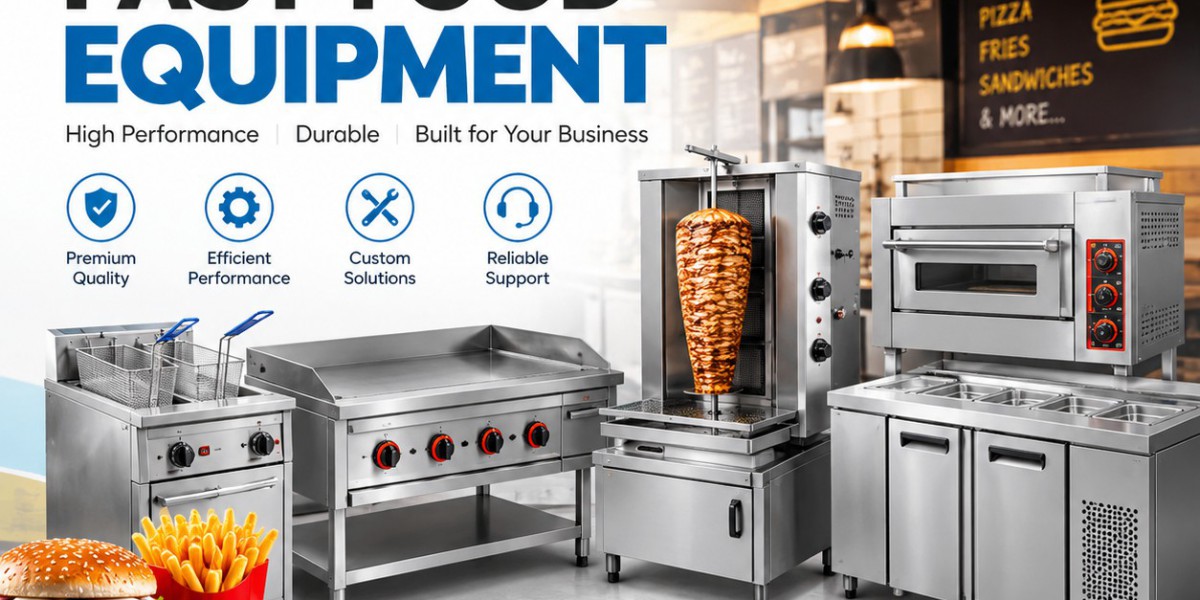

A professional Fast Food Equipment Manufacturer should therefore consider cleanability and maintenance from the design stage rather than treating them as afterthoughts. Smooth surfaces, accessible components, practical drainage, properly finished joints and easy service access can make routine maintenance more manageable.
The goal is not simply to make equipment look clean. It is to design equipment that staff can clean thoroughly, inspect easily and maintain without unnecessary downtime.
Why Easy-Clean Equipment Design Matters in a Fast-Food Kitchen
Fast-food kitchens often operate for long periods with frequent food preparation and cooking.
During normal operation, equipment can accumulate:
- Oil and grease
- Food particles
- Sauce and liquid spills
- Flour or seasoning
- Moisture
- Carbonized food residue
- Dust around external components
If equipment contains difficult-to-reach areas, unnecessary gaps or poorly finished surfaces, routine cleaning can become more complicated.
Good design helps staff reach important areas without excessive dismantling or moving heavy equipment.
How Can a Fast Food Equipment Manufacturer Design for Easier Cleaning?
There is no single feature that makes equipment easy to maintain. Instead, several design decisions work together.
1. Use Suitable Materials for the Application
Material selection is one of the first considerations.
Commercial food-service equipment often uses stainless steel because it can provide a durable, practical surface when the appropriate grade and finish are selected for the application.
A manufacturer should consider:
- Intended use
- Exposure to moisture
- Heat exposure
- Food-contact requirements
- Cleaning chemicals
- Required durability
- Surface finish
Material selection should be based on the actual operating environment rather than simply choosing material by appearance.
2. Create Smooth and Accessible Working Surfaces
Large, accessible surfaces are generally easier to clean than complicated structures containing numerous recesses.
For example, a preparation counter should ideally allow staff to wipe the working area without having to work around unnecessary obstructions.
The manufacturer should minimize design features that make routine cleaning unnecessarily difficult.
This includes considering:
- Worktop accessibility
- Equipment corners
- Underside areas
- Side panels
- Control areas
- Storage compartments
3. Pay Special Attention to Welded Joints
Welding quality has an important role in equipment cleanability.
Poorly finished welds can create:
- Rough surfaces
- Sharp projections
- Unnecessary crevices
- Difficult-to-clean areas
- Residue accumulation points
A professional manufacturer should properly finish relevant welded areas according to the equipment's application.
The objective is to create joints that are structurally appropriate while also remaining practical to clean.
4. Reduce Unnecessary Gaps and Crevices
Small gaps can become difficult cleaning points when food particles or grease enter them.
During design, manufacturers should review:
- Panel joints
- Counter edges
- Corners
- Mounting areas
- Equipment bases
- Internal compartments
Where a gap is necessary for construction, service or movement, it should be designed appropriately rather than creating inaccessible spaces without a functional purpose.
5. Design Equipment With Accessible Components
Some equipment requires regular cleaning of internal or removable components.
If staff cannot easily reach these areas, cleaning may be skipped or performed inadequately.
Depending on the equipment, manufacturers can consider:
- Removable trays
- Accessible filters
- Removable guards where appropriate
- Service panels
- Easy-access compartments
- Detachable food-contact components
However, removable components should be designed securely so they remain stable during normal operation.
6. Make Drainage Part of the Design
Water and liquid management should be considered during equipment design.
Equipment involving washing, rinsing, condensation or liquid waste may require appropriate drainage arrangements.
A good drainage design should consider:
- Drain location
- Flow direction
- Accessibility
- Connection points
- Cleaning access
- Prevention of unnecessary water accumulation
Poor drainage can leave moisture in areas that are difficult to inspect and clean.
7. Design Equipment Bases for Practical Cleaning
The bottom of equipment is often overlooked.
Grease, dust and food particles can collect around equipment bases, especially in busy kitchens.
Depending on the application, a manufacturer may consider:
- Suitable leg height
- Adjustable feet
- Castors where appropriate
- Accessible base areas
- Easy-to-clean plinth arrangements
The correct approach depends on the equipment and kitchen layout.
The goal is to ensure that cleaning staff can access the surrounding floor and equipment base without creating unnecessary obstacles.
8. Keep Controls Protected but Accessible
Control panels need a balance between accessibility and protection.
Controls should be positioned so operators can use them easily, while the design should help reduce unnecessary exposure to:
- Water
- Grease
- Food particles
- Cleaning chemicals
Buttons, switches, knobs and displays should also be positioned so that staff can clean around them without difficulty.
The exact protection required depends on the equipment and electrical design.
9. Design for Easy Grease Management
Grease is one of the major maintenance challenges in many fast-food cooking environments.
Equipment that handles frying, grilling or high-fat cooking should therefore consider grease management during design.
Depending on the equipment, this may involve:
- Grease collection areas
- Removable trays
- Accessible surfaces
- Suitable drainage
- Filters
- Easy-access cleaning points
Grease should be directed toward areas that staff can safely access and clean rather than allowing it to accumulate in hidden locations.
10. Make Frequently Cleaned Parts Easy to Remove
Not every component needs to be permanently fixed.
Parts that require frequent cleaning may benefit from being removable where appropriate.
For example:
Fixed structure → Removable tray → Cleaning → Inspection → Reinstallation
This can make daily cleaning more practical.
However, removable components should have a clear and secure installation method. A part that is easy to remove but difficult to reinstall correctly does not necessarily improve the overall workflow.
11. Provide Adequate Service Access
Cleaning and maintenance are related, but they are not the same.
Daily cleaning may involve wiping surfaces and removing food residue.
Maintenance may require access to:
- Motors
- Heating elements
- Electrical components
- Controls
- Gas-related components
- Bearings
- Pumps
- Filters
A manufacturer should therefore consider service access while designing the equipment.
A technician should not have to dismantle unrelated equipment simply to reach a service component.
12. Design Equipment Around Daily Cleaning Routines
A useful question for a manufacturer is:
“What will the operator need to clean every day?”
This helps distinguish between frequently cleaned components and areas that require periodic servicing.
A practical maintenance design can separate:
Daily tasks
- Wiping work surfaces
- Removing food residue
- Emptying collection trays
- Cleaning accessible components
- Checking visible grease accumulation
Periodic tasks
- Deep cleaning
- Filter inspection
- Component inspection
- Lubrication where required
- Electrical checks
- Burner or heating-system inspection where applicable
The exact maintenance schedule should always follow the equipment manufacturer's instructions.
How a Fast Food Equipment Manufacturer Can Design for Faster Cleaning
Cleaning itself becomes part of kitchen workflow.
If an employee has to move equipment, search for tools or completely dismantle a unit for routine cleaning, the process becomes unnecessarily time-consuming.
Manufacturers can support better workflow by placing frequently cleaned components where they are easy to access.
For example, a food collection tray positioned directly below the relevant working area may be easier to remove and clean than one located behind another component.
The principle is simple:
The more frequently a component needs attention, the easier it should be to access.
Why Equipment Geometry Matters
The shape of equipment can affect cleanability.
Simple, practical geometry can make it easier to wipe surfaces and inspect corners.
Designers should consider:
- Internal corners
- External corners
- Sloped surfaces where appropriate
- Panel transitions
- Worktop edges
- Equipment joints
- Drainage points
The objective is not to eliminate every corner. It is to avoid unnecessary design complexity that creates avoidable maintenance challenges.
Cleaning-Friendly Design for Different Types of Fast Food Equipment
Different equipment categories require different approaches.
Fryers
Important considerations may include:
- Oil-drain access
- Removable baskets
- Accessible surfaces
- Filter access where applicable
- Grease management
- Safe cleaning access
Griddles
The design should allow practical access to:
- Cooking surface
- Grease trough
- Grease collection area
- Control section
- Surrounding surfaces
Preparation Counters
Important features may include:
- Smooth work surfaces
- Accessible storage
- Properly finished corners
- Easy-to-clean shelves
- Practical underside access
Ovens
Depending on the design, inspection may focus on:
- Door surfaces
- Internal cavity
- Trays or racks
- Seals
- Ventilation areas
- Service access
Stainless-Steel Worktables
These should provide:
- Smooth worktops
- Properly finished edges
- Stable legs
- Accessible undersides
- Easy-to-clean joints
The appropriate design depends on the equipment's specific function.
Easy Cleaning Does Not Mean Ignoring Safety
A component should never be made removable simply for cleaning convenience if doing so creates an operational or safety problem.
Manufacturers should balance:
Cleanability + Durability + Safety + Functionality
For example, hot surfaces, electrical components and gas-related systems require appropriate safeguards.
Cleaning instructions should also clearly explain which parts can be removed by kitchen staff and which should only be accessed by qualified service personnel.
Common Design Mistakes That Make Equipment Hard to Maintain
1. Too Many Unnecessary Joints
Complex fabrication can create additional areas where grease and food residue accumulate.
2. Poorly Finished Welds
Rough or poorly finished joints can make cleaning more difficult.
3. Inaccessible Filters
If filters require excessive dismantling to remove, routine inspection may become inconvenient.
4. Poor Drainage
Water that cannot drain properly can create unnecessary cleaning and maintenance problems.
5. Blocked Service Panels
Equipment should not be installed in a configuration that makes essential service areas inaccessible.
6. Ignoring the Underside
The area underneath equipment is frequently exposed to dust, grease and food debris and should be considered during design.
What Should Buyers Ask Fast Food Equipment Suppliers?
When comparing Fast Food Equipment Suppliers, buyers should ask questions specifically about maintenance rather than focusing only on equipment dimensions and price.
Useful questions include:
- Which components need daily cleaning?
- Which parts are removable?
- How are grease and liquid waste managed?
- How can internal areas be accessed?
- Which components require periodic maintenance?
- Where are service panels located?
- Can the equipment be cleaned without moving it?
- Which parts should only be serviced by qualified technicians?
- What cleaning methods are recommended?
- Are replacement components available?
These questions can reveal whether maintenance has genuinely been considered during equipment design.
Why Maintenance Access Should Be Planned Before Installation
A common mistake is to finalize the kitchen layout based only on the equipment footprint.
The equipment may physically fit, but there may not be enough space to:
- Open service panels
- Remove filters
- Access electrical components
- Clean behind the unit
- Perform repairs
- Move removable parts
Therefore, manufacturers, kitchen designers and buyers should consider operational clearance and service access, not just overall equipment dimensions.
Fast Food Equipment Manufacturer in India: Practical Design Considerations
A Fast Food Equipment Manufacturer in India may design equipment for different types of commercial kitchens, from compact outlets to larger QSR operations.
Each project can have different requirements related to:
- Kitchen size
- Menu
- Production volume
- Available utilities
- Staff workflow
- Cleaning practices
- Equipment placement
- Ventilation
- Storage
For this reason, maintenance-friendly equipment should be designed around the actual application instead of relying on a one-size-fits-all configuration.
How to Evaluate Maintenance-Friendly Equipment Before Buying
Before placing an order, buyers can perform a simple practical review.
Ask yourself:
Can I reach the surfaces that need daily cleaning?
If not, the design may require reconsideration.
Can frequently removed components be handled easily?
They should be accessible without unnecessary dismantling.
Can a technician reach service components?
Service access should be considered before installation.
Are grease and liquids directed toward manageable collection points?
Poor waste management can increase cleaning difficulty.
Does the equipment create unnecessary gaps?
Review corners, joints, bases and surrounding areas.
Is the cleaning process documented?
Clear instructions help staff understand what should be cleaned and how often.
A Practical Cleaning and Maintenance Design Checklist
Before approving commercial kitchen equipment, check:
- Suitable material selected for the application
- Smooth and accessible working surfaces
- Welds properly finished
- Unnecessary gaps minimized
- Corners are practical to clean
- Removable components are easy to access
- Drainage has been considered
- Grease collection is practical
- Controls are accessible and appropriately protected
- Equipment base can be cleaned
- Service panels are accessible
- Filters can be inspected or removed where applicable
- Daily cleaning tasks are clearly understood
- Periodic maintenance requirements are documented
- Safety has not been compromised for convenience
FAQs
Why should a Fast Food Equipment Manufacturer focus on easy cleaning?
Easy-clean design can make routine kitchen maintenance more practical and help staff access areas that require regular attention.
What makes stainless-steel equipment easier to clean?
Appropriate material selection, smooth surfaces, properly finished joints and practical equipment geometry can contribute to easier cleaning.
Should commercial kitchen equipment have removable parts?
Components that require frequent cleaning may benefit from being removable, provided they can be safely removed and securely reinstalled.
How does equipment design affect maintenance?
Equipment design determines how easily operators and service personnel can access surfaces, filters, controls, internal components and other areas requiring inspection or cleaning.
What should I ask Fast Food Equipment Suppliers about maintenance?
Ask about daily cleaning procedures, removable parts, service access, grease management, replacement components and recommended maintenance intervals.
Conclusion
A good Fast Food Equipment Manufacturer does not design equipment only for cooking or food preparation. The equipment should also be practical to clean, inspect and maintain throughout its working life.
The strongest approach is to consider maintenance from the beginning: select suitable materials, finish welded joints properly, minimize unnecessary gaps, provide accessible cleaning points, manage grease and liquids effectively, and maintain adequate service access.
For restaurant owners, the important lesson is to evaluate equipment based on how it will be cleaned and maintained every day, not just how it looks when it is new.
When cleanability, maintenance, safety and functionality are considered together, fast-food equipment can become easier for staff to operate and more practical to manage in a demanding commercial kitchen.