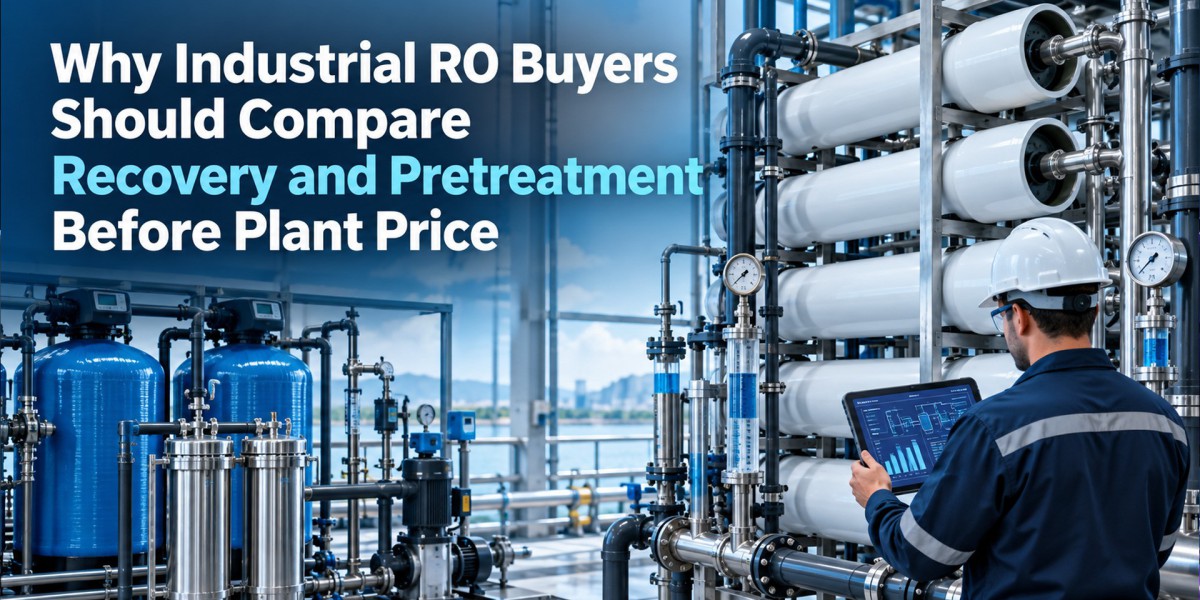

Two RO Plants With the Same Capacity Can Be Completely Different Systems
Industrial RO quotations can be deceptively easy to compare.
Supplier A offers the required cubic metres per day at one price. Supplier B offers the same output at a lower price. Supplier C claims higher recovery.
At first glance, the lowest-cost plant or highest recovery appears to be the obvious choice.
But capacity alone says very little about how the RO system has been designed.
For buyers sourcing an Industrial RO Plant Saudi Arabia project, pretreatment and recovery can influence membrane reliability, reject-water volume, chemical use, operating pressure and lifecycle cost long after the purchase order has been issued.
Begin by Making Sure Every Supplier Uses the Same Feed-Water Analysis
A fair comparison requires a common technical basis.
If one supplier designs around moderate hardness while another assumes much higher scaling potential, their pretreatment and recovery calculations can be very different.
Every bidder should therefore receive the same recent water-quality information wherever possible.
Feed-Water Chemistry Determines More Than Membrane Type
The analysis can influence:
pretreatment;
antiscalant strategy;
membrane configuration;
operating pressure;
recovery;
and cleaning frequency.
This means water analysis is part of commercial procurement, not simply a laboratory exercise.
Why Pretreatment Deserves More Attention
The RO membrane receives most of the attention because it performs the main dissolved-solids separation.
Yet many membrane problems begin upstream.
If suspended solids, hardness, chlorine or other problematic conditions are not controlled appropriately, the membranes may foul, scale or become damaged.
A cheaper RO skid with inadequate pretreatment can therefore become an expensive plant to operate.
Pretreatment Should Match the Actual Feed Water
Depending on water conditions, a plant may use multimedia filtration, softening, activated carbon, cartridge filtration, ultrafiltration or chemical conditioning.
Not every plant needs every stage.
A useful proposal should explain what each pretreatment component is intended to control.
More Pretreatment Is Not Automatically Better Either
An unnecessarily complicated pretreatment system increases equipment cost, consumables and maintenance.
The goal is not to build the longest treatment train.
It is to provide the membrane with feed water that supports stable operation.
Recovery Is Often Misunderstood During Procurement
Recovery describes the proportion of feed water converted into product water.
A higher percentage can reduce reject volume, which sounds commercially attractive.
But the rejected salts remain in the concentrate stream.
As recovery increases, those salts become more concentrated.
This can increase scaling risk depending on feed-water chemistry.
Do Not Choose the Highest Recovery Without Asking How It Was Calculated
A supplier proposing a high recovery should be able to explain:
the feed-water chemistry used;
scaling limits considered;
pretreatment assumed;
antiscalant programme;
membrane configuration;
and expected concentrate conditions.
If the number cannot be explained technically, it should not become a major purchasing advantage.
Lower Recovery Can Sometimes Produce Better Lifecycle Performance
A slightly lower recovery may create more reject water, but if it allows the membrane plant to operate with less scaling, lower cleaning frequency and more stable pressure, the complete economics can still be favourable.
Procurement teams should compare water recovery with membrane reliability rather than viewing them as separate topics.
Reject-Water Cost Should Be Quantified
A low-recovery plant can require more feed water and create more reject.
A high-recovery plant may need stronger pretreatment or more careful chemistry control.
Buyers should therefore calculate the practical effect of both options rather than assuming one is universally better.
Energy Consumption Changes the Commercial Comparison
RO plants use pressure to move water through membranes.
Operating pressure, pump efficiency, membrane condition and pressure losses all influence electrical consumption.
A lower equipment price can lose its advantage if the plant requires significantly higher energy over years of operation.
Blocked Pretreatment Can Increase Energy Use Too
Filters and membrane stages create pressure losses.
When pretreatment becomes fouled or poorly maintained, pressure drop can increase and the high-pressure pump may need to work harder.
Maintenance quality therefore affects energy consumption as well as water quality.
Membrane Cleaning Frequency Should Be Discussed
Suppliers cannot predict every future operating event, but the design philosophy should aim for stable membrane performance.
If an aggressive recovery target is likely to require frequent cleaning, the buyer should understand that maintenance burden before purchase.
Plant Capacity Should Still Be Based on Real Demand
Recovery and pretreatment matter, but the RO plant also needs to match the facility's actual water consumption.
Daily demand, hourly peaks, operating hours and storage all influence the required plant capacity.
A plant operating 20 hours per day may need a very different nominal capacity from one expected to produce the same daily volume in eight hours.
Storage Can Reduce Pressure to Oversize the RO Plant
Where treated water can be stored, the RO plant may operate steadily while the facility consumes water unevenly.
This can reduce the need to purchase a significantly larger system purely to meet short peak-demand periods.
Compare Instrumentation and Controls
Price differences may also reflect what the plant allows operators to monitor.
Useful information can include feed flow, permeate flow, reject flow, pressure, differential pressure, conductivity and tank levels.
Without adequate instrumentation, operators may find it harder to identify developing pretreatment or membrane problems.
Consumables Can Change the Long-Term Cost
Buyers should estimate requirements for filters, membranes, antiscalant, cleaning chemicals and other routine consumables.
A low purchase price means less if the plant consumes more chemicals or replaces filters much more frequently.
Maintenance Access Is Also Part of the Purchase
Filters and membrane elements need replacement.
Pumps need servicing.
Dosing systems and instruments need attention.
Equipment should therefore be arranged so these tasks can be completed without excessive dismantling or downtime.
Create a Like-for-Like Commercial Comparison
Instead of comparing only plant capacity and total price, procurement teams should review:
Feed-Water Basis + Pretreatment + Product Quality + Capacity + Recovery + Membranes + Pumps + Operating Pressure + Controls + Instrumentation + Reject Water + Consumables + Commissioning
Once these items are aligned, the final price comparison becomes far more meaningful.
Ask What Is Excluded From the Quotation
A cheaper plant may exclude raw-water tanks, pretreatment, product storage, installation, dosing systems, instrumentation or commissioning.
Buyers should therefore compare scope rather than relying on the final quotation total.
Purchase the RO System, Not Just the Membrane Rack
Businesses evaluating industrial RO plants in Saudi Arabia should compare the entire treatment train and its operating assumptions before allowing price to decide the project.
A properly engineered pretreatment system and realistic recovery target can be more valuable over the plant's operating life than a small saving in initial purchase cost.
Final Thoughts
The cheapest industrial RO plant is not necessarily the lowest-cost plant to own.
And the highest recovery is not necessarily the most reliable way to produce water.
Compare the water chemistry, pretreatment, recovery and lifecycle requirements first. Then compare the price of systems that are genuinely designed to do the same job.






