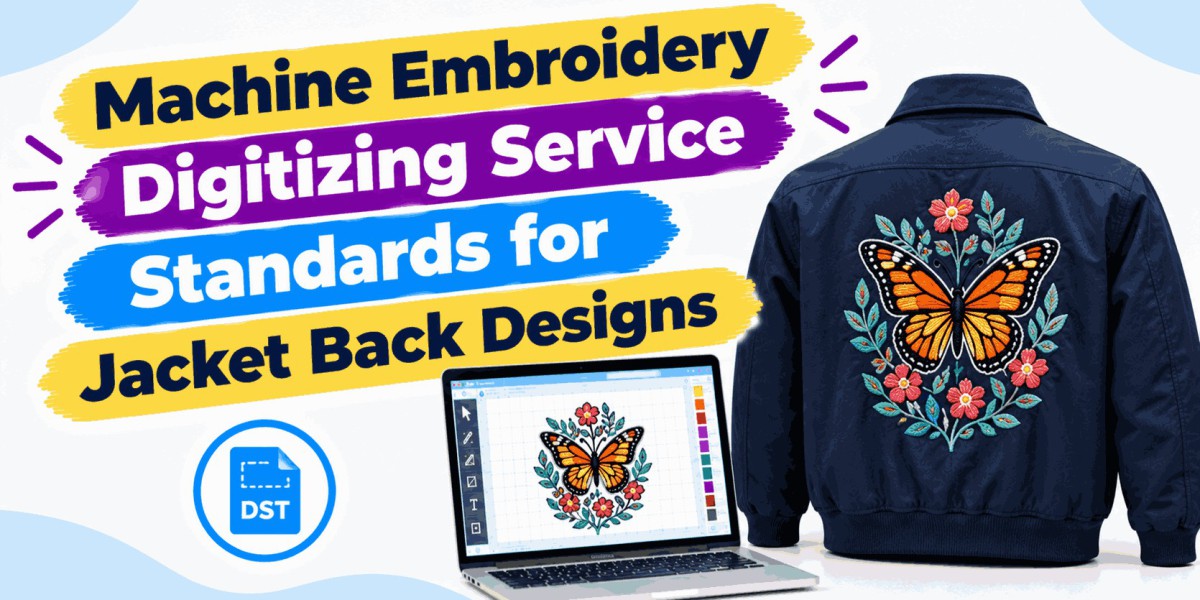

Jacket-back embroidery is one of the most eye-catching forms of machine embroidery. Large back designs can turn a plain jacket into a strong promotional piece, team uniform, fashion statement, or branded garment. However, the size and complexity of jacket-back artwork also create technical challenges that are very different from those involved in small left-chest logos or simple cap designs.
A professional machine embroidery digitizing service must account for the size of the design, fabric characteristics, stitch density, sequencing, registration, thread behavior, and production limitations. Large embroidery files require careful planning because mistakes can become more visible as the design grows.
For businesses that regularly produce embroidered jackets, following clear digitizing standards can improve consistency, reduce production problems, and help ensure that large back designs look professional. Choosing an experienced digitizing provider is therefore an important part of maintaining embroidery quality.
Why Jacket Back Digitizing Requires Higher Standards
A jacket-back design may cover a large portion of the garment. Because of its size, small digitizing problems can become obvious when the design is stitched.
Large designs can experience issues such as:
Excessive stitch density
Fabric distortion
Uneven registration
Poor sequencing
Thread buildup
Weak small details
Excessive stitch counts
Unbalanced stitch directions
Poor edge definition
A professional digitizing service should not simply enlarge artwork and convert it into stitches. The design needs to be rebuilt with embroidery production in mind.
Large Design Areas Need Better Planning
A jacket-back design may include multiple objects, lettering, borders, shading, outlines, and decorative elements. These components need to work together as a single embroidery file.
Poor planning can result in unnecessary jumps, excessive trims, uneven coverage, and longer production times.
Jacket Fabric Behaves Differently
Jackets can be made from denim, nylon, polyester, canvas, twill, leather-like materials, fleece, and other fabrics. Each material can react differently to needle penetration and stitch tension.
A professional digitizer should consider the fabric when planning the design rather than using exactly the same settings for every jacket.
Establishing a Standard for Artwork Preparation
High-quality jacket-back digitizing begins with suitable artwork.
Original vector artwork is often helpful because it provides clean shapes and edges. However, businesses frequently submit logos as raster images, screenshots, photographs, scans, or low-resolution graphics.
A professional service should be able to interpret the artwork and prepare it for embroidery.
Remove Unnecessary Complexity
Printed artwork can contain effects that do not translate directly into embroidery.
Gradients, tiny shadows, extremely fine lines, and subtle color changes may need to be simplified or recreated using suitable embroidery techniques.
The purpose is not to reproduce every visual detail literally. The goal is to produce a stitched version that communicates the same design effectively.
Preserve Important Brand Elements
While simplification may be necessary, important brand characteristics should remain recognizable.
This includes:
Primary logo shapes
Brand lettering
Important symbols
Main colors
Borders
Distinctive visual features
Professional digitizing balances simplification with brand accuracy.
Standard Jacket-Back Design Dimensions
One of the first technical decisions is determining the appropriate embroidery size.
There is no single size that works for every jacket. Available space varies according to garment style, wearer size, placement, and design proportions.
A professional digitizing service should consider the intended jacket and application before finalizing dimensions.
Avoiding Oversized Designs
Making the design as large as possible does not always create a better result.
An oversized design can:
Increase stitch count
Add unnecessary weight
Increase production time
Create more fabric distortion
Make the garment less comfortable
Become difficult to hoop and stabilize
The best size is generally one that provides strong visual impact without creating unnecessary production problems.
Maintaining Design Proportion
When resizing artwork, proportions should remain consistent.
Stretching a logo horizontally or vertically can make the finished embroidery look unprofessional. A digitizer should preserve the intended relationship between design elements.
Managing Stitch Density in Large Designs
Stitch density is one of the most important standards for jacket-back embroidery.
A large design does not automatically need more stitches everywhere. Excessive density can lead to thread buildup and fabric distortion, while insufficient density can produce weak coverage.
Balance Coverage and Production Efficiency
Professional digitizing should create enough stitches to achieve clean coverage without placing unnecessary stitches into areas where they provide little visual benefit.
Density decisions should take into account:
Fabric type
Thread thickness
Design size
Stitch type
Underlay
Object shape
Embroidery direction
Avoiding Heavy Areas
Large filled sections can accumulate significant numbers of stitches.
Instead of filling every area with maximum density, a skilled digitizer can use appropriate stitch spacing, direction, and construction to maintain visual coverage while controlling unnecessary bulk.
Underlay Standards for Jacket Back Embroidery
Underlay forms the foundation for visible embroidery.
It can help stabilize the fabric, prepare the embroidery area, and improve the appearance of the top stitches.
However, adding excessive underlay can make a large jacket-back design unnecessarily thick.
Selecting Suitable Underlay
Underlay should be selected based on the design and fabric rather than applied identically to every object.
Different elements may benefit from different foundation structures.
Edge Support
Some embroidery objects need additional support near edges to help the top stitches maintain a clean shape.
Center Support
Larger filled areas may require a suitable foundation to prevent the visible stitches from sinking unevenly into the fabric.
The objective is to build a stable embroidery foundation without creating excessive thread accumulation.
Push and Pull Compensation
Large embroidery designs can change shape during stitching because thread tension pulls the fabric and neighboring objects in different directions.
Push and pull compensation helps account for these expected changes.
Why Compensation Matters on Large Designs
Without appropriate compensation, a design may show:
Gaps
Misaligned borders
Narrowed shapes
Uneven lettering
Open spaces
Distorted edges
A professional machine embroidery digitizing service should anticipate these effects during file construction rather than attempting to correct them after production.
Sequencing Standards for Jacket Back Designs
Stitch sequence influences both embroidery quality and production efficiency.
Objects should generally be arranged so that unnecessary movement, excessive trims, and avoidable jumps are minimized while maintaining proper registration.
Building the Design in Logical Layers
Large artwork can contain background elements, lettering, borders, fills, and finishing details.
A logical sequence helps prevent later elements from disturbing earlier ones.
Proper sequencing may also help control registration between overlapping objects.
Reducing Unnecessary Machine Movement
An inefficient file can contain excessive travel between distant design sections.
Better sequencing can shorten production time and reduce unnecessary machine movement.
Satin Stitch Standards
Satin stitches are frequently used for borders, lettering, outlines, and narrow columns.
They can provide a clean and professional appearance when properly digitized.
Managing Satin Width
Very wide satin columns can create long stitches that may not perform reliably. Extremely narrow columns may not provide sufficient coverage.
A professional digitizer should adjust satin construction according to the intended size and application.
Maintaining Clean Edges
Jacket-back lettering and borders often depend on sharp satin edges.
Careful stitch placement can help produce cleaner outlines and stronger visual definition.
Tatami and Fill Stitch Standards
Large jacket-back designs frequently include filled areas.
Fill stitches can cover broad shapes efficiently, but they require thoughtful planning.
Adjusting Stitch Direction
Changing stitch direction between objects can create visual separation and add structure to the design.
It can also influence how the design behaves physically after stitching.
Avoiding Repetitive Fill Patterns
Large areas can become visually flat when every object uses identical stitch direction.
A professional digitizer can use direction changes strategically to improve both appearance and structure.
Lettering Standards for Jacket Backs
Many jacket-back designs feature large names, team lettering, company names, or slogans.
Lettering requires special attention because the readability of text is often one of the most important aspects of the design.
Use Appropriate Letter Construction
Large embroidered letters may require a different construction than small text.
The digitizer should select stitch types and spacing that preserve clarity.
Avoid Excessive Compression
Letters that are too tightly packed can lose definition.
Spacing should allow each character to remain visually distinct after stitching.
Check the Final Text Carefully
Spelling errors are especially costly on large jacket-back designs because an entire production run may need to be corrected.
Text should be verified before the file is finalized.
Color Management Standards
Large jacket-back designs often use multiple thread colors.
Without proper organization, color changes can increase production time and create confusion.
Limit Unnecessary Color Changes
Similar shades may sometimes be consolidated when doing so does not negatively affect the artwork.
Reducing unnecessary thread changes can improve production efficiency.
Follow Brand Color Requirements
When embroidery is used for corporate or fashion branding, color consistency is important.
A professional digitizer should understand the importance of maintaining the intended visual identity.
Registration Standards
Registration refers to how accurately different embroidery elements align with each other.
Large designs can be especially sensitive to registration because small shifts become easier to see.
Overlapping Objects
Where one object meets or overlaps another, the stitch structure should be designed to minimize visible gaps.
Border Alignment
Borders should remain visually consistent around the shapes they surround.
Poor registration can make borders appear uneven or separated from the underlying design.
Backing and Stabilization Considerations
A well-digitized design still depends on proper garment preparation.
Jacket type, backing, hooping, and stabilization can influence the final result.
Why Stabilization Matters
Large designs place more stress on the garment than small logos.
Suitable stabilization can help reduce:
Fabric shifting
Puckering
Distortion
Registration problems
Uneven embroidery
The digitizer and production team should consider these factors together.
Hooping Standards for Large Back Designs
Hooping a jacket-back design can be more complicated than hooping a small logo.
The jacket needs to be positioned correctly so the design sits where intended.
Maintain Accurate Placement
Before production, the operator should verify the horizontal and vertical position of the design.
A visually perfect digitizing file can still produce a poor result if the design is placed incorrectly on the garment.
Avoid Fabric Tension Problems
The material should be stabilized without excessive stretching.
Improper hoop tension can contribute to distortion after the garment is released.
File Format and Delivery Standards
A professional machine embroidery digitizing service should deliver the file in a format compatible with the intended production machine.
Depending on the equipment, businesses may use formats such as DST, PES, EXP, JEF, and others.
Use Clear File Names
Large embroidery projects benefit from organized naming.
A file name could include:
Brand-Design-JacketBack-Size-Revision
For example:
TeamLogo-JacketBack-10in-V2
This makes production management easier.
Include a Preview When Possible
A digital preview provides a quick visual reference for the operator and customer.
It can make it easier to verify:
Artwork appearance
Thread colors
Text
Design orientation
Overall proportions
Quality Control Standards Before Delivery
Large jacket-back files should be reviewed before being sent into production.
Quality control can identify errors that might otherwise become expensive after embroidery begins.
Artwork Review
Check that the final file matches the approved design.
Technical Review
Review stitch count, sequencing, density, underlay, trims, jumps, and other construction details.
Production Review
Consider whether the file is realistic for the intended jacket fabric and embroidery application.
A complete review is one of the most important standards a professional digitizing provider can maintain.
Test Stitching Large Designs
A screen preview cannot show every production behavior.
For important jacket-back designs, especially complex or high-volume projects, a test stitch can provide valuable information.
What a Test Stitch Can Reveal
Testing may reveal:
Fabric distortion
Unclear lettering
Registration issues
Dense areas
Weak details
Color problems
Placement concerns
Adjustments can then be made before the full production run.
Standards for High-Volume Jacket Production
Businesses producing large quantities of jackets need consistency as much as quality.
A professional digitizing partner should help maintain the same design appearance across repeat orders.
Keep Approved Versions Organized
Once a jacket-back design has been approved, the final production version should be clearly identified and stored.
This reduces the possibility of accidentally using an older file.
Maintain Consistent Specifications
Repeated orders should ideally use the same approved dimensions, construction, colors, and file standards unless a deliberate change is requested.
How to Choose a Professional Jacket-Back Digitizing Service
The best provider should understand both embroidery design and production realities.
When evaluating a service, consider:
Jacket-back digitizing experience
Large-format embroidery knowledge
Stitch quality
File compatibility
Revision support
Turnaround reliability
Communication
Quality-control practices
Ability to handle complex artwork
Understanding of different fabrics
Test Before Committing to Large Orders
A sample design can provide useful evidence of a digitizer's quality.
Instead of judging a company entirely by its website or price, test its ability with an actual design that represents your regular work.
Common Mistakes in Jacket Back Digitizing
Understanding common problems can help businesses avoid them.
Using Automatically Converted Artwork
Automatic conversion may create excessive stitches, poor sequencing, and inefficient embroidery.
Using Excessive Density
Too many stitches can create bulk and distort the jacket.
Ignoring Fabric Characteristics
Different jacket materials may require different digitizing approaches.
Making Every Detail Too Small
Some printed details are not suitable for direct embroidery reproduction.
Skipping a Production Test
Large designs should not always go directly from the computer to full production.
Failing to Control Versions
Using an outdated file can cause incorrect embroidery across an entire production batch.
Why Professional Standards Improve Business Results
Standardized digitizing practices help businesses produce more predictable embroidery.
When artwork preparation, sizing, stitch density, sequencing, file delivery, and quality control follow a consistent process, production becomes easier to manage.
This is especially important for:
Apparel brands
Embroidery shops
Sports teams
Promotional product companies
Fashion businesses
Uniform suppliers
Custom jacket manufacturers
Consistency builds customer confidence because buyers expect the same level of quality from one order to the next.
About Digitizings
Digitizings provides professional embroidery digitizing services for businesses that need reliable, production-focused embroidery files. Its services can support custom logos, jacket-back designs, cap embroidery, 3D puff, patches, appliqué, lettering, monograms, and other embroidery applications.
For large jacket-back artwork, professional digitizing is particularly important because the design has to balance visual impact with practical stitch construction. Careful attention to density, sequencing, compensation, sizing, lettering, and fabric requirements can help create embroidery that looks polished without unnecessary production problems.
For businesses managing repeat orders or larger embroidery projects, working with a dependable digitizing partner can also make file organization, revisions, and production consistency easier to manage.
Conclusion
Machine embroidery digitizing for jacket-back designs requires a higher level of planning than many smaller embroidery applications. Large artwork magnifies both quality and mistakes, making technical standards especially important.
A professional machine embroidery digitizing service should consider artwork preparation, design dimensions, stitch density, underlay, compensation, sequencing, lettering, colors, registration, stabilization, file delivery, and quality control before a jacket-back design reaches production.
The best results come from treating the embroidery file as a production tool rather than a simple digital conversion. When the design is built specifically for the garment and embroidery process, businesses can achieve cleaner stitching, better consistency, more efficient production, and stronger finished products.
For jacket manufacturers, embroidery shops, apparel brands, and promotional businesses, establishing reliable digitizing standards can make large embroidery projects easier to produce and easier to scale.
FAQs
1. Why are jacket-back designs more difficult to digitize?
Jacket-back designs are usually larger and contain more embroidery elements than small logos. Their size increases the importance of stitch density, sequencing, registration, stabilization, and fabric behavior.
2. What stitch types are commonly used for jacket-back embroidery?
Jacket-back designs may use satin stitches, tatami or fill stitches, running stitches, specialty constructions, and combinations of different stitch types depending on the artwork.
3. How important is stitch density for large jacket designs?
Stitch density is extremely important. Excessive density can create bulk and distortion, while insufficient density can produce weak coverage and poor visual definition.
4. Should a jacket-back embroidery file be test stitched?
For complex, valuable, or high-volume projects, test stitching is strongly recommended. It can reveal issues involving fabric behavior, density, lettering, registration, and overall appearance.
5. What should I look for in a professional jacket-back digitizing service?
Look for experience with large embroidery designs, strong stitch planning, appropriate file formats, reliable revisions, quality control, good communication, and an understanding of different jacket materials and production requirements.