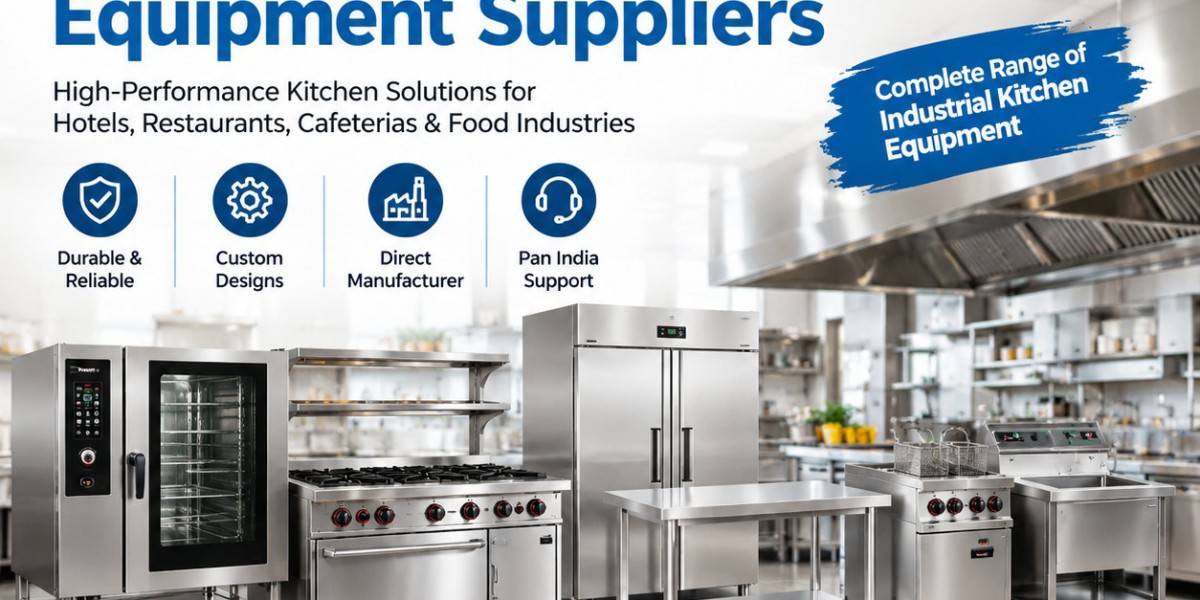

Before purchasing Industrial Kitchen Equipment, buyers should therefore evaluate the equipment against actual production requirements, available space, menu processes, utility conditions, operator movement, cleaning requirements, and future expansion plans. A well-planned selection can improve production consistency while making daily operations easier to manage.
Understand the Production Requirement Before Selecting Equipment
The first consideration should be the actual production requirement of the kitchen. Buyers should understand how much food is produced per batch, how many batches are required per day, what the peak production period looks like, and which menu items require the greatest processing capacity.
Equipment capacity should not be selected only according to the average daily volume. Peak-hour requirements are often more important because bottlenecks generally become visible when the kitchen is operating at maximum load.
For example, if preparation capacity is high but cooking equipment can process only a small batch at a time, prepared ingredients may accumulate and employees may have to wait. Similarly, excessive cooking capacity with inadequate preparation space does not necessarily improve total production.
The objective should be to create a balanced production system rather than maximising the capacity of individual machines.
Evaluate the Complete Kitchen Workflow
A large kitchen normally follows a sequence such as receiving, storage, preparation, cooking, holding or serving, dishwashing, and waste handling. Equipment should support this movement rather than interrupt it.
Before finalising the layout, buyers should consider:
- Where raw materials enter the kitchen
- How ingredients move from storage to preparation
- Where preparation activities take place
- How prepared ingredients reach cooking stations
- Where cooked food is transferred
- How utensils and equipment reach the washing area
- How waste moves out without interfering with food production
Poorly planned movement can increase employee walking distance, handling time, cross-traffic, and the possibility of workflow conflicts.
Check Equipment Capacity Against Actual Batch Sizes
Capacity should be evaluated in relation to the food process, not just the equipment's advertised dimensions.
A buyer should examine factors such as batch size, processing time, frequency of use, recovery time, loading requirements, unloading procedures, and expected peak demand.
For instance, two pieces of equipment may have similar nominal capacities but perform differently when used continuously. One may suit batch production while another may be more appropriate for repeated high-frequency processing.
This is why equipment selection should be based on the kitchen's production pattern rather than on capacity figures alone.
Consider the Menu and Cooking Process
The menu has a direct impact on equipment requirements. A facility producing gravies, fried foods, baked products, prepared meals, or bulk institutional food may require completely different equipment combinations.
Buyers should map major menu processes before purchasing equipment. This helps identify which activities are performed repeatedly and which machines are critical to production.
A useful approach is to divide the menu into preparation, cooking, holding, cooling, storage, and cleaning requirements. Equipment can then be selected around these processes instead of purchasing unrelated machines first and attempting to fit them into the kitchen later.
Examine Construction Material and Fabrication Quality
Equipment used in an industrial kitchen is exposed to heat, moisture, food residues, cleaning chemicals, frequent washing, and continuous handling. Construction quality therefore matters for both operational life and hygiene.
Buyers should examine the quality of stainless steel used, fabrication finish, weld quality, surface accessibility, joints, corners, doors, handles, shelves, legs, and other areas that are regularly exposed to cleaning and moisture.
Smooth and accessible surfaces are easier to maintain than complicated designs containing difficult-to-reach areas where food residues or moisture can accumulate.
The focus should not be on appearance alone. The construction should be suitable for the working conditions in which the equipment will actually be used.
Check Utility Requirements Before Installation
Industrial kitchen equipment may require electricity, gas, water, drainage, ventilation, or a combination of these utilities. These requirements should be reviewed before equipment placement is finalised.
Electrical load, gas connection requirements, water supply, drainage points, exhaust requirements, and ventilation should be coordinated with the kitchen layout.
If utility planning is ignored until installation begins, businesses may face additional modification work, installation delays, or inefficient equipment positioning.
Experienced Industrial Kitchen Equipment Suppliers can assist buyers in identifying these requirements during the planning stage so that equipment and infrastructure can be considered together.
Give Proper Attention to Ventilation and Exhaust
Cooking areas generate heat, vapour, smoke, grease, and odours. An appropriate exhaust and ventilation system is therefore an important part of an industrial kitchen.
The exhaust system should be considered according to the type and quantity of cooking equipment being installed. Hood positioning, exhaust routes, access for cleaning, and airflow requirements should be evaluated as part of the overall kitchen design.
Ventilation should not be treated as an optional addition after cooking equipment has already been installed. Its requirements can influence ceiling space, equipment positioning, duct routing, and maintenance access.
Check Hygiene and Cleaning Requirements
Food production environments require regular cleaning and sanitation. Equipment should therefore be selected with cleaning procedures in mind.
Buyers should consider whether surfaces are easy to access, whether removable components can be cleaned properly, whether water can drain effectively, and whether the equipment design creates unnecessary gaps or difficult-to-clean areas.
The position of sinks, washing stations, preparation tables, storage racks, and waste-handling areas can also influence hygiene practices.
Good equipment planning should make the correct cleaning procedure easier rather than forcing workers to work around poorly positioned equipment.
Consider Operator Safety and Working Ergonomics
Employees may operate kitchen equipment for several hours every day. Equipment height, working position, access points, handles, controls, loading areas, and movement space can therefore influence daily productivity.
Operators should have sufficient space to load, unload, clean, and monitor equipment without unnecessary obstruction.
Hot surfaces, steam-producing equipment, gas systems, sharp preparation tools, and wet areas should be arranged with appropriate operational separation and safe access.
A practical kitchen layout supports both productivity and safe employee movement.
Evaluate Maintenance and Service Accessibility
Equipment selection should include the question: How easy will this equipment be to inspect and maintain after installation?
Machines that perform well but are difficult to service can become expensive operationally. Buyers should check access to important components, availability of replacement parts, cleaning access, routine maintenance requirements, and service support.
Maintenance access should also be considered while finalising the layout. Equipment should not be permanently surrounded by structures that make inspection or repair unnecessarily difficult.
For large production facilities, reliable after-sales support can be as important as the initial equipment purchase.
Compare Industrial Kitchen Equipment Suppliers Carefully
When evaluating Industrial Kitchen Equipment Suppliers in India, buyers should look beyond the quotation price. A supplier should be assessed according to equipment suitability, fabrication quality, technical understanding, customisation capability, installation support, documentation, service availability, and ability to understand the actual production workflow.
A supplier that first studies the kitchen's production requirements can often provide a more practical solution than one that simply supplies standard equipment.
Buyers should also compare specifications on a like-for-like basis. Differences in construction, dimensions, capacity, materials, utility requirements, controls, accessories, and fabrication can significantly affect the overall value of a quotation.
Consider Total Cost Instead of Only Purchase Price
The initial equipment price is only one part of the total cost. Buyers should also consider installation, utilities, maintenance, cleaning, spare parts, downtime, energy consumption, and expected service requirements.
A lower-priced machine may not necessarily provide better long-term value if it requires frequent maintenance or creates production limitations.
The better approach is to evaluate the equipment over its expected operating life and consider how it contributes to production efficiency.
Plan for Future Production Expansion
A kitchen may begin with one production volume and expand considerably over time. Equipment planning should therefore leave reasonable scope for future growth.
Buyers can consider whether additional workstations, storage, refrigeration, cooking equipment, or specialised machinery may be required later. Utility capacity and available floor space should also be considered where practical.
Planning for expansion during the initial design stage can reduce the need for major modifications later.
Create a Practical Equipment Checklist Before Purchasing
Before placing an order, buyers should review each equipment item against a common checklist:
- Required production capacity
- Batch size and processing time
- Available floor space
- Utility requirements
- Material and fabrication quality
- Cleaning accessibility
- Operator safety
- Maintenance access
- Spare parts availability
- Installation requirements
- Service support
- Future expansion requirements
This process makes equipment comparison more objective and helps prevent important operational factors from being overlooked.
Why the Right Equipment Selection Matters
Selecting Industrial Kitchen Equipment for large-scale food production requires a complete understanding of how the kitchen will operate rather than focusing on individual machines in isolation.
The most effective approach is to connect production volume, menu requirements, workflow, equipment capacity, utilities, hygiene, safety, maintenance, and future growth into one practical plan. When these factors are evaluated before purchasing, businesses can reduce unnecessary movement, minimise workflow bottlenecks, improve operational consistency, and make better use of their kitchen space.
For organisations planning a new facility or upgrading an existing one, working with experienced Industrial Kitchen Equipment Suppliers can help translate production requirements into a practical equipment and workflow plan. The right equipment is not simply the machine with the biggest capacity or lowest price—it is the equipment that fits the production process and continues to perform reliably under real operating conditions.






