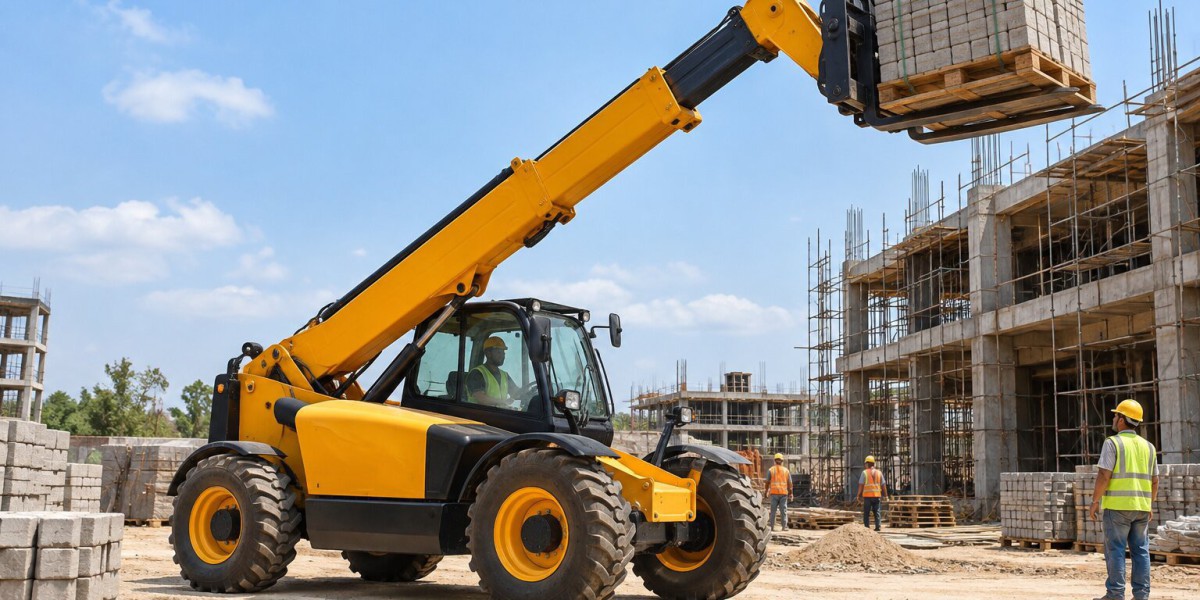

But choosing one requires more than checking the maximum lifting capacity. A proper telehandler comparison should look at lift height, reach, capacity and the type of work the machine will handle.
Start With Lift Capacity
Lift capacity tells you how much weight the machine can handle under specified conditions.
Telehandlers listed in India cover several capacity classes. The ACE AT 30, for example, has a maximum lift capacity of 3,000 kg, while the SANY STH1056A can lift 4,540 kg. Larger rotating models from Manitou go up to 7,000 kg.
The headline figure isn't enough, though.
A telehandler's safe lifting capacity changes as the boom extends. Buyers should check the load chart for the height and reach required on their actual site.
Lift Height Changes the Choice
Some projects need only moderate lifting height. Others require material to reach upper floors, elevated platforms or high storage areas.
Current listings on Desi Machines range from the JCB 530-70, with a 7.0 m maximum lift height, to the Manitou MXT 1740 K at 17.4 m. Rotating telehandlers extend the range much further, with the Manitou MRT-X 3570 reaching 34.7 m.
Buying extra height that the project never needs can add cost without improving productivity.
Reach Matters Too
Lift height and forward reach are not the same thing.
A telescopic material handler needs enough horizontal reach when the load has to be placed beyond the machine's immediate position. This can matter when placing materials over obstacles, trenches or structures.
The Manitou MRT-X 3570, for example, offers 28 m of outreach along with its 34.7 m lift height.
For ordinary stacking and loading, that level of reach may be unnecessary.
Fixed Boom or Rotating?
Telehandlers generally fall into two groups.
Fixed-boom machines raise and extend the boom, but the chassis itself doesn't rotate. They suit loading, stacking and general material movement and usually cost less.
Rotating telehandlers use a turret that allows the upper body to turn around the machine. This lets the operator place loads in different directions without repeatedly repositioning the machine.
For most everyday construction work, a fixed boom may be enough. Rotating machines make more sense where high reach, restricted access or crane-like positioning is required.
Compare Models by Actual Capacity
When you compare telehandlers, don't rely on the model number.
Different manufacturers use different naming systems. JCB's 530-70, for example, represents a 3,000 kg machine with a 7.0 m lift height, while the SANY STH844A offers 3,629 kg capacity and 13.4 m lift height.
The specification sheet provides a much fairer comparison.
Check capacity, maximum height, working reach and operating weight together.
Consider the Application
A telehandler can perform several material-handling jobs.
Construction sites use these machines for lifting and placing materials, stacking blocks and pallets, loading and unloading vehicles, and handling steel or precast components. Attachments can also change how the machine is used.
This makes telehandler material handling equipment particularly useful on sites where one machine needs to perform several related tasks.
The attachment should match the job just as closely as the machine itself.
Look at Site Conditions
Construction sites rarely provide perfectly level ground.
Many telehandlers use four-wheel drive and multiple steering modes to operate across uneven surfaces. Some SANY models, for instance, offer two-wheel, four-wheel and crab steering modes.
Working space matters as well.
A machine that can lift the required load but cannot manoeuvre around the site won't provide much practical value.
Compare the Price With the Specification
Price is another part of a sensible telehandler comparison.
Current Desi Machines listings show indicative prices starting around ₹30–₹38 Lakh for the ACE AT 30. JCB models range from roughly ₹40–₹60 Lakh, while higher-capacity SANY and Manitou fixed-boom machines can approach or exceed ₹1 Crore.
Rotating Manitou models are listed with prices available on request.
The cheapest machine isn't necessarily the lowest-cost option if it cannot perform the required lifts efficiently.
Check Service Support
Telehandlers depend on hydraulic systems, engines, transmissions and other components that require regular maintenance.
Before choosing a machine, check the availability of service and spare parts around the areas where it will operate. This becomes more important when equipment works away from major cities or moves between projects.
Service access can affect equipment availability over the long term.
Make the Comparison Around the Job
A useful telehandler comparison should answer four basic questions.
How high must the machine lift? How far forward must it reach? What load will it carry at that working point? And does the machine suit the site's conditions?
Once those answers are clear, buyers can compare models from JCB, SANY, Manitou and ACE on the specifications that actually matter.
The right telescopic material handler isn't simply the machine with the highest capacity or longest boom. It is the one that can safely handle the regular workload without paying for capability the project doesn't need.