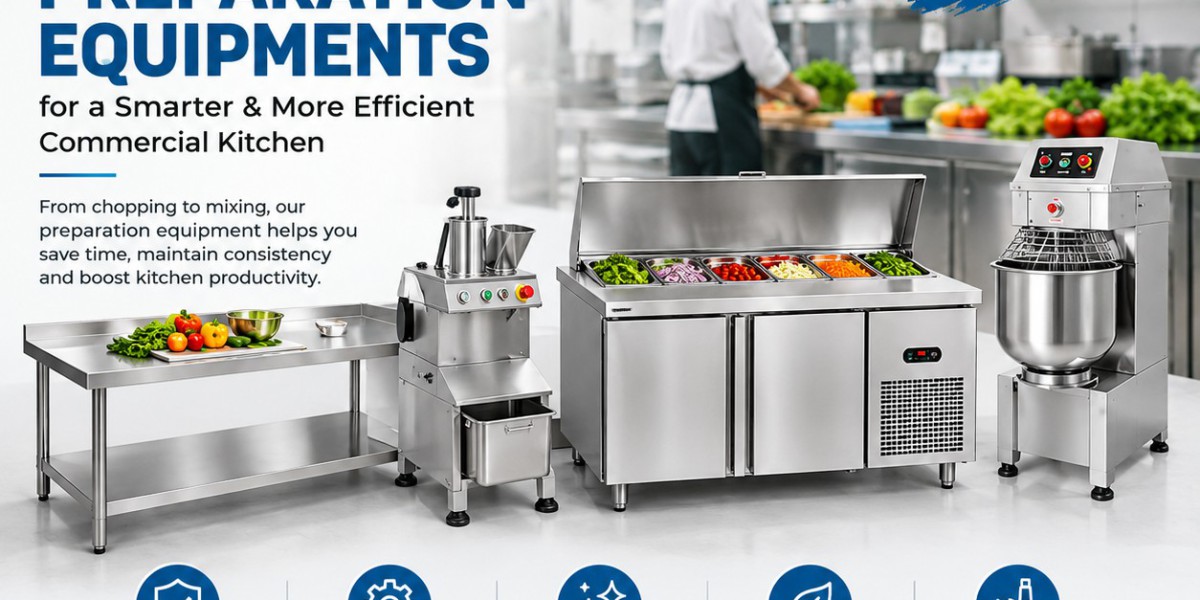

For commercial kitchens, hotels, catering facilities, and food processing units, inconsistent moisture conditions can create challenges such as ingredient sticking, uneven cutting, residue accumulation, and changes in processing time.
This is why equipment design must account for the characteristics of the ingredients being processed. Experienced Preparation Equipments Manufacturers in India consider feeding mechanisms, cutting components, material selection, drainage requirements, and cleaning accessibility when developing equipment for different food preparation applications.
Understanding these design considerations helps buyers select machinery that can maintain consistent processing quality under realistic operating conditions.
1. Understanding How Ingredient Moisture Affects Processing
Moisture does not affect every ingredient in the same way. Wet surfaces can increase adhesion in some applications, while high internal moisture may make delicate ingredients more susceptible to crushing or deformation.
For example, freshly washed vegetables may carry surface water that changes how they move through a feeding system. Soft, moisture-rich ingredients may require a different cutting approach from firm, relatively dry vegetables.
The actual effect depends on several factors:
Ingredient type, maturity, and firmness.
Surface moisture after washing.
Internal moisture and product structure.
Ingredient temperature and size.
Machine design and processing method.
Required finished-product dimensions.
Manufacturers must distinguish between surface moisture and moisture within the ingredient itself. These are different conditions and may require different operational adjustments.
Buyers should therefore evaluate equipment using the ingredients and preparation conditions relevant to their own production process.
2. Designing Feeding Mechanisms for Different Ingredient Conditions
A feeding mechanism must deliver ingredients to the processing area at a suitable rate and in a controlled manner. If wet ingredients stick together or move inconsistently, feeding may become irregular and affect output quality.
Equipment design can address these challenges through suitable hopper geometry, feeding arrangements, surface finishes, and controlled material movement. However, the appropriate solution depends on the ingredient and the machine's intended application.
During a demonstration, buyers should observe whether ingredients enter the machine evenly, whether bridging or sticking occurs, and whether operators need repeated manual intervention.
For example, leafy vegetables may require a feeding arrangement that accommodates their loose structure, while firm root vegetables may require different positioning and feeding controls.
A reliable Preparation Equipments Manufacturer should explain which ingredient conditions the machine can handle and whether particular preparation steps are required before processing.
3. Selecting Cutting Components That Preserve Product Quality
Moisture can influence the interaction between an ingredient and its cutting components. Soft or wet ingredients may deform under excessive pressure, while unsuitable blade geometry can contribute to tearing, crushing, or irregular pieces.
Manufacturers must select cutting components according to the intended food product, cutting dimensions, and expected operating conditions.
Important considerations include:
Blade geometry and cutting action.
Sharpness and alignment.
Appropriate cutting clearance.
Ingredient support during processing.
Compatibility with the required output size.
Inspection and replacement requirements.
A machine designed for firm vegetables should not automatically be assumed to perform equally well with delicate or moisture-rich ingredients.
Buyers should request a practical trial using representative samples. Comparing the finished product at different approved settings can help identify a suitable balance between throughput and quality.
4. Managing Ingredient Sticking and Residue Accumulation
Wet ingredients can sometimes adhere to machine surfaces, cutting components, or product-contact areas. Residue accumulation may interfere with material movement, increase cleaning requirements, and affect production consistency.
Manufacturers can address these challenges through accessible product-contact surfaces, suitable surface finishes, carefully designed component interfaces, and cleaning arrangements appropriate to the application.
During equipment evaluation, inspect areas where ingredients enter, pass through, and leave the machine. Look for places where material could accumulate or become difficult to remove during the approved cleaning process.
Ask the supplier to demonstrate cleaning and reassembly procedures, including any components that require regular inspection.
It is important to distinguish between a design that is easy to clean and a process that has been verified as hygienically effective. Food safety still depends on appropriate cleaning methods, sanitation procedures, and trained operators.
5. Considering Drainage and Water Management
Some preparation processes involve washing ingredients before cutting or further processing. In these situations, surface water may enter the equipment along with the food material.
Equipment intended for such applications should be evaluated for suitable drainage, water management, and protection of components according to its design and intended environment.
Poorly managed water can contribute to pooling, residue movement, corrosion in unsuitable materials, or additional cleaning work. Electrical and mechanical components must also be protected according to the manufacturer's specified operating conditions.
Buyers should verify whether the machine is designed for wet processing, dry processing, or a defined combination of both. Not all food preparation equipment is suitable for direct water exposure or washdown cleaning.
The manufacturer should clearly specify installation requirements, cleaning limitations, and any restrictions relating to moisture exposure.
6. Choosing Materials Suitable for Moisture-Exposed Environments
Repeated exposure to water, food acids, cleaning chemicals, and moisture can affect equipment materials differently. The correct material selection depends on the food being processed, the cleaning procedure, the operating environment, and the relevant hygiene requirements.
Stainless steel is commonly used for food-contact applications, but the appropriate grade and construction details should be selected according to the specific conditions. Surface condition, weld quality, joints, fasteners, and component compatibility also matter.
Buyers should ask manufacturers to clarify:
Which materials are used for food-contact surfaces.
Whether the selected materials suit the intended ingredients.
Which cleaning chemicals and methods are permitted.
How corrosion, wear, and surface damage should be inspected.
Which components require periodic replacement.
A machine's suitability cannot be determined from the material name alone. The complete design and maintenance procedure must support the intended application.
7. Testing Processing Quality Under Different Moisture Conditions
One of the most useful ways to evaluate equipment is to test it with representative ingredients under clearly documented conditions.
Rather than assuming that one demonstration proves performance in every situation, buyers should compare results across the moisture conditions expected during normal production.
A practical testing procedure can include the following steps:
Select a representative ingredient and define the required output quality.
Record ingredient condition, temperature, and preparation method.
Measure surface moisture or another relevant indicator when practical.
Process comparable batches using approved machine settings.
Record processing time and acceptable output.
Inspect the finished product for sticking, crushing, irregular cuts, and residue.
Repeat the test to determine whether results remain consistent.
Keep other variables as similar as possible. Changes in ingredient size, maturity, temperature, or operator technique can affect results independently of moisture.
The aim is to establish how the machine performs within the business's actual operating range—not to assume that all moisture variation can be eliminated through machine design.
8. Evaluating Cleaning and Maintenance Requirements
Equipment exposed to moisture may require particular attention to cleaning, drying, inspection, and preventive maintenance. The requirements vary by machine design and operating environment.
Manufacturers should provide instructions covering approved cleaning procedures, component removal, inspection intervals, lubrication where specified, and replacement of worn parts.
Operators should also know how to identify unusual residue accumulation, damaged surfaces, loose components, or signs of corrosion.
When comparing Preparation Equipments Suppliers in India, ask whether maintenance instructions and spare parts are available and whether technical support can be accessed when needed.
Good documentation helps businesses distinguish between normal cleaning requirements and signs that the equipment needs inspection or servicing.
9. What Buyers Should Check Before Purchasing
Before selecting equipment for ingredients with varying moisture levels, buyers should assess the machine against their actual production requirements.
| Evaluation area | What to verify |
|---|---|
| Ingredient compatibility | Suitability for the required food types and conditions |
| Feeding performance | Consistent movement without excessive sticking |
| Processing quality | Cutting accuracy and acceptable product condition |
| Surface design | Accessible product-contact areas and residue control |
| Water management | Suitable drainage and moisture protection where required |
| Materials | Compatibility with ingredients and cleaning procedures |
| Cleaning | Clear, documented cleaning and sanitation instructions |
| Maintenance | Inspection schedules, replacement parts, and service support |
Request a product demonstration using representative ingredients and ask for written specifications. If the equipment will handle both wet and relatively dry products, ensure that the intended operating conditions are explicitly confirmed.
Comparing several Preparation Equipments Manufacturers in India using the same criteria can help buyers evaluate performance more objectively than relying on catalogue descriptions alone.
Conclusion
Different ingredient moisture levels can influence feeding consistency, cutting accuracy, residue accumulation, cleaning requirements, and finished-product quality. Equipment must therefore be evaluated according to the characteristics of the food being processed and the conditions in which the machine will operate.
Suitable feeding arrangements, appropriate cutting components, accessible product-contact surfaces, effective water management, and clear maintenance procedures can help support consistent preparation quality.
For businesses choosing a Preparation Equipments Manufacturer in India, practical testing is particularly important. A machine should demonstrate acceptable results with representative ingredients rather than relying solely on general performance claims.
Ultimately, the right preparation equipment is one that meets the required output specifications, handles the intended ingredient conditions, and can be cleaned and maintained correctly throughout its service life. A structured evaluation gives buyers a stronger basis for selecting machinery that supports reliable food preparation and efficient production.






