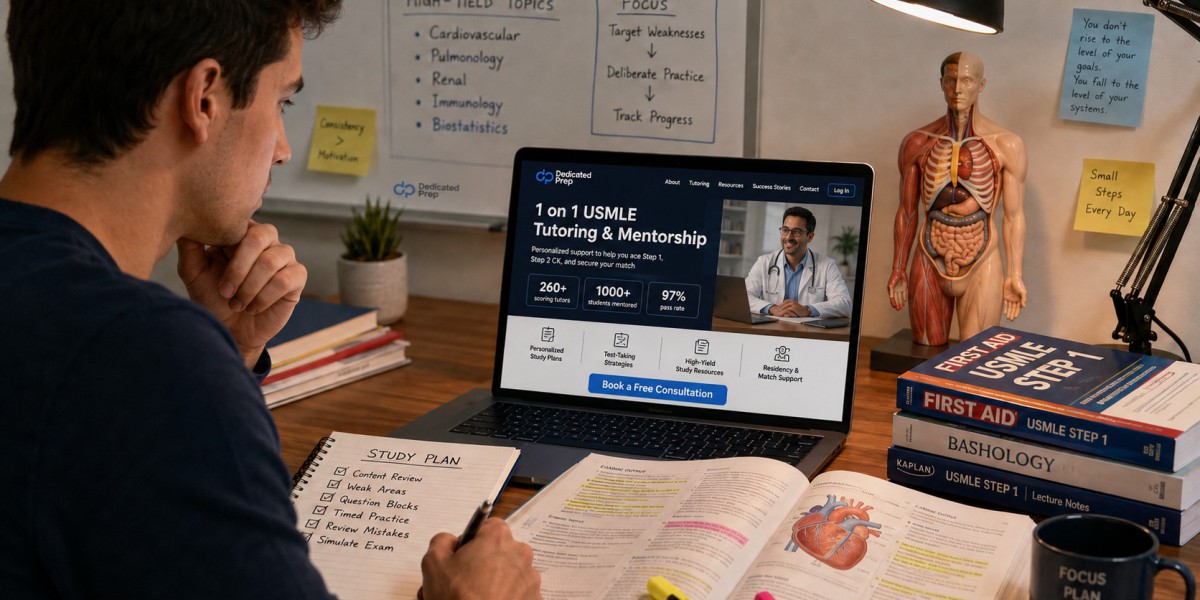

Choosing between tutoring and self-study is a practical decision about learning needs, time, and cost. Some medical students make steady progress with question banks and a structured schedule. Others study consistently but struggle to identify why their performance has stalled. The best approach depends on the problem that needs solving.
USMLE Tutors can provide individualized explanations and feedback, while self-study offers flexibility and control over the learning process. Neither approach removes the need for independent practice. Students should evaluate their preparation through understanding, application, and assessment performance rather than the number of resources completed.
Students considering USMLE Tutoring should first identify what support they need. A recurring reasoning error, an unclear study plan, and difficulty maintaining a routine are different problems. Defining the need makes it easier to decide whether tutoring, independent work, or a combination is appropriate.
What Effective Self-Study Looks Like
Self-study involves more than reading notes without a teacher. A productive independent plan includes learning objectives, question practice, explanation review, retrieval, and periodic reassessment.
A student preparing independently should be able to identify weaknesses and select activities that address them. Missing knowledge may require focused review. Confusion between similar diagnoses may need comparison exercises. Pacing problems require timed practice and examination of inefficient habits.
Question banks, reference materials, and self-assessments serve different purposes. A manageable resource set usually makes the process easier to organize than a collection of overlapping courses.
Self-study is most promising when the student understands why errors occur and can demonstrate improvement after correcting them. Independence should be evaluated through these skills rather than confidence alone.
What USMLE Tutors Should Add to Preparation
Tutoring should provide something the learner is not obtaining effectively through independent work. That may involve identifying misconceptions, clarifying mechanisms, improving clinical reasoning, or organizing a realistic study plan.
A useful USMLE Tutor asks the student to explain an answer before offering feedback. This makes the reasoning visible and helps distinguish a missing fact from a flawed assumption.
Sessions should result in specific follow-up work. The student might practice a diagnostic distinction, explain a physiological relationship, or complete unfamiliar questions that test a corrected principle.
Tutoring becomes less valuable when it consists mainly of reading explanations aloud or repeating lectures the student already has. The purpose is to improve the learner’s ability to study and solve problems independently.
Compare the Approaches Against Actual Needs
The choice should reflect the learner’s current situation rather than the assumption that one method is universally superior.
| Consideration | Self-study | Tutoring |
|---|---|---|
| Scheduling | Greater control over study sessions | Requires coordination with a tutor |
| Feedback | Depends on explanations and the student’s analysis | Can address the learner’s specific reasoning |
| Cost | Avoids tutoring fees, though resources still cost money | Adds an expense that should have a clear purpose |
| Accountability | Relies on routines and independent monitoring | Can include assignments and progress discussions |
| Weakness identification | Requires accurate self-assessment | May help expose patterns the student misses |
| Independent practice | Central to preparation | Still necessary between sessions |
These differences do not establish that tutoring produces better outcomes for every learner. Its value depends on teaching quality, fit, and how the student uses the guidance.
When Self-Study May Be Sufficient
Self-study may suit students whose assessment performance is progressing and whose recurring mistakes respond to focused review.
Such learners can usually explain why an answer fits, identify the closest alternative, and recognize what needs further study. They also maintain a workable schedule without repeatedly abandoning it.
Students should consider whether independent preparation provides:
- Accurate identification of knowledge and reasoning gaps.
- A manageable balance of questions and review.
- Consistent application on unfamiliar material.
- Periodic checks of progress.
- Appropriate coverage of the examination content.
A student meeting these needs does not necessarily require tutoring. Occasional input from an academic advisor or study partner may provide enough additional perspective.
When Tutoring May Be Worth Considering
Tutoring may help when structured independent work does not resolve persistent difficulties.
One example is a student who understands explanations after reading them but cannot apply the same principle in a new question. Another is a learner who repeatedly selects an appropriate treatment at the wrong stage of evaluation.
A tutor can investigate these patterns through think-aloud practice. The student explains the case, and the tutor asks questions that reveal where interpretation breaks down.
Tutoring may also help organize preparation when the student cannot prioritize competing weaknesses. However, the resulting plan should be realistic and responsive to evidence.
A low percentage by itself is not enough to determine the need. The cause, preparation stage, and testing conditions matter.
Step 1 and Step 2 CK Require Different Priorities
Step 1 preparation
Step 1 emphasizes understanding and application of foundational scientific principles. A USMLE Step 1 Tutor should help connect mechanisms with physiological changes, disease findings, and treatment effects.
Independent preparation should test those connections through closed-book explanations and unfamiliar questions. USMLE Step 1 Tutoring is most useful when it clarifies gaps that the learner cannot resolve effectively alone.
Step 2 CK preparation
Step 2 CK emphasizes applying clinical science to patient care under supervision, including prevention and health promotion. A USMLE Step 2 Tutor should therefore examine clinical interpretation and decision-making.
USMLE Step 2 CK Tutoring may focus on distinguishing diagnoses, evaluating severity, and selecting an appropriate next step. A Step 2 CK Prep Tutor should explain why patient context changes the decision rather than teach unsupported shortcuts.
A Hybrid Approach Can Address Specific Gaps
Students do not have to choose exclusively between tutoring and self-study. A hybrid approach preserves independent preparation while using sessions for problems that benefit from individualized feedback.
For example, a learner might complete questions independently, record recurring errors, and bring a focused set of difficulties to a session. The tutor then helps clarify the pattern and assigns follow-up practice.
This can keep 1-on-1 USMLE Tutoring purposeful. Sessions are organized around evidence from the student’s work rather than a generic lesson calendar.
The frequency should reflect need and budget. More sessions are not automatically better; students require time to apply feedback and determine whether it helps.
Evaluate Quality and Cost Before Committing
Students should ask what a session includes and how progress will be monitored. A strong examination score is relevant background, but it does not establish teaching ability by itself.
Useful questions include:
- How does the tutor identify the cause of mistakes?
- How much time involves student explanation and practice?
- What assignments follow the session?
- How does instruction change between examinations?
- What are the fees, cancellation terms, and support limits?
Online USMLE Tutoring may offer flexibility, but the format does not guarantee quality. Students should assess communication, accuracy, and whether feedback leads to clearer independent reasoning.
The expense should be weighed against the specific need. A limited assessment or focused session may be more appropriate than immediately purchasing a large package.
Measure Whether the Approach Is Working
Both approaches need reassessment. Students should look for fewer recurring errors, clearer explanations, and better application on unfamiliar questions.
Resource completion and repeated-question accuracy provide incomplete evidence. NBME notes that consulting resources, changing timing conditions, or repeating an assessment can reduce the reliability of its readiness information.
If progress remains limited, students should examine the study method, workload, and unresolved gaps. When readiness is concerning near the examination date, an academic advisor can help evaluate the broader plan.
Conclusion
Self-study can suit learners who identify and correct their weaknesses effectively. Tutoring may add value when persistent gaps require individualized explanation, feedback, or planning. A combination can provide focused support while preserving independent practice.
Students exploring DedicatedPrep’s USMLE Tutors should assess whether the instruction addresses a defined need. The best fit is an approach that produces measurable learning within the student’s time and budget.
Frequently Asked Questions
1. Can students prepare successfully through self-study alone?
Yes, self-study can be appropriate when learners maintain a structured plan, understand their errors, and demonstrate progress on unfamiliar assessments.
2. Does every student need a USMLE tutor?
No. The decision should depend on unresolved learning needs, progress, available time, and budget rather than the assumption that tutoring is mandatory.
3. Can tutoring replace question-bank practice?
No. Tutoring should improve independent reasoning and review, while question practice provides opportunities to apply and test that learning.
4. How frequently should tutoring sessions occur?
There is no universal schedule. Frequency should allow enough independent practice to apply feedback and evaluate whether the sessions are helping.
5. What should students do if tutoring does not improve preparation?
They should review the objectives, feedback, assignments, and evidence of progress. The teaching approach, tutor fit, or broader study plan may need adjustment.






