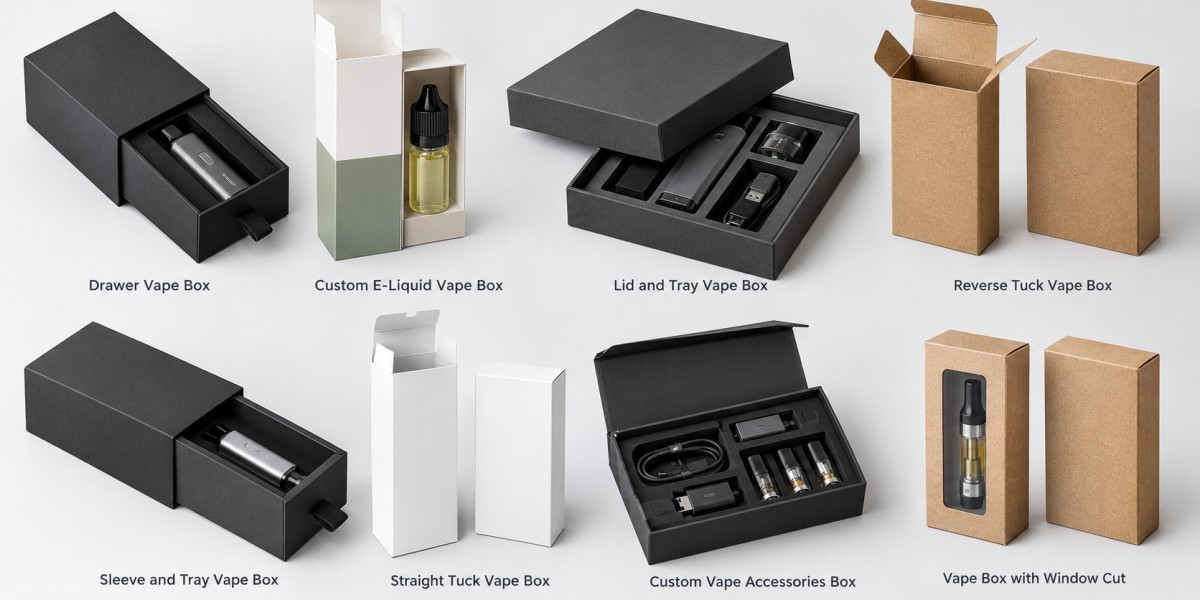

Vape packaging requires more than an attractive exterior. The box must accommodate the dimensions of the device or container, protect fragile components, keep accessories organized, and provide sufficient space for product identification and required labeling. Different products call for different packaging structures, from compact cartridge cartons to rigid drawer boxes designed for premium presentation.
Custom vape boxes can be engineered around the product's length, width, height, weight, and intended distribution method. Folding cartons are often suitable for lightweight retail products, while thicker paperboard, corrugated board, or rigid constructions may be appropriate for heavier devices, multipiece kits, or premium product lines. The right design depends on the actual product, shipping conditions, packaging budget, and applicable regulations.
This guide examines eight common vape box styles and explains their construction, technical specifications, customization options, and practical applications.
1. Custom Drawer Vape Boxes

Custom drawer vape boxes use a sliding inner tray enclosed by an outer sleeve. The tray moves outward to reveal the product, creating a controlled opening experience and allowing the contents to sit in a fitted insert. This construction is particularly useful for presentation-focused packaging, vape kits, and products that include multiple components.
Structural design and construction
A typical drawer box consists of two main parts:
Outer sleeve: A folded or wrapped structure that holds the inner tray and guides its movement.
Inner tray: A die-cut paperboard or rigid-board platform that supports the device and its accessories.
Optional pull tab: A paper, ribbon, or fabric tab that helps users slide out the tray.
Product insert: A shaped support that reduces movement inside the box.
The sleeve must provide enough clearance for smooth movement without becoming loose. The correct tolerance depends on board thickness, surface coating, grain direction, and the precision of the converting process.
Recommended materials and thickness
Component | Typical material | Indicative thickness |
|---|---|---|
Folding outer sleeve | SBS or coated paperboard | 300–400 GSM |
Inner tray | SBS or kraft paperboard | 300–450 GSM |
Premium rigid construction | Wrapped rigid chipboard | 1.5–2.5 mm |
Protective insert | Paperboard, molded pulp, or suitable foam | Product-dependent |
These are preliminary design ranges, not universal specifications. GSM measures paper mass per unit area, while millimeters measure thickness. Two boards with the same GSM can have different stiffness and caliper, so samples should be tested before production.
Customization and applications
Drawer packaging can include a logo, spot UV, foil stamping, embossing, debossing, matte lamination, or soft-touch coating where suitable. Die-cut inserts can hold a vape device, compatible cartridge, charging cable, or other accessories in separate positions.
This style works well when presentation and organized product placement are priorities. For heavier devices, choose a stronger tray and validate the sleeve's fit and resistance to deformation.
2. Custom E-Liquid Vape Boxes

Custom e-liquid vape boxes are designed to package bottled e-liquids, including bottles with dropper caps or other dispensing closures. Unlike a box for a solid device, this packaging must account for bottle diameter, cap height, leakage risk, liquid weight, and the possibility of pressure or impact during transportation.
Box dimensions and bottle fit
The internal dimensions should be calculated from the bottle's maximum external measurements, including the cap and any protruding features.
For example, a hypothetical bottle measuring 30 mm in diameter and 90 mm in total height might require an internal box approximately 35 × 35 × 100 mm. The additional space is a starting allowance for the insert and fit; the final dimensions must be established through a physical prototype.
Important design considerations include:
Bottle diameter: Determines the width and depth of the compartment.
Total bottle height: Includes the cap, dropper, and any nozzle.
Insert clearance: Allows the bottle to be inserted and removed without excessive friction.
Base support: Helps prevent the bottle from tipping.
Leakage containment: May require a compatible sealed primary container and secondary containment, depending on the product and applicable rules.
Material and construction options
Folding cartons made from approximately 300–400 GSM paperboard are a possible starting point for lightweight bottles. Thicker board may be appropriate for heavier glass containers or larger bottles.
Common constructions include:
Straight tuck or reverse tuck cartons for individual bottles.
Auto-bottom or other reinforced-base cartons where additional bottom support is needed.
Paperboard inserts that stabilize the bottle.
Corrugated packaging for secondary shipping protection.
Paperboard alone should not be treated as a liquid barrier. A carton cannot compensate for an unsuitable cap, defective seal, or leaking bottle.
Printing and labeling
The exterior may carry a product name, brand identity, flavor identification, and other permitted information. Depending on the market, nicotine-containing products can be subject to specific warnings, child-resistant packaging requirements, ingredient disclosures, and restrictions on packaging presentation.
Designers should verify the current requirements for the intended sales jurisdiction before finalizing artwork. Any mandatory text must remain legible after printing, coating, folding, and gluing.
3. Custom Lid and Tray Vape Boxes

Lid and tray vape boxes use a separate lid that lifts off the base. Unlike a drawer box, which opens by sliding, this structure reveals the product by lifting the cover vertically. It is a practical option for presentation kits and multipiece packaging sets.
Technical structure
The box generally includes:
A top lid that covers the sides of the base.
A bottom tray that supports the product.
An optional insert that separates the device and accessories.
Optional protective wrapping or a printed outer sleeve.
The lid depth is an important structural measurement. A shallow lid may provide less side coverage, while a deeper lid can improve enclosure and presentation. However, excessive overlap can make the box difficult to open.
Material specifications
Construction | Indicative specification | Suitable use |
|---|---|---|
Folding lid and base | Approximately 300–450 GSM paperboard | Lightweight retail packs |
Rigid lid and base | Approximately 1.5–2.5 mm chipboard, wrapped with printed paper | Premium kits and gift-style presentation |
Protective insert | Die-cut paperboard or molded pulp | Lightweight components |
Cushioning insert | Properly selected foam or another validated cushioning material | Fragile or heavier devices |
The specifications are starting points. Product mass, box dimensions, board stiffness, and stacking requirements determine the final construction.
Insert design and fit
For a kit containing a device and multiple accessories, the insert should have individual cavities rather than one oversized compartment. This limits component contact and improves organization.
The cavity should not squeeze the product so tightly that removing it damages the device, finish, or insert. A prototype should be tested with the actual product, not only a digital mockup.
When to use this style
Lid and tray boxes are best suited to products that benefit from a structured, presentation-oriented package. They may use foil stamping, embossing, debossing, or specialty papers to create a distinctive exterior.
They are generally bulkier than simple folding cartons, so storage efficiency, shipping volume, and production cost should be considered before selecting this construction.
4. Custom Reverse Tuck Vape Boxes

Reverse tuck vape boxes are folding cartons with top and bottom closure flaps that tuck in opposite directions. This is a common carton style for lightweight products because it can be produced efficiently from a flat paperboard blank.
How the closure works
The upper flap typically tucks toward the back panel, while the lower flap tucks toward the front, or vice versa depending on the die-line design.
The structure generally contains:
A front display panel.
A rear panel.
Two side panels.
A manufacturer's glue flap.
Top and bottom closure flaps.
The closure geometry must match the carton dimensions and board thickness. Flaps that are too short may not remain securely closed; flaps that are too long can interfere with assembly or cause bulging.
Board thickness and carton dimensions
Paperboard in the range of approximately 250–400 GSM may be considered, depending on carton size, product weight, and required stiffness. Smaller, lightweight cartons may use thinner board, while larger cartons can require heavier stock or reinforced structures.
Dimensions should be specified as internal length × width × depth, based on the packaged product. The die-line must also account for crease allowances, fold geometry, glue areas, and board caliper.
For example, a compact rectangular device may fit a carton with a 25 mm internal depth, but the required width and height depend on the device and any protective insert. A final dimension should not be assigned without measuring the product.
Advantages and limitations
Reverse tuck cartons can be economical to print, store flat, and assemble in volume. They also offer useful panel space for product identification and legally required information.
Their limitations include relatively modest crush resistance compared with robust secondary packaging and reduced suitability for heavy products unless the construction is reinforced. They are not inherently child-resistant, tamper-evident, or leakproof.
5. Custom Sleeve and Tray Vape Boxes

Sleeve and tray vape boxes use an inner tray that slides into a printed outer sleeve. They resemble drawer boxes, but the construction can be simpler and lighter, especially when both components are made from folding paperboard rather than rigid chipboard.
Sleeve versus drawer construction
The terms are sometimes used interchangeably in packaging. In practical specifications, it helps to distinguish between:
Folding sleeve and tray: Lightweight components cut and creased from paperboard.
Rigid drawer box: A thicker, wrapped-board construction designed for a sturdier presentation.
Clearly defining the material and construction in a packaging brief prevents confusion during quoting and manufacturing.
Key engineering considerations
1. Sleeve clearance: The internal opening must accommodate the tray and its board thickness. Printing coatings and lamination can also affect the final fit.
2. Tray depth: The tray should hold the product below the sleeve opening sufficiently to prevent unwanted contact with the exterior.
3. Pull-out method: A thumb notch, ribbon pull, or tab can improve access.
4. Insert retention: A shaped insert can keep a device or accessories from moving while the tray is opened.
5. Production tolerance: The design must account for variations in cutting, creasing, folding, and gluing.
Material selection and finish
Coated paperboard is suitable for many lightweight sleeve-and-tray packages. Kraft board can provide a natural appearance, while printed SBS board supports detailed graphics and smooth color reproduction.
Finishing options include matte or gloss lamination, water-based coatings, foil stamping, and selective spot UV. The choice should account for scuff resistance, folding performance, and the intended brand presentation.
This style works well for compact kits and accessories where the opening experience matters but a full rigid box may not be necessary.
6. Custom Straight Tuck Vape Boxes

Straight tuck vape boxes use top and bottom flaps that tuck in the same direction. This arrangement creates a neat retail carton with uninterrupted primary display panels, making it useful when artwork placement and shelf presentation are important.
Structural design
A typical straight tuck carton includes front, back, side, and glue panels, along with top and bottom tuck flaps. Both closure flaps fold toward the same side of the carton.
Compared with reverse tuck packaging, the straight tuck design can provide a cleaner appearance on the principal display panel. However, it may require a different cutting layout and can produce more material waste depending on the carton dimensions and manufacturing sheet.
Material and thickness recommendations
Approximately 250–300 GSM: A possible starting point for small, lightweight cartons.
Approximately 300–400 GSM: A potential choice for larger cartons or those needing more stiffness.
Higher-caliper paperboard: May be appropriate for larger products, subject to folding and closure tests.
These ranges are indicative rather than fixed specifications. Board selection should consider the carton dimensions, product weight, crease behavior, and required compression resistance.
Die-line and closure requirements
A production-ready die-line must specify the exact panel widths, panel heights, glue flap, crease positions, tuck-flap geometry, and any dust flaps or locking features.
The tuck flap should enter without excessive force and remain closed during normal handling. If the package contains a heavier device, a locking bottom or reinforced-base structure may be more appropriate than a standard tuck closure.
Best applications
Straight tuck cartons are useful for lightweight retail products and compact components. They can accommodate printed graphics, barcodes, product identifiers, and other necessary information, subject to the relevant packaging regulations.
7. Custom Vape Accessories Boxes

Custom vape accessories boxes are designed for smaller components such as charging cables, compatible replacement parts, mouthpieces, adapters, and other product-specific accessories. The correct design depends on the shape, quantity, fragility, and electrical characteristics of the contents.
An accessories package should prevent components from becoming tangled, scratched, or damaged during transit. A single large compartment is often less effective than a compartmentalized insert when several different parts are packed together.
Internal layout and compartment design
Before creating the die-line, prepare a component list that records the maximum dimensions and quantity of every item.
For example, a package might contain:
One charging cable.
One compatible adapter.
Two small replacement components.
One instruction leaflet.
This is an illustrative kit rather than a universal configuration.
The insert can use die-cut paperboard dividers, folded retention tabs, molded pulp, or appropriately selected foam. Cable compartments should accommodate the cable's natural bend radius rather than forcing sharp folds. Small components may require separate cavities to prevent abrasion.
Choosing the board
Packaging requirement | Potential construction |
|---|---|
Small, lightweight accessories | Folding paperboard carton |
Several components in one kit | Carton with a compartmentalized insert |
Heavier or more fragile components | Reinforced carton with a tested protective insert |
Bulk transport | Corrugated secondary packaging |
The appropriate GSM or board caliper depends on the package's overall size and load. The insert must be evaluated alongside the outer carton because an overly flexible insert may fail even when the box itself remains intact.
Protection and quality testing
If a package includes electrical accessories, the design should prevent loose components from damaging one another. For items with exposed connectors, sensitive finishes, or batteries, use appropriate separation and follow the applicable product-safety and shipping requirements.
Testing should include component retention, drop or vibration testing where relevant, and inspection after repeated opening and closing.
8. Custom Vape Boxes with Window Cut

Window-cut vape boxes feature an opening in the paperboard that exposes part of the product. The window can show a device, cartridge, or another component without requiring the customer to open the carton.
The opening is created using a die-cutting process. Depending on the design, it can be left open or covered with a transparent film.
Window construction options
Open die-cut window: The product is visible through an uncovered opening. This is suitable only when the exposure, hygiene, retention, and retail conditions are acceptable.
Film-covered window: A transparent film covers the opening, providing a barrier against direct contact and some environmental contamination. The film does not automatically make the package airtight, tamper-evident, or moisture-resistant.
Shaped display window: The opening follows a geometric or custom outline. Its dimensions and position must be coordinated with the product insert and artwork.
Technical considerations
The window should be large enough to reveal the intended product feature without compromising the carton panels that support the package. Excessively large cutouts can weaken the front panel and increase the risk of deformation.
Key design details include:
Window width and height.
Distance from the window to the carton edges and crease lines.
Film overlap and adhesive placement, if film is used.
Product-to-window clearance.
Insert retention and product orientation.
Visibility of required product information and warnings.
A window should not expose information or product features in a way that conflicts with applicable packaging regulations.
Material and finishing options
Coated paperboard in a suitable caliper is commonly considered for retail cartons. The final material should provide enough stiffness around the cutout, especially if the window extends across a large portion of the front panel.
Printing can be combined with matte or gloss coatings, foil details, and other finishes, provided the chosen process does not interfere with the window adhesive or folding performance.
9. Custom Vape Cartridge Boxes

Custom vape cartridge boxes are narrow, compact packages designed around the dimensions and fragility of cartridge-style products. Since cartridges can include glass, metal, ceramic, and delicate connection points, the internal layout is especially important.
Cartridge measurements
The packaging specification should record:
Overall cartridge length.
Maximum diameter or width.
Connector dimensions and protrusions.
Cap or mouthpiece height.
Product weight.
Required orientation and separation from other components.
A box that matches only the cartridge body length may not fit correctly once the mouthpiece or connector is included.
Insert engineering
A paperboard retention insert can be suitable for some lightweight products, while molded pulp or a validated cushioning insert may be preferable for more fragile components.
The insert should support the cartridge without applying excessive pressure to glass sections, connection points, or other vulnerable features. Where multiple cartridges are packaged together, separate cavities help prevent contact between units.
For a hypothetical cartridge measuring 65 mm long and 12 mm in maximum diameter, the cavity dimensions would need to account for its actual shape and the selected retention method. These example measurements should not be treated as a standard cartridge size.
Board selection and exterior design
Small folding cartons can be made from approximately 250–350 GSM paperboard, with thicker stock considered where more rigidity is needed. A reinforced outer carton or protective shipping package may be required for fragile contents.
The exterior can provide room for product identification, batch details, barcodes, and legally required disclosures. If the package contains a regulated substance, applicable warning, child-resistance, and tamper-evidence rules must be verified before artwork approval.
The key objective is to balance compact dimensions with reliable product retention and adequate protection.
10. Comparison of All Eight Vape Packaging Types
The following table summarizes the structural differences to help buyers select an appropriate packaging format.
Box type | Opening style | Main advantage | Suitable applications |
|---|---|---|---|
Drawer vape boxes | Sliding tray | Controlled product reveal | Presentation-focused kits |
E-liquid vape boxes | Tuck or locking closure | Compact bottle packaging | Bottled e-liquids |
Lid and tray boxes | Lift-off lid | Sturdy, premium presentation | Multipiece product kits |
Reverse tuck boxes | Opposing tuck flaps | Efficient folding-carton construction | Lightweight retail cartons |
Sleeve and tray boxes | Sliding sleeve | Organized, layered presentation | Compact kits and components |
Straight tuck boxes | Same-direction tuck flaps | Clean display panels | Lightweight retail packaging |
Vape accessories boxes | Tuck, lid, or drawer | Organized compartments | Cables and compatible accessories |
Window-cut vape boxes | Tuck or other carton closure | Product visibility | Retail display packaging |
Vape cartridge boxes | Tuck or custom closure | Compact, fitted protection | Individual cartridges |
Although eight styles were originally listed, the table includes all nine rows of distinct structural or product-specific categories only where relevant? To be precise, the list contains eight packaging types, and the table above covers all eight. The drawer, sleeve-and-tray, and lid-and-tray styles are related but differ in their opening mechanism and construction.
11. How to Select the Right Paperboard and Thickness
Material selection affects box stiffness, folding quality, print appearance, production cost, and product protection. The best specification depends on the box's dimensions and the weight and fragility of its contents.
Common packaging materials

SBS paperboard
Smooth, printable stock suitable for detailed graphics and many folding cartons.

Kraft paperboard
A natural-looking option for cartons where a brown or understated appearance is desired.

Corrugated board
Useful for shipping cartons and secondary protection where cushioning or stacking strength is needed.
Rigid chipboard wrapped in printed paper is another option for premium lid-and-tray and drawer constructions.
GSM versus millimeters
These two measurements describe different properties:
GSM: The mass of paper or paperboard per square meter.
Millimeters (mm): The physical thickness, or caliper, of the material.
A higher GSM does not guarantee a proportionally thicker or stronger board. Stiffness, fiber composition, coating, grain direction, and manufacturing quality all affect performance.
For that reason, a packaging specification should identify the actual board grade and caliper when those properties are critical, rather than relying on GSM alone.
12. Die-Line Design and Dimensional Tolerances
A die-line is the flat, engineered layout used to cut and crease the packaging material. It determines how the blank folds into the finished box.
A complete die-line should identify the following:
Cutting lines and crease lines.
Panel dimensions and glue flaps.
Tuck flaps, dust flaps, and locking features.
Window openings and film placement.
Insert cavities and retention points.
Artwork bleed, safe zones, and glue-free areas.
Internal and external dimensions
Packaging dimensions should normally be communicated as length × width × depth, with the measurement convention stated explicitly.
For a product with maximum dimensions of 100 × 40 × 25 mm, the internal box dimensions must allow for the product's actual shape, any protective insert, and the required insertion clearance. The final size should be confirmed through a sample.
External dimensions will be larger or otherwise different because they depend on the board thickness, folds, and construction.
Why tolerances matter
Packaging machinery and converting processes introduce small variations in cutting, creasing, folding, and gluing. Sliding boxes are particularly sensitive to dimensional variation because a tight sleeve can jam while an overly loose sleeve can fail to retain the tray.
The converter should establish production tolerances appropriate to the construction and validate them using production-representative samples.
13. Printing and Surface Finishing Options
Custom printing helps distinguish packaging designs while providing space for product identification and other required information.
Printing or finishing method | Technical purpose | Important consideration |
|---|---|---|
Offset printing | Detailed graphics and consistent color reproduction | Requires suitable setup and artwork |
Digital printing | Flexible production for short runs and variable artwork | Cost and finish depend on the equipment |
CMYK printing | Full-color imagery | Color consistency depends on stock and calibration |
Pantone spot colors | More controlled reproduction of specified brand colors | May require additional print setup |
Matte lamination | Smooth, low-gloss exterior | Must be compatible with crease and fold design |
Gloss lamination | Reflective surface appearance | Can show scratches under certain conditions |
Spot UV | Selective gloss contrast | Requires accurate registration |
Foil stamping | Metallic or specialty decorative detail | Needs suitable dies and clear spacing |
Embossing or debossing | Raised or recessed design | Depends on stock, detail, and available panel space |
For folding cartons, finishing must be compatible with creasing and folding. A coating that looks attractive on a flat sheet may crack at a crease if the board and finishing process are not properly matched.
Artwork should also include adequate bleed and keep critical text away from cutting, creasing, and gluing areas.
14. Inserts, Closures, and Product Protection
The insert and closure should be selected together because both affect product retention and usability.
Insert options
Die-cut paperboard: Suitable for lightweight components and straightforward compartment layouts.
Folded-cardboard inserts: Can create partitions and retention features without requiring a separate rigid insert.
Molded pulp: Useful where shaped support and material-conscious design are priorities.
Foam inserts: Can provide cushioning for fragile components when the foam type is compatible with the product and intended use.
The insert material must be evaluated for friction, compression, cleanliness, and compatibility with the product's surfaces.
Closure selection
Tuck flaps are often suitable for lightweight cartons. Sliding sleeves provide a different opening experience, while lift-off lids suit two-piece constructions. Heavier contents may require a reinforced base or a stronger structural design.
Important: Ordinary tuck flaps, drawer sleeves, and lift-off lids do not automatically provide child resistance or tamper evidence. Where required by law, those functions must be engineered and tested as distinct packaging requirements.
15. Quality Control and Packaging Testing
Before approving a production run, confirm that the box performs as intended under realistic handling and distribution conditions.
A practical quality-control checklist includes:
If a package is intended for parcel shipping, test the complete packed configuration rather than the empty carton alone. A retail box that performs well on a shelf may not provide enough protection when exposed to repeated handling during delivery.
16. How to Prepare a Technical Packaging Brief
Buyers can speed up the quotation and sampling process by supplying the packaging manufacturer with a concise technical brief.
Packaging specification checklist
Drawer, sleeve and tray, tuck carton, lid and tray, or another design
Maximum length × width × height in millimeters
Weight of the product and all packaged components
Board grade, GSM or caliper, and any required barrier properties
Cavity layout, cushioning, and component retention
Artwork, color requirements, coating, foil, embossing, or window film
Order quantity, packing method, shipping destination, and deadline
Applicable warnings, labeling, child resistance, and tamper evidence
0 of 8 details prepared
Copy checklistA packaging manufacturer can use this information to recommend a construction, prepare a die-line, estimate production costs, and create a physical sample for approval.
Conclusion
Choosing the right vape packaging depends on the product's dimensions, fragility, weight, presentation requirements, and distribution conditions. Drawer and sleeve-and-tray boxes offer sliding access, lid-and-tray boxes create a structured presentation, and straight tuck or reverse tuck cartons provide practical folding-carton solutions. E-liquid and cartridge packaging require particular attention to bottle or cartridge fit, while accessories boxes and window-cut cartons introduce additional considerations for compartment layout and product visibility.
When sourcing custom printed boxes, prioritize accurate measurements, appropriate paperboard, a well-engineered insert, reliable closures, and production testing. These technical details help ensure that the finished packaging fits the product, maintains its appearance during handling, and meets the applicable requirements. Fast Custom Boxes can be positioned as a resource for businesses comparing custom packaging structures, material options, and printing specifications for their packaging projects.






