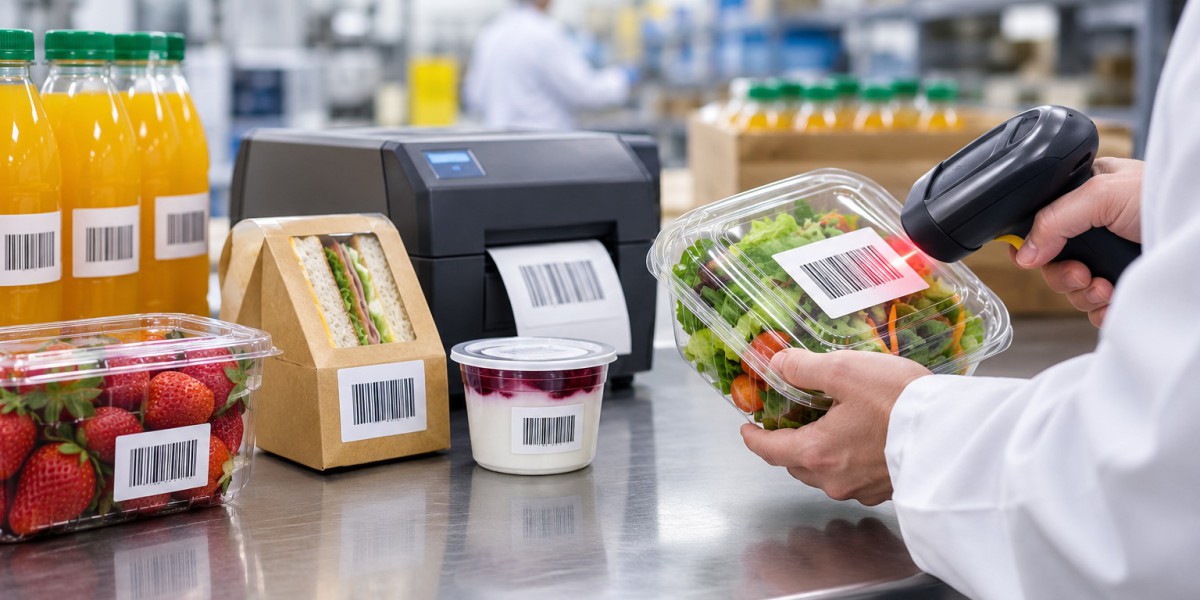

Barcode labeling plays an important role in the food and beverage industry by helping businesses track products, manage inventory, monitor batches, and improve supply chain efficiency. From food manufacturing plants to supermarkets and distribution centers, accurate barcode labels make it easier to identify products and maintain reliable records.
However, food and beverage environments present unique challenges, including refrigeration, moisture, condensation, frequent handling, and strict labeling requirements. Businesses need suitable barcode formats, durable labels, and reliable printing equipment to maintain readability throughout a product's lifecycle.
Pointus Solutions helps businesses explore barcode and printing products for their operational needs. Companies looking to buy barcode scanner kuwait or compare the thermal label printer price kuwait should consider the specific demands of food and beverage labeling.
Table of Contents
Why Is Barcode Labeling Important in Food and Beverage?
Best Practices for Barcode Labeling
Choosing the Right Barcode Type
Selecting Suitable Labels and Printing Equipment
Common Barcode Labeling Mistakes to Avoid
Frequently Asked Questions
Conclusion and Call to Action
1. Why Is Barcode Labeling Important in Food and Beverage?
Food and beverage businesses manage products with different ingredients, batch numbers, production dates, expiration dates, and storage requirements. Barcode labeling helps connect physical products with digital records, making everyday operations more accurate.
Key benefits include:
Inventory accuracy: Helps employees record incoming stock, transfers, and outgoing products.
Batch traceability: Supports the identification of products associated with a specific production batch.
Expiration date management: Helps businesses track shelf life and prioritize products approaching expiration.
Faster order fulfillment: Reduces product selection and shipping errors.
Recall support: Helps locate affected batches when product safety or quality issues arise.
Improved efficiency: Reduces manual data entry and makes product information easier to retrieve.
Barcode systems support traceability, but businesses must also maintain accurate records and follow applicable food safety and labeling regulations.
2. Best Practices for Barcode Labeling
A. Choose the Right Barcode Format
Select a barcode format based on the information required, scanning equipment, and customer or industry specifications.
Traditional one-dimensional barcodes, such as EAN and UPC, are widely used for retail product identification. GS1-128 and GS1 DataMatrix can support additional structured information, such as batch numbers and expiration dates, in appropriate applications.
Confirm the required format with retailers, distributors, and relevant standards before implementation.
B. Include Accurate Product Information
Depending on the product and applicable requirements, labels may need information such as:
Product name and identifier
Batch or lot number
Production or packing date
Expiration or best-before date
Net weight or volume
Storage instructions
Required ingredient and allergen information
Barcode data should match the business's product records. Do not rely on a barcode alone to meet mandatory food labeling requirements; required human-readable information must also be provided where applicable.
C. Use Moisture-Resistant Labels
Food and beverage products may be exposed to refrigeration, condensation, spills, and repeated handling. Standard paper labels may become damaged or unreadable in these conditions.
Choose label materials and adhesives according to the packaging surface, temperature range, moisture exposure, and expected storage period. Synthetic label materials may be suitable for demanding environments, but they should be tested under actual operating conditions.
D. Maintain High Print Quality
A barcode that is smudged, faded, or poorly aligned can slow down scanning and create errors.
To maintain readability:
Use appropriate printer resolution.
Maintain strong contrast between the barcode and background.
Follow barcode sizing and quiet-zone requirements.
Clean and maintain printer components.
Test sample labels with the scanners used in daily operations.
Use formal barcode verification when required by the application or trading partner.
E. Place Labels Correctly
Barcode placement affects scanning speed and reliability. Labels should be positioned on a flat, accessible surface whenever possible.
Avoid placing barcodes across package seams, folds, closures, or highly curved areas. On bottles and other curved containers, test the label position to ensure scanners can read it consistently.
F. Track Batches and Expiration Dates
Food businesses should maintain clear links between product identifiers, batch numbers, and relevant dates.
When supported by the selected barcode format and system, scanning can retrieve batch and expiration information. Inventory software can then help employees apply the First Expired, First Out (FEFO) approach, prioritizing products with the earliest expiration dates.
G. Consider Food Contact Requirements
Labels used on outer packaging differ from labels that may directly contact food. Businesses must ensure that label materials, adhesives, inks, and other components are suitable for their intended use and comply with applicable local requirements.
Where packaging may contact food, obtain appropriate supplier documentation and assess the complete labeling application rather than assuming every label is suitable.
3. Choosing the Right Barcode Type
The most suitable barcode depends on product identification and traceability needs.
EAN/UPC: Commonly used for retail product identification.
Code 128: Useful for internal tracking and logistics applications.
GS1-128: Supports structured supply chain data in suitable applications.
GS1 DataMatrix: Can encode multiple data elements in a compact two-dimensional symbol.
Businesses should confirm that scanners, software, and supply chain partners support the chosen format.
4. Selecting Suitable Labels and Printing Equipment
Barcode Scanners
Businesses planning to buy barcode scanner kuwait should consider whether they need 1D or 2D scanning, wired or wireless connectivity, and equipment suitable for wet, cold, or high-volume environments.
For refrigerated areas, verify the scanner's specified operating temperature and resistance to condensation or moisture where relevant.
Thermal Label Printers
Thermal label printers are widely used for food packaging, inventory labels, and shipping labels. Direct thermal printing may suit certain short-term applications, while thermal transfer printing can offer greater durability when the right ribbon and label material are used.
When comparing the thermal label printer price kuwait, consider print resolution, speed, supported label sizes, printing volume, maintenance, and ongoing supply costs.
Pointus Solutions can be a starting point for businesses exploring barcode scanning and printing products suited to their labeling requirements.
5. Common Barcode Labeling Mistakes to Avoid
Avoid these common problems:
Printing incorrect batch or expiration information.
Using labels that cannot withstand refrigeration or moisture.
Selecting a barcode format incompatible with existing scanners.
Placing labels where they become hidden or distorted.
Failing to test barcode readability before production.
Ignoring retailer, industry, or regulatory labeling specifications.
Relying on barcode data without maintaining accurate inventory records.
Establishing standard procedures for label design, printing, inspection, and replacement can help prevent these issues.
6. Frequently Asked Questions
1. Which barcode is best for food products?
EAN and UPC are common for retail identification, while GS1-128 and GS1 DataMatrix can support additional traceability data in suitable applications. The correct choice depends on product requirements and trading partner specifications.
2. Can barcodes store expiration dates?
Some barcode formats can encode expiration dates and batch information. The barcode must be designed accordingly, and the connected system must support the data format.
3. Are thermal labels suitable for refrigerated food products?
They can be, provided the label material, adhesive, printing method, and ribbon where applicable are suitable for the temperature and moisture conditions.
4. How can businesses reduce barcode scanning errors?
Use clear printing, suitable label materials, correct placement, compatible scanners, and regular quality checks.
5. Do barcode labels replace food safety labels?
No. Barcodes support identification and traceability, but they do not replace mandatory product information or other applicable food safety and labeling requirements.
7. Conclusion and Call to Action
Effective barcode labeling helps food and beverage businesses improve inventory accuracy, product traceability, and order fulfillment. By selecting appropriate barcode formats, using durable labels, maintaining print quality, and recording accurate batch and expiration information, businesses can build a more reliable labeling process.
Looking for barcode solutions for your food and beverage operations? Explore Pointus Solutions for barcode scanning and printing products suited to your needs. Whether you want to buy barcode scanner kuwait or compare the thermal label printer price kuwait, choose equipment and supplies that support your working environment and labeling requirements.






