
Search "custom NFL jersey" and you'll find two very different things. One is the league's own store, where you can put your name on an official team jersey. The other is a wall of custom football jerseys that look like they came off a Sunday sideline but carry a team name nobody has heard of yet. Yours.
Both are fine. They just solve different problems, and confusing them is how people end up with the wrong order, or a box of knockoffs that won't survive a season.
This guide is for teams who want the pro look under their own name: flag football leagues, youth and high school programs, adult rec squads, office leagues and fan clubs that want matching gear for road games. It covers what makes a jersey read as "pro," which decoration method to pick, and how to order without the usual roster-sheet chaos.
What people mean by a custom NFL jersey
The phrase covers two separate products, and the right one depends on whose name goes on the front.
Option 1: A personalized official jersey
If you want your favorite team's actual jersey with your own name and number on the back, you're shopping for a licensed product. The NFL's official shop and licensed retailers sell them. Nike makes the league's uniforms and sells them in three retail tiers: Game (printed numbers, the most affordable), Limited (stitched numbers and a closer fit) and Elite (the on-field cut and materials).
This works for a single fan or a gift. It doesn't work for a team. You can't change the colors, add your own logo or get team pricing, and every jersey is priced as a one-off.
Option 2: An NFL-style custom team jersey
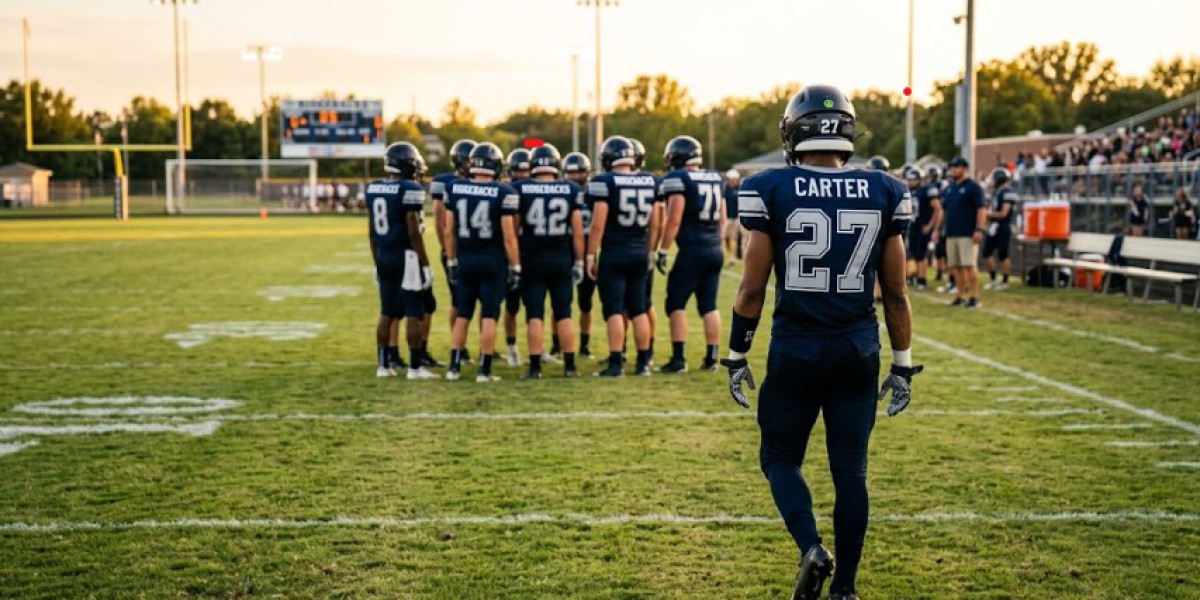
This is what most coaches, league organizers and team captains actually want. Your team name, your logo and your colors, built with the same details pro jerseys use: bold block numbers, a nameplate across the shoulders, contrast sleeve stripes and a cut made for the way you play.
The rest of this guide is about option 2.
The licensing line you can't cross
NFL team names, logos, helmet designs and the league shield are registered trademarks. A custom manufacturer without an NFL license can't legally put them on a jersey, and a reputable one will turn the order down.
So if a seller offers you jerseys with an NFL team's logo and your fantasy league's name for a suspiciously low price, you're looking at counterfeit gear. Those orders get held at customs, the decoration tends to peel early, and there's no one to complain to when they arrive in the wrong sizes.
What you can borrow freely is the look. Block numerals, shoulder stripes, sleeve numbers, a two-color outline on the numbers, a mesh body: none of that belongs to anyone. Build your own logo, pick your own colors, and you'll get a jersey that reads as pro without the legal risk.
Anatomy of a pro-style football jersey
A jersey reads as "pro" because of a handful of construction choices. Get these right and even a rec-league squad looks like it has an equipment manager.
Cut and fit
Tackle football jerseys are cut wide through the chest and shoulders so they fit over pads. The sleeves are short and sit on top of the shoulder pad caps, and many pro-style designs use stretch side panels so the jersey hugs the pads instead of flapping.
Flag football players don't wear pads, so a tackle cut swallows them. Worse, a long, loose jersey can hang over the flag belt, and many flag leagues require jerseys to be tucked in so flags stay visible. For flag teams, order a shorter, athletic cut.
Numbers and nameplate
The classic layout is large numbers on the front and back, a player name arched or straight above the back number, and smaller numbers on the sleeves or shoulders. Those sleeve numbers exist so officials and broadcast cameras can identify players from the side, and they help your league's refs and photographers too.
Readability beats style here. A number should be legible from across the field, which means strong contrast between the numeral and the body color, plus an outline when the colors sit close together. Silver on white looks great on a mockup and disappears in afternoon sun.
Numbering rules have loosened at the top level. The NFL opened up more number ranges by position in 2021, and in 2023 owners voted to allow No. 0 for every player except offensive and defensive linemen. Your league may not be as flexible. Many tackle programs still tie eligibility to number ranges, so check your rulebook before players fight over single digits.
Fabric
Game jerseys are almost always polyester knits, often with mesh panels for airflow. Polyester wicks sweat, dries fast and takes color well. Heavier knits handle tackle football's grabbing and ground contact. Lighter fabrics suit flag football, 7-on-7 and summer leagues where heat matters more than abrasion.
Sublimation vs tackle twill vs heat transfer
How the design gets onto the fabric affects the look, the weight, the durability and the price more than anything else. There are three common methods.
Method | How it works | Best for | Trade-off |
|---|---|---|---|
Sublimation | Dye is heat-pressed into polyester fibers, so the design becomes part of the fabric | Full-color designs, gradients, patterns, lightweight game jerseys | Needs polyester; adding a player mid-season means a small reorder |
Tackle twill | Numbers and letters are cut from fabric and stitched onto the jersey | The authentic stitched look of a pro jersey, fan and banquet jerseys | Heavier, costlier and slower to produce |
Screen print / heat transfer | Ink or vinyl sits on top of the fabric | Simple one or two color designs on a tight budget | Can crack or peel after many washes |
For most teams, sublimated football jerseys give the best value. You get unlimited colors and design freedom at no extra weight, and because the dye sits inside the fibers there's nothing to crack or peel. A sublimated jersey after a full season usually looks close to how it arrived.
One catch: sublimation needs polyester, and it prints best on a white or light base, since dye can't print lighter than the fabric underneath. Dark jerseys still work. The dark color simply gets printed as part of the design.
Tackle twill is worth paying for when the texture matters: coaches' jerseys, senior night, a fan club that wants something that feels like a real pro jersey. Screen printing and heat transfer make sense for practice jerseys, scrimmage pinnies and one-off events where long-term durability isn't the point.
Flag football jerseys and adult leagues
Flag football is growing fast. The NFL runs its own NFL FLAG youth program, and the sport is set to make its Olympic debut at the 2028 Los Angeles Games. Plenty of adult leagues are filling up too, which means more teams need flag football jerseys that actually suit the game.
Fit comes first. Go athletic and shorter, because a jersey that covers the flag belt is a rules problem, not just a style one.
Lightweight sublimated fabric is the norm, since there are no pads to protect and games often happen in the heat of summer. Reversible jerseys with numbers on both sides earn their keep in leagues that schedule home and away colors or shuffle rosters every season.
Adult rec teams and fantasy football leagues are where personalization gets fun. A personalized football jersey with name and number can carry a nickname, an inside joke or last year's league title. Keep it league-appropriate, because refs and other teams will be reading those nameplates all season.
How to order custom team uniforms without the headaches
Most problems with team orders aren't about the jerseys. They're about the process: a missing size, a misspelled name, two players who both claimed No. 7. A clean order follows the same sequence every time.
- Set the deadline first. Count back from your first game and allow time for design, proofing, production and shipping, plus a buffer. Six to eight weeks is a safe window for most full-custom orders.
- Build one roster sheet. Name spelling, jersey number, size and youth or adult fit, all in one spreadsheet owned by one person. Group chats are where spelling errors are born.
- Size from measurements, not guesses. Use the maker's size chart, or ask for a size sample if your roster spans youth through adult XXL. Order one or two spare jerseys for late sign-ups.
- Read the proof slowly. Check every name letter by letter, look at the number colors from a distance, and remember that colors on a monitor shift slightly on fabric.
- Keep the files for next time. Save the final design and roster so mid-season additions and next year's reorder match exactly.
Working with a dedicated maker of custom team uniforms like Gear Team Apparel makes steps three and four easier, because you see a real proof of your design before anything goes into production.
What drives the price of custom football jerseys
There's no single price for a custom jersey. A few variables move it up or down.
Decoration method matters most. Sublimation is usually the most cost-efficient choice for full-color designs, while tackle twill costs more because every number and letter is cut and stitched.
Quantity changes the math. Design and setup work gets spread across the order, so per-jersey cost usually drops as the roster grows. Each extra decoration spot (sleeve numbers, a chest logo, a nameplate) adds work on stitched and printed jerseys. Stretch panels, heavier knits and custom collars push the price up, and rush production costs extra almost everywhere.
If the budget is tight, cut the decoration method before you cut the fabric. A sublimated jersey on decent fabric will outlast a stitched jersey on thin fabric.
Custom NFL jersey FAQs
Can I get a custom NFL jersey with my own name on it?
Yes. For a real NFL team's jersey, order a personalized licensed jersey through the league's official shop or a licensed retailer. For your own team in an NFL style, a custom jersey maker can add a name and number to every piece.
Can a custom jersey company print an NFL team logo?
Not without an NFL license. Team names, logos and helmet designs are trademarks, so legitimate custom makers decline those orders. You can still match the pro style with your own logo and colors.
Are sublimated football jerseys durable?
Yes. The dye is inside the polyester fibers, so the print can't crack or peel. Wash them cold and inside out, skip fabric softener, and hang dry or tumble on low heat to keep colors sharp.
What's the difference between flag football jerseys and tackle jerseys?
Tackle jerseys are cut wide to fit over shoulder pads. Flag football jerseys are lighter, shorter and closer to the body so they don't cover the flag belt.
How long does it take to get custom football jerseys?
It depends on the maker, the method and the time of year. Plan on several weeks for a full-custom team order once the design is approved, and start six to eight weeks before your first game to be safe.
Can I order just one personalized football jersey?
Some makers take single orders and others have team minimums. Ask before you design so you know whether a one-off fan jersey or a coach's jersey fits their process.
Build a jersey your team will want to wear
The best custom NFL jersey isn't a copy of a pro team's uniform. It's your team's own identity, built with the details that make pro jerseys look sharp: numbers you can read from the sideline, a cut that matches how you play and decoration that survives a season of laundry.
Gear Team Apparel builds custom football jerseys and full team uniforms around your colors, your logo and your roster. Send your idea or a rough sketch to the Gear Team Apparel team, approve your proof, and take the field this season looking like you've got an equipment budget.