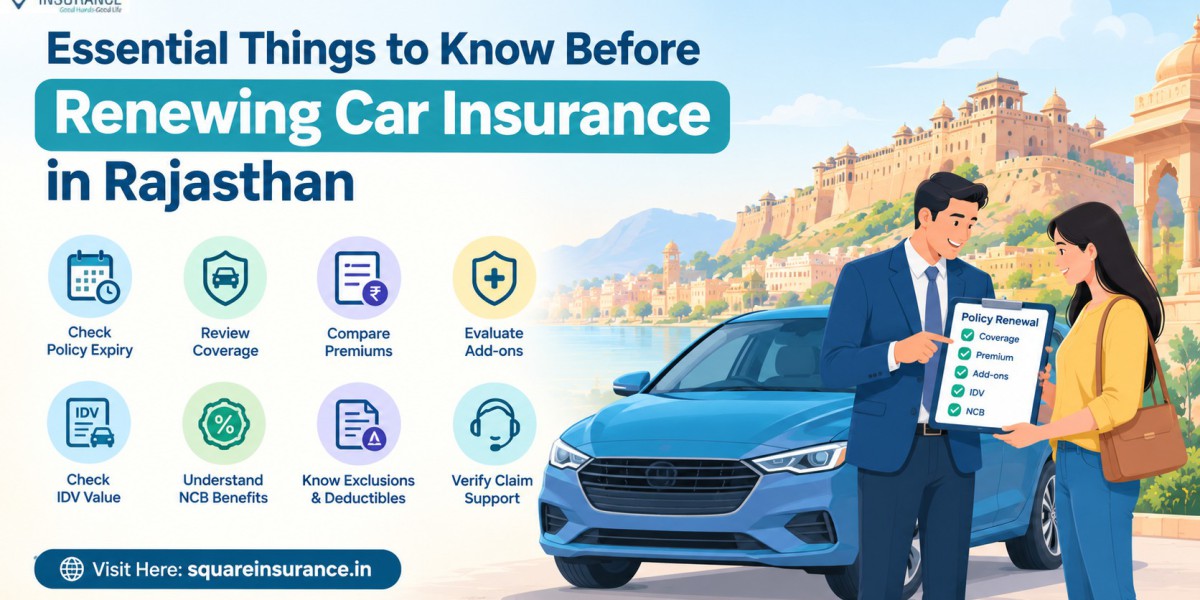

Renewing car insurance on time is an important responsibility for every vehicle owner in Rajasthan. Whether you drive daily through Jaipur, travel between Jodhpur and Udaipur, or use your car for family trips across the state, an active insurance policy helps you manage covered financial risks and comply with applicable motor vehicle laws. However, renewal should not be treated as a routine payment. It is an opportunity to review your existing coverage, compare available options, and ensure that your policy still meets your needs.
Before renewing car insurance in Rajasthan, consider factors such as policy expiry, coverage requirements, claim history, Insured Declared Value (IDV), add-on covers, deductibles, and premium costs. Understanding these details can help you make a more informed decision and avoid common mistakes.
1. Check Your Car Insurance Expiry Date
The first step is to confirm your current policy's expiry date. Renewing before the deadline helps maintain continuous coverage and reduces the risk of driving without valid insurance.
If your policy expires before renewal, you may face legal consequences for driving without the required third-party insurance. You could also become responsible for eligible repair costs and third-party liabilities that arise during the uninsured period.
Some insurers may require an inspection before issuing a policy after a lapse, particularly when renewing certain types of coverage. The process and conditions depend on the insurer and policy.
Practical tip: Set a reminder several days before the expiry date. This gives you enough time to review your coverage, compare premiums, and complete the renewal process without unnecessary pressure.
2. Review Your Existing Insurance Coverage
Your insurance requirements may change over time. A policy that suited your needs when you purchased your car may no longer provide the right level of protection.
In India, car insurance generally includes the following options:
· Third-party insurance: Covers specified legal liabilities for injury, death, or property damage caused to a third party, subject to applicable terms and limits. It does not cover damage to your own car.
· Comprehensive insurance: Generally combines third-party liability cover with own-damage protection for covered events, such as accidents, fire, theft, and certain natural calamities, subject to exclusions and policy conditions.
· Standalone own-damage insurance: Covers eligible damage to your own vehicle. It is generally purchased alongside a valid third-party policy.
When renewing, consider your car's age, daily usage, parking arrangements, travel frequency, and ability to manage unexpected repair expenses. For example, a car regularly driven through busy urban areas may require different protection from a vehicle used occasionally.
Choose coverage based on your actual needs rather than selecting a policy only because it has a lower premium.
3. Compare Car Insurance Premiums and Benefits
Premium comparison is an important part of renewal, but the cheapest policy is not necessarily the most suitable one. Two policies with similar prices may differ in coverage, exclusions, deductibles, add-ons, and claim procedures.
Before making a decision, compare:
· Coverage included in the policy.
· Insured Declared Value of the vehicle.
· Available add-on covers and their costs.
· Deductibles and other applicable out-of-pocket expenses.
· Cashless garage availability and claim requirements.
· Policy exclusions and special conditions.
Check whether the premium difference reflects a meaningful improvement in coverage or simply a difference in pricing. Read the policy wording and compare benefits on a like-for-like basis.
Reviewing multiple options before renewing car insurance in Rajasthan can help you balance affordability with suitable financial protection.
4. Understand the Insured Declared Value (IDV)
The Insured Declared Value is an important factor in own-damage car insurance. It represents the insurer's declared value for the insured vehicle and is generally used as the basis for calculating the maximum payable amount in certain total-loss or theft claims, subject to policy terms.
IDV can influence both the premium and the potential claim settlement amount. A higher IDV may increase the premium, while a lower IDV may reduce it but could also affect the amount payable in an eligible total-loss claim.
During renewal, check whether the proposed IDV reasonably reflects your vehicle's age, make, model, and applicable depreciation method.
Avoid choosing an unusually low IDV simply to reduce the premium. Instead, review the insurer's offered value and clarify how it has been calculated.
5. Evaluate Useful Car Insurance Add-Ons
Add-ons provide additional protection beyond the standard policy, subject to eligibility and specific terms. They can be particularly useful when your driving habits, vehicle type, or repair costs justify the extra expense.
Common options include:
· Zero depreciation cover: Helps reduce the impact of depreciation deductions on eligible replaced parts, according to the policy conditions.
· Engine protection cover: May cover specified engine-related damage that is otherwise excluded, subject to stated conditions.
· Roadside assistance: Provides specified support for breakdowns and other covered roadside situations.
· Return to invoice cover: May provide an additional benefit in eligible total-loss or theft cases, according to the policy wording.
· Consumables cover: May cover eligible consumable items used during repairs.
· Key and lock protection: May cover specified expenses associated with lost or damaged keys and locks.
Not every add-on is necessary for every vehicle. Consider your car's age, usage, maintenance needs, and the cost of each benefit. Also check exclusions, claim limits, waiting periods where applicable, and whether the add-on is available for your vehicle.
6. Consider Your Claim History and No Claim Bonus
Your previous claim history can affect your renewal premium and available benefits. One important factor is the No Claim Bonus (NCB), which is generally a discount on the own-damage premium for eligible claim-free policy periods.
NCB usually belongs to the policyholder rather than the vehicle, and it may be transferred when changing insurers, subject to applicable rules and documentation.
Before renewal, verify the NCB percentage shown in the quotation and confirm that it matches your eligibility. Do not claim an NCB discount if you are not entitled to it, as incorrect information may create complications during a claim.
If you made a recent claim, review how it affects your renewal premium. For minor damage, it may be worth comparing the repair expense with the potential impact on your NCB, but the decision should also account for policy conditions and the nature of the loss.
7. Check Policy Exclusions and Deductibles
A policy does not cover every possible loss. Exclusions and deductibles determine when coverage applies and what costs you may need to pay yourself.
Common areas to review include damage outside the insured scope, unauthorised use, driving without a valid licence, and incidents involving alcohol or other prohibited circumstances. Specific exclusions depend on the policy wording and applicable law.
A deductible is the portion of an admissible claim that you must bear. Choosing a higher voluntary deductible may reduce the premium, but it also increases your out-of-pocket expense when making a claim.
Before renewing, read the policy schedule and wording carefully. Make sure you understand the conditions that could affect a future claim.
8. Verify the Insurer's Claim Support and Garage Network
The quality of claim support matters when an accident or other covered event occurs. Before renewing, assess the insurer's claim process, document requirements, support channels, and the availability of cashless repair facilities.
Check whether authorised or cashless garages are conveniently located near your home or workplace in Rajasthan. If you frequently travel between cities, consider whether suitable repair facilities are available along your usual routes.
A cashless facility generally allows eligible repair expenses to be settled directly between the insurer and the network garage, subject to approval, deductibles, exclusions, and policy limits. It does not necessarily mean every repair expense will be covered.
Review the claim process in advance so that you know what steps to take if an incident occurs.
9. Provide Accurate Information During Renewal
Always check the details entered in your renewal application. Incorrect information about the vehicle, registration number, previous claims, modifications, usage, or policyholder can lead to delays or disputes.
Keep the following information readily available:
· Existing policy details.
· Vehicle registration certificate details.
· Accurate vehicle identification information.
· Previous policy and claim information.
· Valid personal and vehicle documents requested by the insurer.
Disclose relevant information honestly and review the final policy document after renewal. If you notice an error, contact the insurer promptly to understand the correction process.
10. Renew Before Expiry and Keep the Documents Safe
Once you have selected suitable coverage, complete the renewal process before the existing policy expires. Check the premium amount, coverage period, IDV, add-ons, deductibles, and policyholder details before making the payment.
After renewal, download and securely save the policy document. Keep an accessible digital copy and retain any other documents required for your vehicle.
If the policy has already expired, avoid assuming that coverage continues automatically. Contact the insurer to confirm the steps required for renewal and whether an inspection is necessary. Do not drive until the required insurance is valid.
Conclusion
Renewing car insurance in Rajasthan involves more than paying the premium. Vehicle owners should review coverage, compare policy benefits, verify IDV and NCB, assess useful add-ons, understand exclusions, and check the insurer's claim support before making a decision. Timely renewal and accurate documentation can also help reduce avoidable complications.
Square Insurance helps customers compare insurance options and understand policy features so they can make informed decisions based on their vehicle and coverage requirements. Reviewing your needs carefully before renewal can help you select suitable protection for your car and your journeys across Rajasthan.
Frequently Asked Question (FAQs)
Q1. When should I renew my car insurance in Rajasthan?
It is best to renew your policy before its expiry date. Starting the process several days in advance gives you time to compare options and avoid an unintended gap in coverage.
Q2. Can I change my insurer when renewing car insurance?
Yes. You can generally compare policies and switch insurers at renewal. Check the new policy's coverage, documentation requirements, and the process for transferring eligible No Claim Bonus benefits.
Q3. Is third-party car insurance enough for my vehicle?
Third-party insurance meets the basic legal requirement when valid, but it does not cover damage to your own car. Consider comprehensive or standalone own-damage coverage if you need protection for eligible damage to your vehicle.
Q4. What is IDV, and why should I check it at renewal?
IDV is the declared value of your insured vehicle used in calculating own-damage premiums and determining certain total-loss or theft claim payments, subject to policy terms. An appropriate IDV helps balance premium cost and potential claim benefits.
Q5. Can I renew car insurance after the policy expires?
Renewal may still be possible, but the insurer may require an inspection or additional steps depending on the policy and lapse period. Do not assume you are covered during the gap.
Q6. Does a car insurance renewal premium increase after a claim?
It may increase depending on the claim history, NCB eligibility, coverage selected, and insurer's pricing. Review your renewal quotation and confirm how any previous claim affects the premium.
Q7. Which add-ons should I choose when renewing car insurance?
The right add-ons depend on your vehicle's age, usage, repair costs, and budget. Zero depreciation, roadside assistance, engine protection, and return to invoice cover are some options to evaluate against their conditions and costs.